


AI is transforming customer support. By 2030, systems will handle 80% of common issues independently, reducing costs and improving speed. Businesses that act now will outperform those relying on outdated methods. Here’s what to know:
- AI agents are replacing basic chatbots, managing complex tasks like refunds and account updates without human help.
- Omnichannel support is critical, ensuring seamless interaction across platforms like email, chat, and social media.
- Human-AI collaboration is key, with AI automating repetitive tasks, leaving humans to handle sensitive cases.
- Proactive AI will solve problems before customers report them, like fixing billing errors or delays.
- Personalization requires connected data, pulling insights from CRMs and order histories.
- Voice, visual, and multilingual support will expand, making AI more versatile in customer interactions.
- Trust and governance matter, ensuring AI operates reliably and escalates issues when needed.
To prepare, businesses should centralize data, streamline workflows, and invest in systems that integrate AI and human teams effectively. Companies that modernize now will lead in delivering faster, smarter, and more efficient customer support.
AI Customer Support Trends and Statistics 2025-2030
From Simple Chatbots to AI Agents
Why Traditional Chatbots Fall Short
Traditional chatbots operate on fixed scripts and predefined triggers. They can handle basic tasks like matching keywords, navigating decision trees, and improving customer self-service through FAQs. But their abilities stop there. If a customer asks something outside the script or needs support across multiple systems, the chatbot often fails, requiring a handoff to a human agent.
The issue goes beyond limited functionality. These chatbots don’t retain context from past interactions. This means customers often have to repeat themselves, which can be incredibly frustrating. In fact, 70% of customers expect support teams to remember their interaction history when they reach out. Unfortunately, most older chatbot systems forget everything as soon as a session ends. This lack of continuity wastes time for both customers and agents, making the experience feel clunky and impersonal.
These shortcomings highlight the need for a smarter, more capable solution.
How AI Agents Are Different
AI agents go beyond simply answering questions – they take action and complete tasks. Unlike traditional chatbots that provide information and then rely on humans to step in, AI agents can handle complex workflows independently. They can process refunds, update shipping addresses, check inventory, and pull data from tools like CRMs or payment systems – all in real time.
This leap in capability is powered by the “Observe, Plan, Act” triad. AI agents gather data, reason through possible actions, and execute multi-step processes across different platforms without waiting for human approval at every step. For instance, if a customer inquires about a delayed order, the agent can check the shipping status, identify the issue with the carrier, and proactively issue a replacement or refund – managing the entire process from start to finish.
The benefits are already clear. Companies using AI agents have reported a 50% reduction in cost per interaction. Looking ahead, experts predict that by 2029, AI agents will autonomously resolve 80% of common customer service issues. The difference between chatbots and AI agents isn’t just about technology – it’s about moving from answering questions to solving real problems.
sbb-itb-58cc2bf
AI vs Humans: Who Wins Customer Service by 2030? | Off Script

7 AI Support Trends That Will Define 2030
The way businesses approach customer support is undergoing a major transformation. AI is evolving from simple automation to tools that reshape customer expectations and redefine how support teams operate. Here are seven trends shaping the future of AI-powered customer service – and what businesses should be ready for.
Trend 1: AI Will Handle Entire Support Tasks, Not Just Questions
AI is stepping up from answering questions to managing complete support tasks. Instead of just telling a customer how to request a refund, AI will handle the entire process – verifying purchases, checking eligibility, processing the refund, and confirming the transaction – all without human involvement.
This shift is driven by agentic AI, which can observe, plan, and act across platforms. Imagine an AI agent checking inventory, updating a shipping address in your CRM, and sending a confirmation email – all in one seamless workflow.
“Unlike traditional GenAI tools that simply assist users with information, agentic AI will proactively resolve service requests on behalf of customers, marking a new era in customer engagement.”
- Daniel O’Sullivan, Senior Director Analyst, Gartner
By 2029, experts predict that agentic AI will autonomously resolve 80% of common customer service issues, cutting operational costs by 30%. Unlike traditional chatbots, these AI agents will take full ownership of tasks, reducing escalations and speeding up resolutions. Businesses will need to ensure these capabilities work smoothly across all customer touchpoints.
Trend 2: Omnichannel Support Will Become the Norm
Modern customers expect seamless support across platforms – whether it’s a website chat, email, WhatsApp, or social media. By 2030, businesses will rely on AI systems that operate across all these channels while maintaining full context of every interaction.
Currently, many systems treat each channel independently, forcing customers to repeat their issues when switching platforms. True omnichannel AI will retain context across all touchpoints. For example, if a customer starts a chat on a website and continues via email days later, the AI will pick up right where the conversation left off.
In 2025, SNAP Finance adopted Cresta’s Omnichannel AI Agent to manage support across voice and digital channels. Under Adam Christensen, Vice President of Resource Management, the company achieved a 5.5x improvement in containment rates while preserving context across channels, significantly reducing costs. Furthermore, over 60% of customers say “immediate” support is critical when reaching out.
While omnichannel systems improve customer experience, the next challenge lies in fostering collaboration between AI and human teams.
Trend 3: Human and AI Teams Will Collaborate
AI isn’t here to replace human agents – it’s here to change how they work. By 2030, AI will handle repetitive, high-volume tasks, allowing human agents to focus on complex, sensitive, or high-value interactions.
This collaboration depends on smart orchestration. Systems will need to decide which tasks AI can handle independently and which require human expertise. For example, when an AI’s confidence level drops below a set threshold, it should escalate the issue to a human, transferring the full conversation history so customers don’t have to repeat themselves.
Research shows that “not having to re-explain their issue” is a top driver of customer satisfaction. As AI takes on routine tasks, new roles like AI Workforce Managers and AI Performance Specialists are emerging to train and monitor AI systems. Currently, 30–40% of repetitive interactions can already be handled without human intervention.
“The future of customer service lies not in the solitary actions of people or machines but in smart partnerships between the two.”
- Marcus Wittig, Managing Director & Senior Partner, BCG
Trend 4: AI Will Solve Problems Before Customers Ask
AI is moving from reactive to proactive support. Instead of waiting for customers to report issues, AI will identify and address problems before they escalate.
Using tools like intent sniffing and product telemetry, AI can detect potential issues early. For instance, it might identify a failed payment and offer a solution before the customer even notices. Similarly, AI could step in to assist when a new user struggles with onboarding.
Companies using proactive AI support have seen a 20–30% boost in customer satisfaction. By 2030, businesses are expected to employ AI to “self-heal” common issues like billing errors or shipping delays, reducing ticket volume and improving the overall experience.
Trend 5: Smarter Answers Need Connected Customer Data
As AI becomes more advanced, generic responses won’t cut it. Customers want support tailored to their individual needs and history.
This level of personalization requires AI systems to access connected data ecosystems, pulling real-time information from CRMs, order histories, and support tickets. According to research, 70% of customers expect support teams to know their history when they reach out. AI platforms that centralize all customer interactions into a single source of truth will outperform those relying on scattered data. The ability to understand both the business context and individual customer preferences will define the quality of AI support.
Trend 6: Voice and Multilingual Support Will Grow
AI support is expanding beyond text. By 2030, businesses will handle voice interactions, visual inputs, and multilingual support seamlessly.
Voice support is already advancing, with AI agents managing real-time phone conversations while sending relevant digital resources – like sharing a troubleshooting video during a call. AI is also improving at processing visual data, such as screenshots or product photos, to provide more accurate solutions.
Multilingual capabilities are becoming essential, too. Instead of hiring support teams for every language, AI can deliver consistent, accurate responses in multiple languages, ensuring a high-quality experience for global audiences.
Trend 7: Trust and Quality Control Will Be Crucial
As AI takes on a bigger role in customer service, ensuring trust, accuracy, and governance will be more important than ever. Businesses need clear guidelines for when AI can act independently and when human intervention is required. This includes implementing digital circuit breakers and escalation paths to prevent errors and maintain compliance with brand and regulatory standards.
Strong quality control measures will be critical to ensure AI-driven support resolves issues reliably while maintaining customer trust. For businesses preparing for the future, building these systems now will set the foundation for sustainable AI-powered support.
What Businesses Should Do Now to Prepare
The divide between companies embracing AI early and those lagging behind is growing rapidly. By 2029, agentic AI is projected to autonomously resolve 80% of common customer service issues. Yet, many businesses struggle to keep up because of outdated infrastructure, poor governance, and weak execution. Here’s how to get your systems ready for the AI-driven future of customer service.
Review Your Current Support Channels
Start by evaluating your current support channels. Look at repetitive tasks like order status updates, password resets, or basic FAQs – these are prime candidates for automation.
Next, identify where information flow breaks down. For example, does a customer have to repeat their issue if they switch from live chat to email? If so, your system may not be retaining context effectively. Mapping how information moves across your support channels will reveal opportunities to improve and pinpoint areas where AI can make the biggest impact.
Build a Unified Knowledge Base and Connect Your Data
AI systems are only as effective as the data they have access to. If your knowledge base is scattered – FAQs in one tool, policies in another, and product details lost in Slack threads – you’ll end up with inconsistent results. The solution? Centralize all your resources into a single, reliable source of truth.
Go beyond just compiling answers. Document the reasoning behind them, so your AI can mimic the problem-solving approach of your human experts. Additionally, connect your AI to live systems like your CRM, billing platform, and order management tools. This ensures it can provide personalized, up-to-date answers instead of generic responses.
Define Clear Handoff Rules Between AI and Humans
Smooth transitions between AI and human agents are critical to delivering a good customer experience. Set clear rules for when AI should escalate an issue – such as when its confidence level drops below 80% or when a customer specifically requests human help.
“The handoff problem is the #1 failure mode of AI support. When AI ‘resolves’ something incorrectly, or escalates but the human has no context, the customer experience is worse than if you’d never used AI at all.”
- Cole D’Ambra, Marketing, Plain
To avoid this, ensure the system transfers the entire conversation history and AI’s reasoning to the human agent. Customers rank “not having to re-explain their issue” as one of the top factors for a positive support experience. For sensitive actions – like processing large payments or closing accounts – set up checkpoints where AI pauses and waits for human approval before proceeding.
Choose Tools That Work Seamlessly Across Channels
It’s not enough to have AI tools that work well in isolation. Your AI should function effortlessly across all customer channels – whether it’s live chat, email, WhatsApp, or Slack – while maintaining full context throughout.
Look for platforms designed with multi-channel functionality at their core, not systems that add integrations as an afterthought. Tools with API-first, thread-based architecture allow your AI to access customer timelines and trigger workflows automatically. Platforms supporting “Bring Your Own Agent” (BYOA) also let you customize AI behavior to suit your business needs without locking you into a single vendor’s system.
Track Performance and Continuously Improve
AI support isn’t a one-and-done solution. To stay competitive, you’ll need to monitor performance and refine your systems regularly. Focus on metrics like Automation Coverage (the percentage of issues fully resolved by AI) and Agent Effort Reduction (how much time your human team saves).
Use performance data to identify weak spots. If AI escalates certain types of questions frequently, it might mean your workflows need adjustment or your knowledge base needs updates. Regularly review unanswered questions to spot gaps and improve accuracy. Continuous monitoring and updates are key to maximizing results.
How Quidget Helps Teams Prepare for Modern AI Support
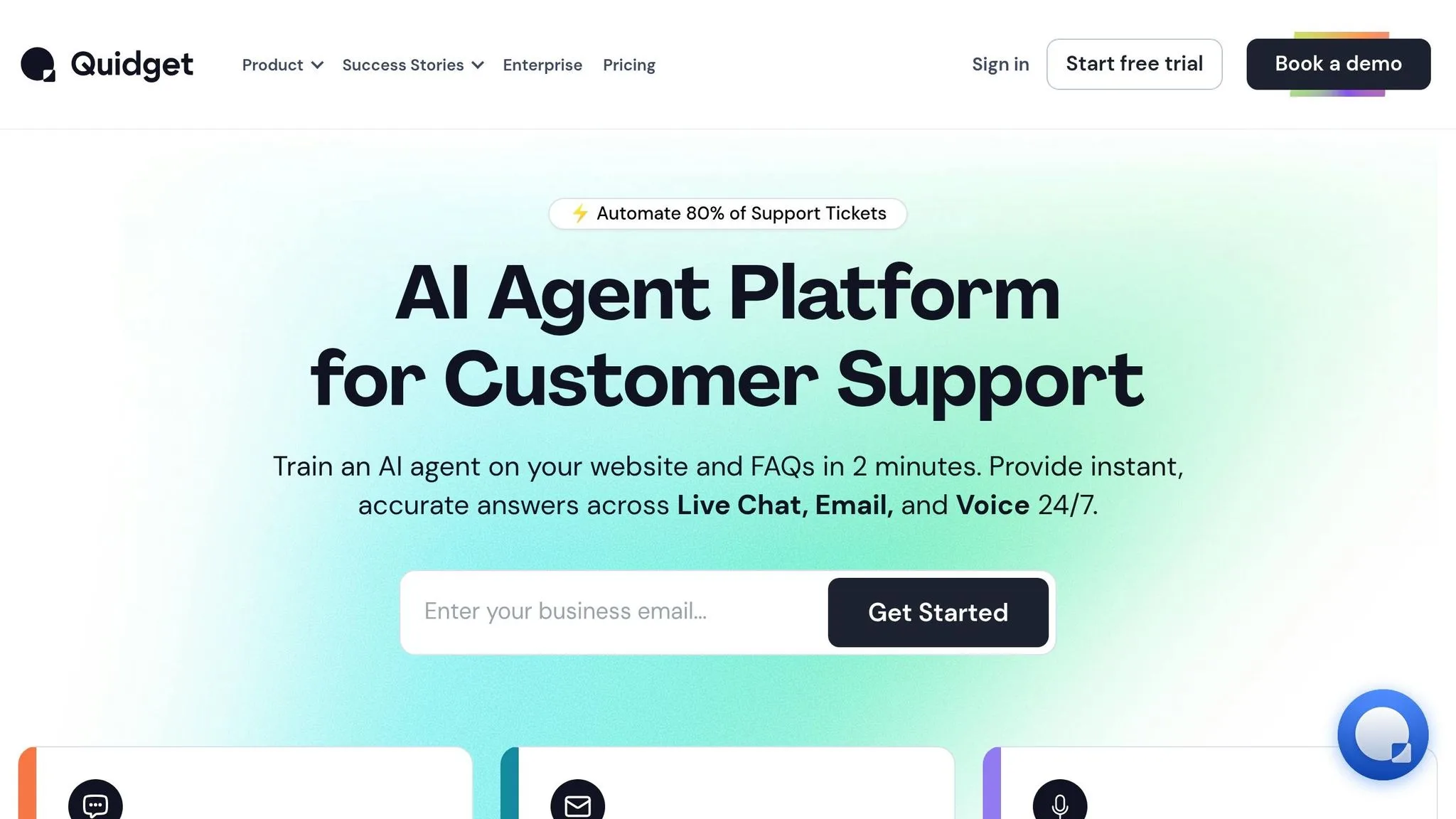
Quidget steps in as a comprehensive solution for businesses looking to embrace the latest AI support trends. It provides the tools and infrastructure needed to implement these advancements without requiring extensive custom development or starting from scratch.
One AI System Across All Your Channels
Quidget ensures that conversations remain consistent across platforms like your website, WhatsApp, Slack, and Telegram. For instance, if a customer begins a chat on your website and later continues it on WhatsApp, Quidget’s AI remembers the entire conversation. This eliminates the “persistence of context” issue, which often frustrates customers and wastes valuable time for support agents.
By using an API-first architecture, Quidget structures and stores conversations in a unified data model, delivering real-time insights that improve every interaction. Your team benefits from a complete timeline of customer interactions, no matter which platform they occur on, directly addressing the demand for seamless, omnichannel support.
Easy Handoff Between AI and Human Agents
When Quidget’s AI encounters a situation where it lacks confidence in its response, it automatically escalates the issue to a human agent. Importantly, the full chat history is transferred, ensuring that the agent has all the necessary context to resolve the issue effectively. This seamless handoff prevents customers from feeling stuck or having to repeat themselves.
“If Quidget isn’t confident in an answer, it passes the conversation to your team with the full chat history. Your customer never hits a dead end – they get a real person who already knows what was discussed.” – Quidget.ai
A real-world example? In early 2025, Softorino adopted Quidget to manage its growing support needs. Under the leadership of Customer Success Manager Alex Novak, the AI handled 60% of first-level responses, allowing the human team to tackle more complex cases and reducing overall ticket volume by 35%.
No-Code AI Agent Setup
Quidget offers a no-code builder that makes training AI agents quick and straightforward. You can train the system on your knowledge base, FAQs, or other documents in just minutes. It even includes a web crawler to automatically pull information from your site or lets you upload files directly. With pre-built templates for use cases like support, sales, and lead generation, you can skip lengthy pilot phases and see results faster.
This streamlined setup process pairs well with Quidget’s scalable architecture, making it an ideal choice for businesses looking to expand their omnichannel and multilingual support capabilities.
Built for Omnichannel, Multilingual, and Growing Teams
Quidget supports over 45 languages, automatically detecting and responding in the customer’s preferred language. As your business grows, the platform scales effortlessly, allowing you to deploy up to 50 AI agents across various teams, products, or regions. Each chatbot can also have multiple user seats for collaboration.
Beyond customer support, Quidget integrates with tools like Calendly for scheduling and connects to CRMs for lead capture, making it a versatile option for both support and revenue-focused workflows. These features position Quidget as a forward-thinking platform that not only meets current needs but also prepares businesses for the AI-driven future of customer support envisioned for the years ahead.
Conclusion
Businesses That Prepare Early Will Lead the Way
AI-driven support isn’t some distant future concept – it’s already reshaping the landscape today. With service demand growing rapidly, businesses relying on traditional support models are struggling to keep up. Rising costs and declining customer satisfaction are forcing a choice: embrace intelligent automation or risk falling behind.
Early adopters of AI support systems are already reaping rewards. Companies implementing AI agents now report lower costs and smoother operations by automating repetitive tasks. Waiting to adapt could mean accumulating technical debt, widening performance gaps, and losing competitive ground to businesses that have optimized their AI-human workflows. The next decade will favor those who invest in smarter service strategies, not just in increasing manpower.
The key isn’t just in adopting AI – it’s in combining its strengths with human expertise.
The Future Lies in AI and Human Collaboration
By 2030, the most successful businesses won’t be those that rely solely on AI or human agents. Instead, the winning formula will be a seamless partnership between the two. AI can handle high-volume, repetitive Level 1 support tasks 24/7, while human agents focus on complex, nuanced conversations that require empathy, creativity, and judgment. This hybrid approach is already delivering productivity gains of 60% or more for companies leading the charge.
“The future of customer service lies not in the solitary actions of people or machines but in smart partnerships between the two.”
- Marcus Wittig, Managing Director & Senior Partner, BCG
Platforms like Quidget make this vision a reality by enabling smooth collaboration between AI and human teams. Their solutions ensure seamless omnichannel support, preserve context during handoffs, and eliminate the frustration of customers having to repeat themselves.
The businesses that succeed in this new era will be those that act early, combining the efficiency of AI with the empathy and adaptability of human agents. Quidget exemplifies this forward-thinking approach, offering tools to help companies deliver outstanding customer experiences while achieving long-term productivity gains.
FAQs
What is the future of AI support?
By 2030, AI support will progress far beyond today’s chatbots, becoming more independent, versatile, and proactive. Agentic AI – a term for AI systems capable of managing tasks autonomously – will handle the majority of customer interactions, taking on complex workflows and automating repetitive processes. To stay ahead, businesses should start adopting tools that blend AI capabilities with human expertise, ensuring smooth transitions and tailored customer support. This shift will reshape customer experiences, offering early adopters the dual benefits of improved efficiency and higher customer satisfaction.
How will AI customer service change by 2030?
By 2030, agentic AI is set to revolutionize customer service. These advanced systems will autonomously handle up to 80% of routine support issues, managing everything from ticket triage to resolving complex problems. This shift means customer support will become more proactive, tailored, and efficient. AI will take over repetitive tasks, freeing human agents to concentrate on high-stakes or sensitive situations, enhancing both the customer experience and overall operational performance.
What is agentic AI in customer support?
Agentic AI in customer support refers to autonomous systems designed to handle customer interactions with little to no human involvement. Unlike standard chatbots, these advanced systems can manage multi-step workflows, tackle complex issues, and make decisions on their own. The goal is to deliver faster, more scalable, and highly tailored support, freeing up human agents to concentrate on sensitive or high-priority cases. This evolution points toward a future where fully autonomous customer support could become the norm by 2030.
Will AI replace human support agents?
AI is projected to take over many routine customer service tasks, but it won’t completely replace human agents. By 2029, AI could handle up to 80% of common issues. Even so, human agents will still play a crucial role in managing complex, sensitive, or high-stakes interactions. The future of customer support will rely on a partnership between AI and humans, where AI boosts efficiency while humans provide empathy and tackle nuanced challenges.
How can businesses prepare for the future of customer support?
To get ready for what customer support will look like by 2030, businesses should focus on building an AI-first support system. This approach can handle increasing complexities and meet rising customer expectations. Here’s how companies can prepare:
- Automate repetitive tasks: Free up human agents for more complex issues by letting AI handle routine inquiries.
- Develop a strong knowledge base: Ensure customers and support teams have easy access to accurate, up-to-date information.
- Enable seamless omnichannel support: Integrate tools that allow customers to switch between channels without losing context.
In addition, creating clear workflows for how humans and AI will collaborate is critical. Strong governance practices will also play a big role in maintaining accuracy and building trust. These steps will help businesses provide outstanding customer experiences and remain competitive as the landscape continues to evolve.
How can Quidget help modernize customer support?
Quidget transforms customer support by automating up to 80% of common inquiries across platforms like live chat, email, and voice. By leveraging your existing resources, it ensures accurate, round-the-clock responses, cutting down on both ticket volume and response times.
With its seamless integrations and smooth human handoff capabilities, Quidget creates unified workflows. This allows AI to manage routine tasks efficiently, freeing up your agents to tackle more complex issues. The result? Improved efficiency, better customer experiences, and a boost to your business growth.


