


AI customer service chatbots are transforming how businesses handle customer support. They manage up to 80% of routine inquiries, saving costs and allowing human agents to focus on complex issues. In 2026, businesses are using chatbots for 24/7 multilingual support, seamless integration with tools, and automation of tasks like refunds, lead qualification, and order management.
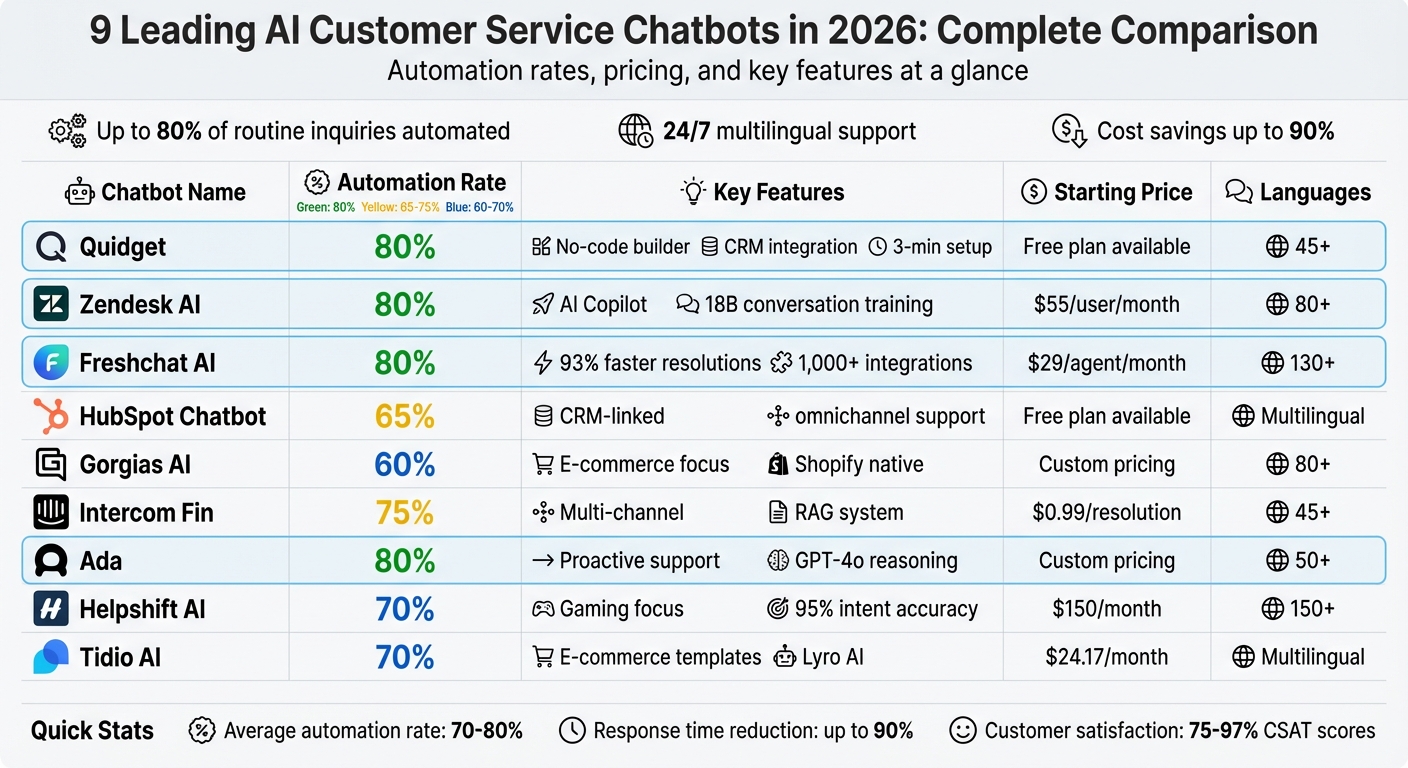
Here’s a quick look at nine leading chatbots making an impact:
- Quidget: Automates 80% of inquiries, integrates with tools like Zendesk and Shopify, and supports 45+ languages.
- Zendesk AI: Handles 80% of interactions, offers 18 billion conversation training, and powers tools like AI Copilot.
- Freshchat AI: Freddy AI reduces resolution time by 93% and integrates with over 1,000 tools.
- HubSpot Chatbot: Tied to its CRM, it automates 65% of conversations, boosting efficiency.
- Gorgias AI: Built for e-commerce, it automates 60% of queries and reduces support costs by 50%.
- Intercom Fin: Resolves up to 75% of queries, supports 45+ languages, and integrates with tools like Salesforce.
- Ada: Focuses on resolution rates, automating up to 80% of inquiries with GPT-4o reasoning.
- Helpshift AI: Designed for gaming and apps, automates 70% of interactions with 95% intent accuracy.
- Tidio AI: Lyro AI automates 70% of inquiries, cutting response times by 90%.
These tools are reshaping customer support by improving efficiency, reducing costs, and offering faster service.
Quick Comparison
| Chatbot | Automation Rate | Key Features | Starting Price | Languages Supported |
|---|---|---|---|---|
| Quidget | 80% | No-code builder, CRM integration | Free trial | 45+ |
| Zendesk AI | 80% | AI Copilot, 18B conversation training | $55 per user/month | 80+ |
| Freshchat AI | 80% | 93% faster resolutions, 1,000+ tools | $29 per agent/month | 130+ |
| HubSpot Chatbot | 65% | CRM-linked automation, omnichannel | Free plan available | Multilingual |
| Gorgias AI | 60% | E-commerce focus, Shopify native | Custom pricing | 80+ |
| Intercom Fin | 75% | Multi-channel, RAG system | $0.99 per resolution | 45+ |
| Ada | 80% | Proactive support, GPT-4o reasoning | Custom pricing | 50+ |
| Helpshift AI | 70% | Gaming focus, modular workflows | $150/month | 150+ |
| Tidio AI | 70% | E-commerce templates, Lyro AI | $24.17/month | Multilingual |
These chatbots are helping businesses scale support while maintaining quality service.
AI Customer Service Chatbot Comparison 2026: Features, Pricing and Automation Rates
How To Build An AI Chatbot for Customer Service (2026) | Step-by-Step
1. Quidget – AI Agent Builder for Customer Support & Sales
Quidget, created by SupportYourApp, leverages over 14 years of experience working with 250+ businesses. It automates up to 80% of repetitive customer inquiries across chat and email, slashing support costs by as much as 90%. Plus, it ensures 24/7 availability with instant, human-like responses, making it a game-changer for both customer support and sales processes.
Automation Capabilities
This AI tool takes care of routine customer requests while seamlessly passing complex issues to human agents with all the necessary context. Beyond support, it streamlines sales tasks by capturing and qualifying leads and syncing prospect details in real time with CRMs. Operational tasks like bookings, order management, inquiries, and refunds are also handled automatically, eliminating the need for manual intervention. Setup is quick and easy – taking less than three minutes – using a no-code builder where businesses can upload URLs, FAQs, and internal documents.
Integration with Business Tools
Quidget integrates effortlessly with popular platforms like Zendesk, Freshdesk, Slack, WhatsApp, Shopify, Calendly, and Zapier. It also supports messaging on Telegram, Viber, Facebook, and Instagram. For websites, it offers a Web Chat API and Webhooks for custom integrations and works seamlessly with website builders like WordPress, Wix, Webflow, Squarespace, Framer, and Bubble. Advanced users can design complex workflows using variables, logic actions, and webhooks to trigger external system actions.
Scalability
Designed for businesses of all sizes, Quidget scales effortlessly to meet growing demands. It supports over 45 languages, automatically detecting the customer’s language to serve a global audience. The platform manages high conversation volumes simultaneously and can be deployed on websites, embedded in mobile apps, or shared as a standalone AI assistant through a unique link. It adheres to GDPR, ISO, and PCI standards, ensuring secure, encrypted responses. Pricing starts with a free plan and includes a 7-day trial for businesses to explore its capabilities.
2. Zendesk AI
Zendesk AI uses advanced AI technology to autonomously manage customer interactions across various channels, including email, web, mobile, voice, and social platforms like WhatsApp and Facebook. With training on an impressive 18 billion customer conversations, it’s designed to understand complex queries and industry-specific terminology right from the start. This enables its AI agents to solve problems effectively and adjust their responses to meet unique customer needs.
Automation Capabilities
Zendesk AI handles an impressive 80% of customer interactions on its own. It achieves this by retrieving accurate information, troubleshooting issues, and even processing refunds and order cancellations. For instance, during TaskRabbit‘s global expansion in October 2025, the platform managed 158,000 monthly tickets, automating all first contacts and deflecting 28% of tickets. Similarly, Unity saved $1.3 million while achieving an 83% improvement in first-response efficiency. Meanwhile, HelloSugar automated 66% of their customer queries, saving $14,000 monthly while scaling their operations from 81 to 160 locations.
"We currently have 81 salons and are going to grow to 160 this year, without growing our reception staff. And with automation, we’re able to do that while offering way better CX." – Austin Towns, Chief Technology Officer, HelloSugar
The AI Copilot feature enhances these capabilities by suggesting replies, summarizing conversations, and recommending next steps based on predefined workflows. It also identifies customer intent, sentiment, and language automatically, ensuring tickets are routed correctly or resolved instantly.
All these automation features seamlessly integrate into Zendesk’s larger system, creating a cohesive experience.
Integration with Business Tools
Zendesk AI connects effortlessly with other tools through API orchestration, pulling customer data like purchase history, preferences, and behaviors to deliver personalized support. It works natively within the Zendesk Suite, utilizing existing tickets, macros, and reporting tools, eliminating the need for external connectors. Additionally, the Sunshine Conversations platform enables businesses to create interactive chatbot experiences on platforms like Instagram, Facebook Messenger, and X (formerly Twitter). Pricing starts at $55 per user per month, with automated resolutions available for as little as $1.00 each.
These integrations make it easier for businesses to scale their operations while maintaining personalized customer experiences.
Scalability
Zendesk AI is built to handle high-volume environments efficiently. It supports over 80 languages with native fluency, automatically switching languages based on customer input. It operates 24/7, managing interactions across time zones and handling seasonal traffic surges seamlessly. For businesses with more complex needs, the Advanced tier offers hybrid conversation flows that combine generative AI with pre-scripted responses. It also includes advanced analytics to track and optimize performance across various scenarios.
This scalability ensures that Zendesk AI can meet the demands of businesses of all sizes and industries.
3. Freshchat AI
Freshchat AI is powered by the Freddy AI Agent, a tool designed to handle tasks like processing refunds, updating records, and checking shipment statuses automatically. Using intent detection, Freddy AI understands customer issues – even when they’re phrased casually – and delivers tailored responses through its intuitive no-code bot builder [23, 27, 30]. These features streamline routine interactions, making them more efficient.
Automation Capabilities
Freddy AI Agent takes care of up to 80% of routine customer queries, cutting resolution times by an impressive 93% [23, 25, 28]. Available 24/7 across web, mobile apps, and popular messaging platforms like WhatsApp, Messenger, and Apple Business Chat, it ensures uninterrupted customer support. If the bot encounters an issue it can’t solve, the IntelliAssign feature steps in, directing the conversation to the right agent with all the necessary context.
"With Freddy AI Agent, our chatbots can address inquiries round the clock. It’s a powerful feature to improve the customer experience while freeing our agents to focus on immediate traveler needs." – Krishnamoorthy Venkatakrishnan, Manager, Customer Experience, Pickyourtrail
The results speak for themselves: a 96% customer satisfaction (CSAT) rate, a 40% boost in agent productivity, and conversational resolutions averaging under 2 minutes [28, 31]. This level of automation also integrates seamlessly with existing business tools, enhancing overall efficiency.
Integration with Business Tools
Freshchat consolidates communication from platforms like WhatsApp, Facebook Messenger, Instagram, Apple Business Chat, and SMS into one unified hub [24, 31]. Through the Freshworks Marketplace, businesses gain access to over 1,000 pre-built integrations, including CRMs like Salesforce and HubSpot, and e-commerce platforms such as Shopify [24, 28]. Custom integrations are also possible using APIs and webhooks to align with your tech stack.
For instance, Fantastic Services saw a 100% increase in chat ROI using IntelliAssign, while Klarna achieved a first response time of just 60 seconds by leveraging Freshchat’s tools.
Scalability
Freshchat AI is designed to grow with your business. It can support teams ranging from 10 to over 500 agents. The platform handles multilingual interactions in over 130 languages, ensuring personalized service across different regions [26, 28]. Companies using Freshworks’ conversational AI report a 97% first contact resolution rate across multiple channels. Pricing starts at $29 per agent per month (billed annually) under the Growth plan, with a free option available for teams of up to 10 agents [26, 29].
4. HubSpot Chatbot
HubSpot’s chatbot builder is directly tied into its CRM platform, making automated customer service more effective by leveraging CRM data. The Breeze Customer Agent uses this integration to resolve 65% of customer conversations automatically by pulling from CRM and knowledge base information. Some teams have even achieved up to 90% automation in resolving inquiries. This setup streamlines the customer journey while reducing the workload on human agents.
Automation Capabilities
HubSpot’s chatbot takes on repetitive tasks that typically consume 70–80% of service reps’ time. These include answering FAQs, qualifying leads, booking meetings, and creating support tickets. For more complex issues, it smoothly transitions conversations to human agents, providing the full chat history and CRM context. This ensures that customers receive personalized and efficient support.
Take Nutribees, for instance. After integrating the Breeze Customer Agent into their Service Hub, they reduced human-handled support tickets by 77%. Pietro Ripanti, their Chief Marketing Officer, shared:
"We have lowered the number of tickets handled by customer support by 77% while simultaneously improving the conversion rate through 24-hour support. Breeze customer agent is a key tool for generating revenue and increasing customer satisfaction".
Additionally, teams using Breeze reported 39% faster ticket resolution compared to those without it.
Integration with Business Tools
HubSpot’s chatbot doesn’t just automate – it also integrates seamlessly with other business tools. It syncs with HubSpot CRM, saving chat transcripts and using customer data like names, industries, and recent activities to tailor interactions. The chatbot supports omnichannel messaging, connecting with platforms like WhatsApp, Facebook Messenger, Instagram, and SMS, ensuring consistent service across channels. Conversations can even trigger workflows, such as enrolling contacts in marketing sequences or routing tickets to specific teams.
In March 2025, Superchat, a messaging platform, enabled hundreds of businesses to launch AI chatbots through HubSpot’s native integration. These bots handled over 1.5 million AI-powered messages in just one month, syncing all conversation history directly into the CRM. The chatbot also supports Model Context Protocol (MCP) connectors, allowing integration with other AI tools to further automate tasks across various systems.
Scalability
Scalability is one of HubSpot’s chatbot’s standout features. It manages high volumes of conversations without requiring additional staff. For example, Kaplan Early Learning Company used the chatbot to automatically handle 37% of 1,800 chat requests in a single quarter, according to Ben Simon, their HubSpot Administrator.
The platform also supports multilingual capabilities, making it ideal for businesses with global customers. Hostelworld utilized the Breeze Customer Agent to provide multilingual support for international travelers, which is projected to reduce response times by 40–50% and cut total ticket volume by 10–20%. Pricing options start with a free plan for basic functionality, while the Starter plan costs $15 per seat per month when billed annually.
5. Gorgias AI
Gorgias AI is built specifically for ecommerce businesses, offering a native Shopify integration that pulls real-time data like order history, inventory levels, and customer tags. The AI Agent handles repetitive customer queries such as "Where is my order?" (WISMO), returns, exchanges, cancellations, and product details. It also integrates with over 100 ecommerce tools, including Loop Returns, Recharge, and various shipping carriers, to trigger actions and streamline responses.
Automation Capabilities
Gorgias AI can automate up to 60% of email and chat conversations, achieving an average resolution time of under one minute. Using Vision Technology, it processes images for tickets involving damaged items or proof of returns. To ensure accuracy, every response is reviewed by a secondary AI model.
Tosha Moyer, Senior CX Manager at an ecommerce brand, highlighted how the tool helps during peak seasons:
"We’ve seen the most impact from Gorgias through our customer service cost-savings. We don’t have to hire during the holiday season or backfill when natural attrition happens, because AI Agent is there to help us."
Businesses using Gorgias AI report a 50% reduction in support costs and reclaim 65% of their support team’s time for more strategic tasks. Its fast, automated responses are further enhanced by seamless integrations with third-party tools.
Integration with Business Tools
Gorgias AI works across email, chat, and SMS, adjusting its tone and message length based on the communication channel. Its "Actions" feature allows the AI to perform tasks in third-party apps, such as processing returns in Loop Returns or modifying subscriptions in Loop Subscriptions. With API capabilities, businesses can create custom workflows to handle specific troubleshooting needs or complex order edits, making it a versatile tool for resolving customer issues quickly.
At Pepper, the Gorgias Shopping Assistant manages pre-purchase questions and provides product recommendations using live inventory and shopper data. Gabrielle McWhirter, CX Operations Lead at Pepper, shared:
"At Pepper, Gorgias Shopping Assistant has become a natural extension of the customer journey. It’s helped us turn everyday conversations into sales opportunities through upselling and cross-selling, grow revenue, and deliver fast, personalized support any time of day."
Scalability
The AI Agent operates 24/7 and supports over 80 languages, even leveraging Help Center content to respond in languages where localized material isn’t available. This feature helps businesses scale their customer support globally. Additionally, Gorgias AI meets SOC 2 Type 2 and HIPAA compliance standards, with data hosted on Google Cloud Platform servers worldwide to ensure proximity to users.
Customization Options
Gorgias AI offers extensive customization to meet specific business needs. Companies can define custom workflows for standard procedures, set escalation triggers for human intervention, and choose from preset or tailored tones of voice, such as Friendly, Professional, or Sophisticated. The AI also detects customer frustration or high-value orders and escalates them to human agents when necessary. An "AI Reasoning" feature provides transparency by showing why the AI selected a particular response, allowing teams to refine its behavior through feedback.
sbb-itb-58cc2bf
6. Intercom Fin
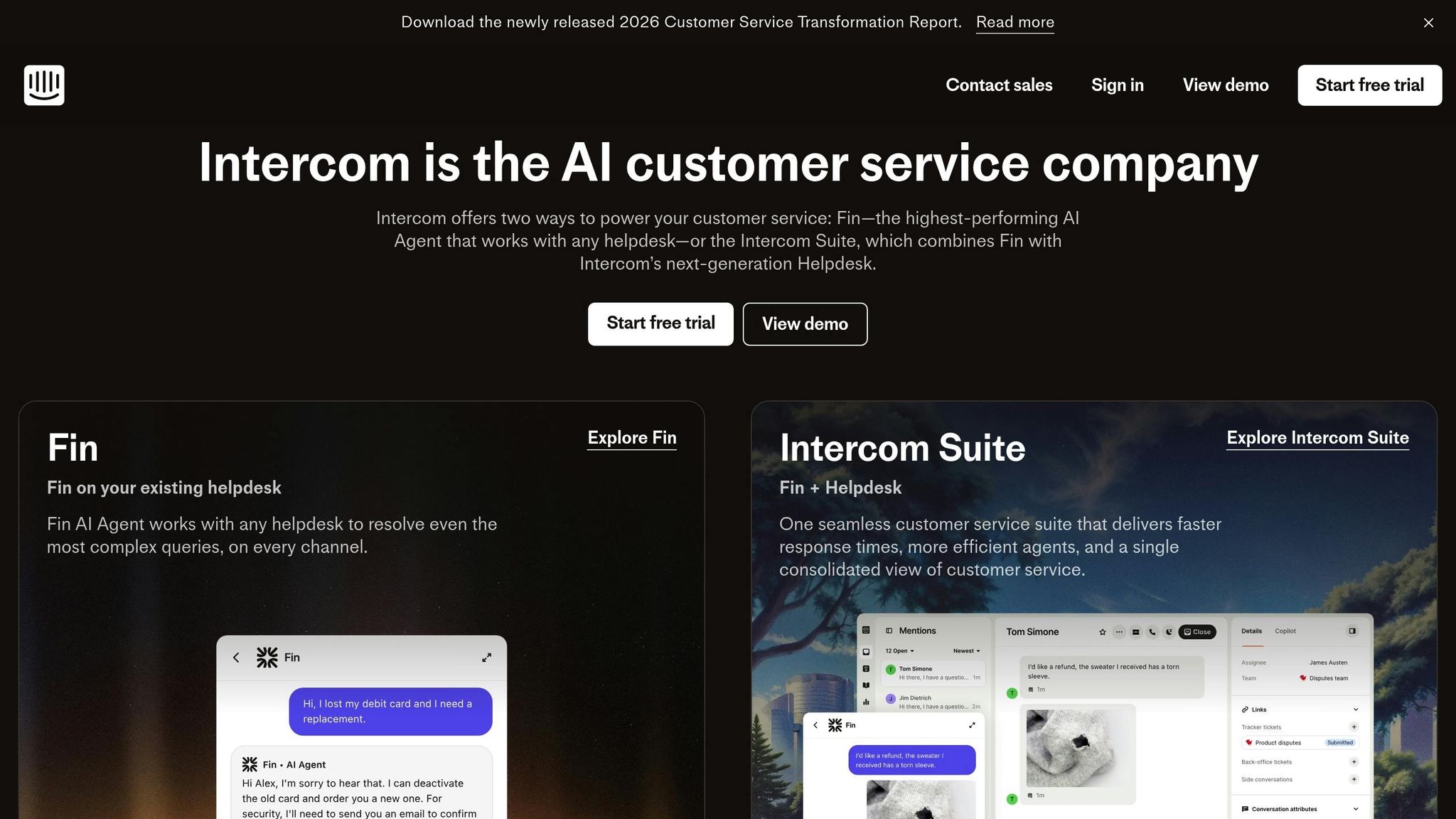
Intercom Fin leverages AI to handle customer conversations across various channels, including live chat, email, WhatsApp, SMS, and phone support through its Fin Voice feature [51,55]. It boasts an average resolution rate of 41%, with some businesses achieving up to 75% resolution from start to finish [50,53]. Supporting over 45 languages, it automatically detects and responds in the customer’s preferred language [50,55]. This multi-channel capability forms the backbone of its advanced automation tools.
Automation Capabilities
Fin excels at automating complex tasks, such as processing refunds and managing subscription changes. Its Fin Vision feature can even analyze images – like screenshots, invoices, or error messages – to quickly address technical issues, improving resolution accuracy [51,55]. Another standout feature is Simulations, which allows teams to run fully simulated customer interactions and test edge cases before going live [51,56].
For example, Anthropic, an AI research lab, implemented Fin in 2024 and saw dramatic time savings. Emily Lampert, Head of Product Support, shared:
"The time savings have been huge – in the first month, we’d already saved over 1,700 hours of our team’s time. Without Fin, it would have taken us months to work through that volume."
Lightspeed, which operates in over 100 countries, now uses Fin in 99% of its customer conversations, achieving up to 65% resolution rates, even for more complex tier-two issues. Angelo Livanos, Vice President of Global Support at Lightspeed, remarked:
"Fin is in a completely different league. It’s now involved in 99% of conversations and successfully resolves up to 65% end-to-end – even the more complex ones."
Integration with Business Tools
Fin integrates effortlessly with major business platforms like Salesforce, HubSpot, Shopify, Stripe, and Jira through its Data Connectors. These integrations enable it to pull real-time data, allowing for personalized responses to queries about order statuses or subscription details. Using a retrieval-augmented generation (RAG) system, Fin learns from various knowledge sources – like Help Center articles, internal notes, PDFs, Notion, Confluence, and public URLs – while minimizing the risk of inaccuracies [50,51,55]. If a query cannot be resolved, Fin seamlessly escalates it to human agents via the Intercom Inbox, maintaining full context for a smooth handoff.
Customization Options
Fin offers businesses the ability to tailor its responses to match their brand voice, vocabulary, and policies through the Guidance feature [51,55]. The AI Suggestions tool identifies gaps in existing content by analyzing unresolved queries and proposes updates for review [51,55]. To ensure quality, teams can measure performance with the CX Score and other essential chatbot analytics metrics, which assesses all interactions without relying on customer surveys [51,54]. Pricing starts at $0.99 per successful resolution, and a 14-day free trial is available [20,59].
7. Ada
Ada uses Playbooks to guide its AI agents through predefined SOPs, enabling them to tackle complex, multi-step customer inquiries effectively. The platform prioritizes the resolution rate – actually solving customer problems – over simply reducing handoffs to human agents. By leveraging GPT-4o-based reasoning, Ada has doubled its automated resolution rate from 30% to 60%, with some clients achieving rates exceeding 80%. This approach allows Ada to deliver strong automation outcomes.
Automation Capabilities
Ada’s AI agents save an impressive 60,000 labor hours each month while maintaining a 75% customer satisfaction score. The platform also offers proactive support, addressing issues before customers even reach out. For example, in January 2026, Delta Airlines’ "Ask Delta" chatbot reduced call center volumes by 20%, while H&M’s implementation cut response times by 70%.
"From one technology to the next, we’ve doubled the amount of conversations we can automatically resolve with a great experience." – Mike Gozzo, Chief Product and Technology Officer, Ada
Integration with Business Tools
Ada extends its automation capabilities by integrating with critical business systems. It provides prebuilt connections to platforms like Salesforce, Zendesk, Kustomer, Freshworks, Twilio, and Contentful. Additionally, it pulls information from knowledge bases such as ServiceNow, GitHub, GuruKB, and Helpjuice to deliver precise, real-time responses. Over a two-year period ending in January 2026, iHerb reported a 400% drop in inquiries by automating high-complexity questions through Ada’s APIs.
Scalability
Ada supports more than 50 languages across chat, email, and voice channels, effortlessly handling peak periods. For instance, Monday.com reduced agent handle time by 42% while serving over 225,000 customers, and IPSY achieved a 943% return on investment within just four months.
Customization Options
Ada’s no-code interface allows businesses to refine processes, set rules, and test scenarios in sandbox environments. It also includes custom PII redaction features and complies with regulations like HIPAA, SOC2, GDPR, and AIUC-1. Real-time dashboards provide insights into key metrics such as resolution rates and customer satisfaction, helping businesses track performance effectively.
8. Helpshift AI
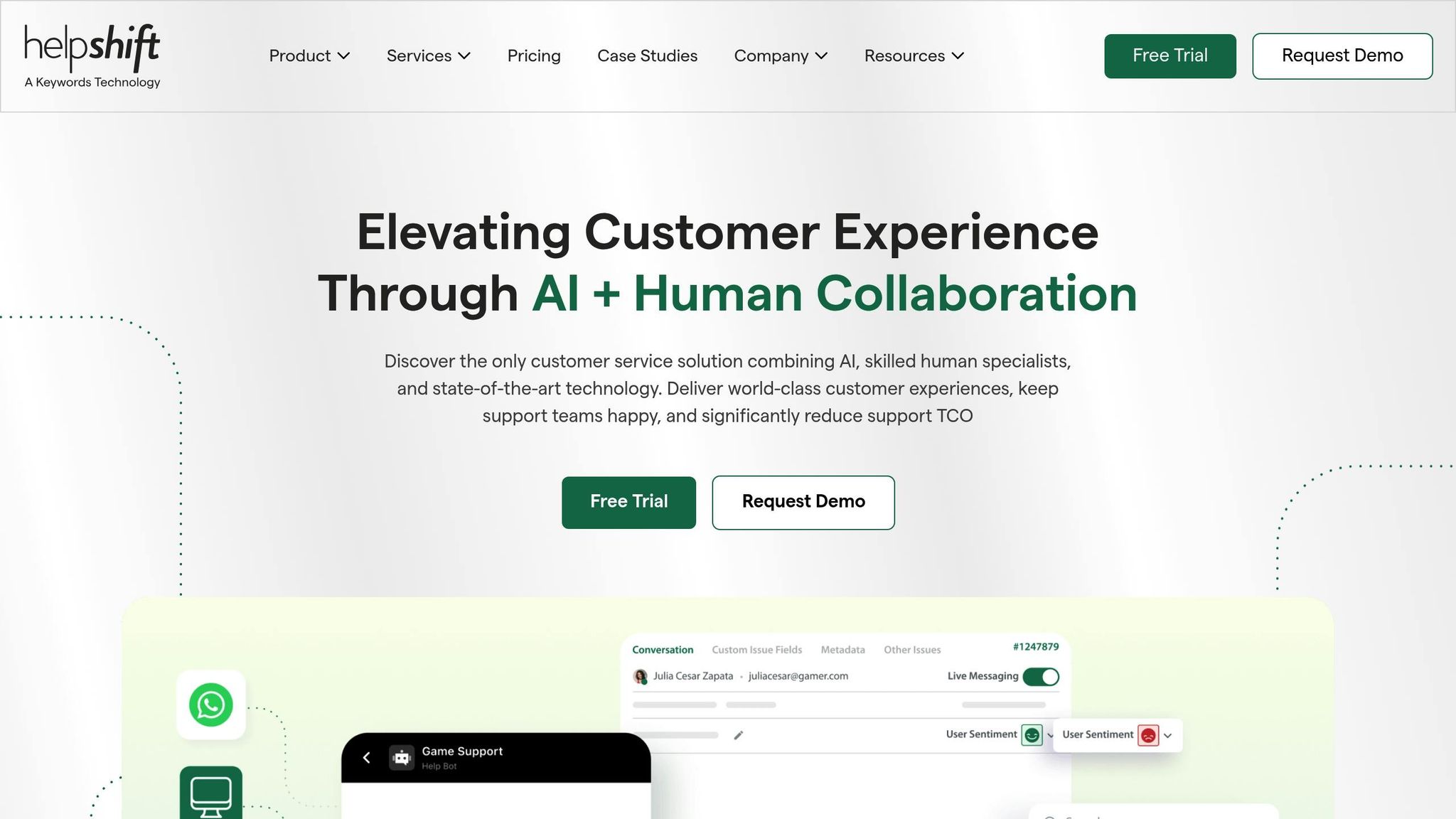
Helpshift AI is designed to handle high-volume customer support for gaming and mobile apps, automating up to 70% of interactions with an impressive 95% accuracy in intent detection through pre-built menus.
Automation Capabilities
Helpshift AI offers four distinct bots to streamline customer support:
- Answer Bot: Delivers instant, pre-approved responses.
- Feedback Bot: Collects customer satisfaction (CSAT) scores.
- Quick Search Bot: Provides access to the knowledge base.
- Identity Bot: Ensures secure customer authentication.
In 2024, SYBO, the creators of Subway Surfers, adopted Helpshift AI and saw a 77% automation rate while boosting their CSAT score from 3.8 to 4.3 in just three months. Another gaming studio implemented Helpshift AI across 23 games within eight months, achieving a remarkable 91% ticket deflection and maintaining a 4.3 CSAT rating.
"Training AI to understand language, determine intent, and triage problems through well-defined workflows helps offload the grunt work from the agents, allowing them to focus on problem-solving, creative solutions, and empathy for the customer." – Erik Ashby, Senior Director and Head of Product at Helpshift
These automation tools are at the core of Helpshift AI’s ability to deliver efficient, scalable solutions globally.
Scalability
Helpshift AI supports over 150 languages using its proprietary Language AI. This feature allows businesses to manage 3.5 times more support tickets without needing additional staff. For companies handling non-English tickets, this has resulted in a 30% reduction in costs. The platform also uses Retrieval-Augmented Generation to ensure responses are pulled only from verified knowledge base content, effectively eliminating AI hallucinations.
Customization Options
Helpshift AI provides a no-code Visual Automation Builder, enabling teams to create modular workflows for seamless task handoffs or escalations to human agents. With Intent Analytics dashboards, businesses can monitor real-time performance, identify knowledge gaps, and address common errors for ongoing refinement.
Pricing starts at $150 per month for the Starter plan, which includes a 30-day free trial and 250 free tickets. Growth and Enterprise plans are available for larger-scale operations, offering tailored solutions to meet specific needs.
9. Tidio AI
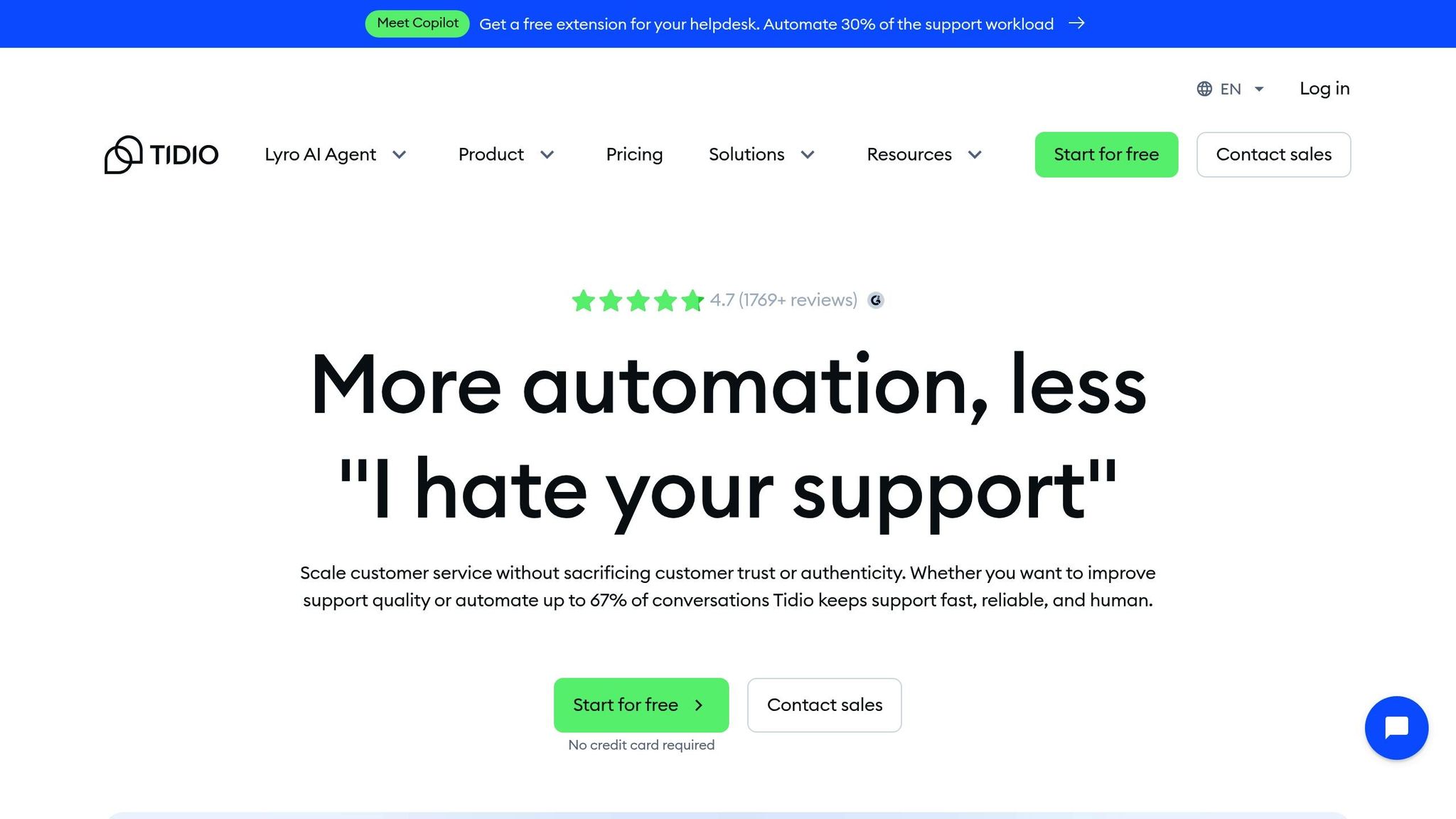
Tidio AI uses its Lyro AI Agent to transform customer support. This platform automates up to 70% of customer inquiries and reduces response times by a whopping 90%. By relying on a business’s existing support knowledge, Lyro ensures accurate answers while keeping errors to a minimum.
Here’s a closer look at how Tidio AI’s automation, integrations, scalability, and customization features make support operations more efficient.
Automation Capabilities
Tidio’s Lyro Smart Actions handle tasks like updating orders, qualifying leads, and checking delivery zones in real time. With over 40 e-commerce templates, businesses can automate processes like abandoned cart recovery, lead generation, and offering discounts. The platform also uses AI to scan incoming emails, resolving routine issues automatically so human agents can focus on more complex cases.
Take Suitor, a suit rental company, as an example. By adopting Lyro, they automated 85% of their support workload. According to Co-founder and CEO Daniel Reid, customer wait times plummeted by 97%, with the chatbot responding in just 6 seconds on average. Similarly, luxury eyewear retailer Eye-oo saw wait times drop from 5 minutes to just 30 seconds – a reduction of 86%. They also experienced a 25% boost in sales. Marketing Manager Evelin Lopez shared that Lyro managed 1,825 out of 2,233 support conversations and generated 1,305 leads. These automation tools work seamlessly alongside Tidio’s integrations.
Integration with Business Tools
Tidio integrates with major platforms like Shopify, WordPress, Wix, and Magento, making it a go-to solution for e-commerce businesses [15, 21, 76]. It consolidates communication from Facebook Messenger, Instagram, and WhatsApp into one dashboard, simplifying multi-channel management [15, 73, 76]. For CRM and help desk workflows, Tidio connects with tools like Zendesk, HubSpot, Mailchimp, and Zapier [72, 77]. Its Shopify integration is particularly powerful, allowing agents and bots to preview carts, recommend products, cancel orders, and even issue refunds – all within the chat window.
But Tidio doesn’t just stop at integrations. Its scalability ensures it can meet the demands of businesses of all sizes.
Scalability
Tidio’s multilingual support, powered by natural language processing (NLP), can handle dozens of languages [72, 73]. For example, ADT Security Service uses Tidio’s AI to monitor social media channels in 16 different languages, cutting response times by 65% while managing thousands of tickets. Tidio+ customers also report a 50% resolution rate within just a few weeks of onboarding.
"I’m so much happier because we can trust that the customer service is being taken care of by the chatbot."
- Daniel Reid, Co-founder and CEO of Suitor
Customization Options
Tidio offers a user-friendly, no-code visual builder for creating custom workflows and triggers. Teams can personalize branding, adjust chatbot personas, and access detailed analytics to track performance. Pricing is flexible, starting at $24.17 per month for the Starter plan. The Growth plan begins at $49.17 per month, while scaling businesses can opt for the Plus plan at $749 per month or the Premium plan starting at $2,999 per month.
Conclusion
By 2026, AI chatbots have reshaped customer support. From Quidget’s quick 2-minute setup to Zendesk’s agents trained on a staggering 18 billion interactions, these tools now handle the majority of routine inquiries while maintaining impressive CSAT rates.
Across the nine platforms we explored, the benefits are clear – both financially and operationally. For example, HelloSugar saves $14,000 every month, and Lush recovers 360 agent hours by automating repetitive tasks. With pricing models as low as $0.99 per successful resolution, companies only pay when these tools deliver results.
These AI agents offer 24/7 support in over 80 languages, ensuring customers get immediate help no matter their location or time zone. For more complex cases, platforms like Quidget and Zendesk seamlessly hand off queries to human agents, complete with all necessary context. This ensures service quality remains high while allowing teams to focus on more strategic, high-value interactions.
"Quick solutions – like answers given by the AI agent – help free up our agents to spend more time with customers that need tailored help for more in-depth queries." – Lucy Hussey, Customer Service Manager, Motel Rocks
Whether you’re a fast-growing startup like Sorare, cutting escalated tickets by 30%, or an established retailer like Everlane, boosting deflection rates by 400%, the impact of AI chatbots is undeniable. These tools represent a major shift in customer support, where bots not only respond but also reason and adapt independently. This evolution allows businesses to scale their support operations without needing to expand their teams proportionally, cementing AI chatbots as essential tools in 2026.
FAQs
How do AI chatbots make customer service more efficient?
AI chatbots are transforming customer service by taking over routine tasks, providing quick and consistent answers, and staying available around the clock. Unlike human agents, they can handle multiple conversations at the same time, making it possible for businesses to manage large volumes of inquiries without the need to expand their team.
By speeding up interactions and cutting down on wait times, chatbots elevate the customer experience while allowing human agents to concentrate on more complex problems. This approach saves both time and money while ensuring customers get prompt and dependable support.
What features should I look for in a customer service chatbot?
When picking a customer service chatbot, focus on features that boost both customer happiness and your team’s productivity. One key feature is natural language understanding (NLU), which helps the chatbot grasp complex questions and reply in a conversational, human-like way. Another important tool is sentiment analysis, allowing the chatbot to tailor its tone based on the customer’s mood, creating a more personalized interaction.
Your chatbot should also work effortlessly across different platforms – like your website, social media, or messaging apps – so customers can reach out wherever they prefer. Automating routine tasks, like tracking orders or answering FAQs, can free up your team’s time and speed up responses. Additionally, features like customizability, scalability, and analytics ensure the chatbot can evolve with your business, adapt to new demands, and provide insights to keep improving customer service.
How can AI chatbots help businesses save money and improve efficiency?
AI chatbots are a game-changer for businesses aiming to cut costs and improve efficiency. By automating customer interactions, they reduce the need for large support teams and ensure faster response times. Plus, since they operate 24/7, customers can get help anytime – no extra staffing required.
Chatbots shine when it comes to handling repetitive questions and simplifying processes. This frees up human agents to tackle more complex issues, boosting productivity while trimming operational expenses. The result? Lower costs and a smoother, more satisfying experience for customers.


