


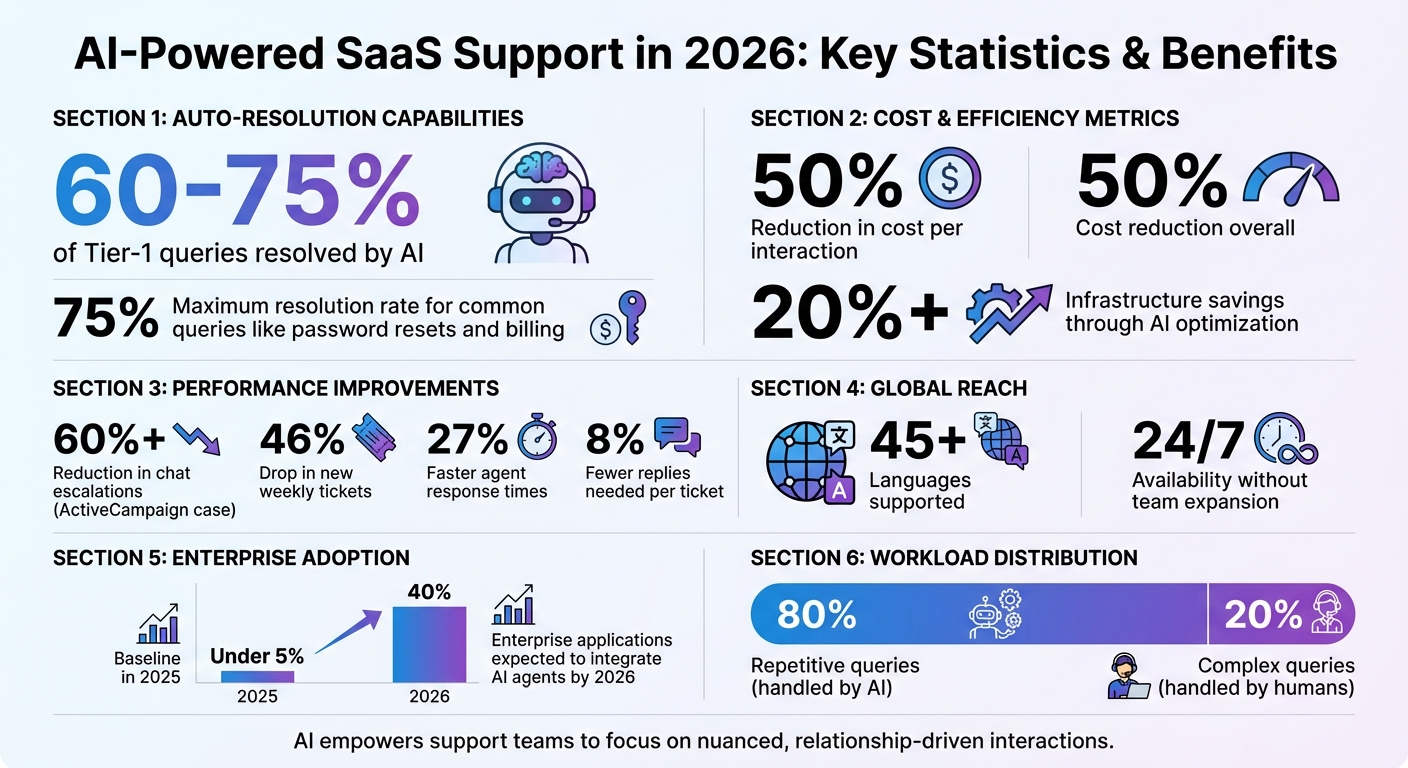
AI-powered tools have reshaped SaaS customer support in 2026 by automating repetitive tasks, improving response times, and enhancing customer experiences. Companies now rely on advanced AI agents capable of resolving up to 75% of Tier-1 queries, such as password resets or billing questions, in seconds while maintaining context across channels like Slack, WhatsApp, and email. These systems also handle multilingual support in over 45 languages, reducing costs by 50% and enabling 24/7 availability without increasing team sizes.
Key takeaways:
- Automated Resolutions: AI resolves 60–75% of repetitive queries, freeing human agents for complex cases.
- Context-Aware Responses: AI uses customer data to provide personalized answers and seamless handoffs to agents.
- Scalability: Handle thousands of queries simultaneously, cutting costs while maintaining quality.
- Omnichannel Integration: Operates across Slack, email, WhatsApp, and more.
- Quick Setup: Tools like Quidget train in minutes and integrate with CRMs.
AI tools are not replacing humans but empowering support teams to focus on nuanced, relationship-driven interactions. Solutions like Quidget offer a fast, cost-effective way for SaaS companies to modernize their support systems.
AI-Powered SaaS Support Statistics and Benefits in 2026
What AI-Powered SaaS Support Looks Like in 2026
From chatbots to intelligent AI agents
The jump from early 2020s chatbots to the AI agents of 2026 is nothing short of transformative. Back then, chatbots relied on rigid decision trees and keyword matching, often falling apart when users asked questions slightly outside their programmed scripts. Fast forward to 2026, and Large Language Models (LLMs) have turned those limitations on their head by interpreting the true intent behind questions, not just the words used.
One of the most exciting advancements is Retrieval-Augmented Generation (RAG). Instead of relying on pre-written templates, today’s AI agents pull live, product-specific information straight from a company’s documentation. For example, when a user asks, "How do I add a team member to my workspace?" the AI doesn’t just guess – it retrieves the correct steps from the knowledge base and delivers a tailored response. This approach has pushed auto-resolution rates to an impressive 60-75%, a massive improvement over the limited capabilities of older bots.
Another game-changer is the adoption of thread-based infrastructure. Traditional helpdesks depended on manual ticketing systems, but modern AI-driven platforms use "headless" backends. These systems leverage real-time APIs to operate seamlessly across channels like Slack, email, and Discord, eliminating the need to force conversations into rigid ticket formats. This means AI agents can keep track of ongoing conversations, maintain context across multiple interactions, and even take independent actions – like issuing refunds, updating account details, or creating Jira tickets – without waiting for human approval.
"The shift from ‘helpdesk with AI bolted on’ to ‘AI-first support infrastructure’ is happening now – and it’s happening fast." – Cole D’Ambra, Marketing, Plain
These advancements lay the foundation for the sophisticated, context-aware capabilities shaping SaaS support today.
Core capabilities of AI-powered SaaS support
The technological strides made in AI support systems have completely redefined how SaaS companies engage with their customers.
Real-time, context-aware responses are now the norm. AI agents don’t just answer questions – they do so with a deep understanding of the customer’s context. This includes knowing who the customer is, what plan they’re on, and their recent activity within the product. For example, when an Enterprise-tier customer asks about a feature, the AI tailors its response based on their subscription level. This level of personalization helps solve modern SaaS challenges by improving accuracy and simplifying workflows across multiple channels.
Intelligent routing and escalation take things a step further. AI systems can now classify conversations by urgency, topic, and sentiment, ensuring that issues are directed to the right teams – billing inquiries go to finance, while technical bugs land with engineering. When escalation is necessary, the AI hands off the entire conversation history, customer timeline, and the reasoning behind the escalation, sparing customers from having to repeat themselves. This is a far cry from the days of bots that would simply say, "transferring you to an agent", and leave the user starting from scratch.
24/7 multilingual support is another standard feature. AI agents can automatically detect a customer’s language and seamlessly continue the conversation in any of 45+ languages. This ensures instant, around-the-clock support without requiring a global team. Combined with sub-second response times, these systems eliminate the long wait times that used to frustrate users asking straightforward questions like, "Where’s my invoice?" or "How do I reset my password?".
The most advanced systems go beyond answering questions – they take action. Instead of instructing customers on how to cancel a subscription, the AI can process the cancellation, update the CRM, or even offer a retention discount. By 2026, 40% of enterprise applications are expected to integrate task-specific AI agents, a sharp increase from under 5% in 2025. Companies deploying these agents have seen a 50% reduction in cost per interaction, highlighting how these tools boost efficiency without the need to expand teams.
"The teams getting the most value from AI support in 2026 share a common trait: they view AI as a way to provide better support, not cheaper support." – Jonathan Bar, Founder, Corebee
sbb-itb-58cc2bf
Scale Customer Support with AI (Without Hiring More Agents)
Why SaaS Teams Are Adopting AI Support
SaaS teams are increasingly turning to AI-powered support to tackle persistent operational challenges. Traditional support models struggle to keep up with the demands of modern SaaS products, where users expect instant, round-the-clock assistance. With product-led growth enabling users to sign up and start using software immediately, the need for timely support has become non-negotiable. However, support teams are often bogged down by repetitive questions about billing, setup, and "how-to" inquiries – tasks that can consume up to 60–80% of their capacity. The pressure to scale support without expanding headcount has made AI-driven solutions an essential tool for SaaS companies.
Handling Repetitive Queries with Automation
One of the biggest advantages of AI is its ability to handle repetitive tasks, freeing up human agents to focus on more complex issues. Common Tier-1 questions like "How do I reset my password?", "Where can I find my invoice?", or "How do I add a team member?" are predictable and high in volume. These queries don’t require deep human judgment but still take up valuable time that could be better spent on building relationships or solving intricate problems.
Softorino’s experience with Quidget highlights the impact of AI in reducing workload. By automating responses to common inquiries, Quidget significantly decreased ticket volume and allowed human teams to focus on higher-value tasks:
"Setting up Quidget was surprisingly quick – It now handles 60% of our first-level responses, slashing wait times and letting our team focus on real customer needs."
- Alex Novak, Customer Success Manager, Softorino
Scaling Without Growing Headcount
Hiring more support agents to match customer growth is both costly and time-consuming. While a human agent may handle 21–70 issues daily, AI agents can manage thousands of conversations simultaneously. This scalability has led companies to reduce their cost per interaction by 50%. AI isn’t about replacing human agents – it’s about enabling teams to scale smarter. AI handles high-volume, predictable queries, especially during peak times, while human agents focus on nuanced problems that require empathy, creativity, or judgment. This balance not only improves support quality but also keeps team sizes manageable, aligning with the broader role support now plays across the customer journey.
The Overlap of Support, Onboarding, and Conversion
Support has evolved far beyond just solving problems – it now plays a key role in guiding users through their entire journey. For example, when a user asks, "How do I integrate with Slack?" they might be onboarding, evaluating an upgrade, or even considering leaving the platform. Modern AI support tools use customer context – such as plan details, recent activity, and past interactions – to provide tailored responses that meet the user’s specific needs.
This integrated approach is especially critical for product-led growth companies, where support, onboarding, and sales often happen within the same conversation. In fact, sales and support teams together account for 58% of upsell efforts in SaaS organizations. Tools like Quidget not only answer basic questions but also help teams identify high-priority conversations, ensuring that support efforts align with broader business goals.
Key Benefits of AI-Powered SaaS Support
When SaaS teams introduce AI-driven support, they see improvements in three key areas: speed, consistency, and efficiency. These aren’t just theoretical gains – they directly enhance customer experiences while improving operational costs.
Faster Response Times and Better Coverage
AI removes the delays typical of first-response times by delivering instant replies to common questions like billing issues, setup guidance, or account access problems. Instead of waiting hours (or even days) for a human to respond, customers get answers in seconds. This speed is especially crucial during weekends or off-hours, preventing the dreaded "Monday backlog" of unresolved tickets.
Take ActiveCampaign as an example: in March 2026, they reported a 60%+ reduction in chat escalations and a 46% drop in new weekly tickets created in Zendesk after adopting AI tools. Even for cases requiring human intervention, AI sped up agent response times by 27% and cut down replies per ticket by 8%.
Modern AI, powered by Large Language Models (LLMs), doesn’t just rely on keywords – it understands context and intent. For instance, if a user asks, "Why isn’t my payment going through?" the AI can analyze the account status and provide a specific, actionable response. This eliminates the frustration of navigating endless decision trees and ensures faster resolutions.
More Consistent and Accurate Answers
AI ensures that customers receive accurate and uniform responses across all channels. By leveraging Retrieval-Augmented Generation (RAG), AI pulls directly from your help center, product manuals, and knowledge base, keeping answers up-to-date and aligned with your documentation.
This level of consistency is maintained across platforms – whether customers reach out via Slack, email, Discord, or live chat, the AI references the same unified data source, avoiding "context silos". For global SaaS companies, the AI even supports over 45 languages, removing the need for separate regional teams.
AI systems also use confidence thresholds to handle uncertainty. If the AI isn’t sure about an answer, it escalates the query to a human agent, providing the full conversation history for context. This ensures customers aren’t left with incorrect or incomplete information.
"The teams getting the most value from AI support in 2026 share a common trait: they view AI as a way to provide better support, not cheaper support." – Jonathan Bar, Founder, Corebee
By delivering consistent answers and avoiding errors, AI improves customer satisfaction while streamlining operations.
Operational Efficiency and Cost Savings
AI transforms support operations by managing the repetitive 80% of queries – like password resets, billing inquiries, or feature explanations – freeing up human agents to focus on the remaining 20% that require empathy, judgment, or creative problem-solving. This shift allows support teams to scale efficiently without compromising quality.
AI-driven systems achieve auto-resolution rates of 60% to 75%, significantly reducing the workload for human agents. Companies using AI report a 50% drop in cost per interaction, highlighting the cost-effectiveness of these tools. For instance, Quidget’s AI-powered support delivers quick resolutions while cutting costs, enabling SaaS teams to maintain high customer satisfaction. Similarly, Softorino’s AI implementation led to fewer tickets and better response handling.
Beyond direct savings, AI reduces infrastructure costs by consolidating tools like live chat, bug reporting, and feedback systems into a single platform. This eliminates the "fragmentation tax" of managing multiple software solutions. Additionally, AI-based load forecasting predicts resource spikes, enabling proactive scaling of infrastructure. Some enterprises have seen infrastructure savings of over 20% through such optimizations.
The bottom line? AI doesn’t just make support faster and more reliable – it also helps SaaS companies manage costs as they grow.
How to Choose the Right AI Support Tool
By 2026, SaaS companies will need support platforms that integrate effortlessly, adapt to their product data, and grow alongside their businesses. The right tool can make support faster and more dependable while avoiding unnecessary complications for your team.
Must-Have Features to Consider
Start with Retrieval-Augmented Generation (RAG). This feature ensures the AI pulls answers directly from your help center and product documentation. Without RAG, the AI might rely on generic responses instead of leveraging your specific product knowledge.
Another key feature is context-preserving handoff. When the AI escalates a query to a human agent, it should transfer the full conversation history, its reasoning, and the customer’s account details. This ensures customers don’t have to repeat themselves, keeping the experience smooth.
For better performance, prioritize tools that support thread-based conversations rather than rigid ticket systems. AI agents perform more effectively when they can maintain context throughout a discussion – especially for complex questions that require a back-and-forth exchange.
A no-code setup is also a game changer for quick deployment. Platforms like Quidget allow you to train the AI on your website and FAQ in just minutes. The faster you can get started, the quicker you’ll see results. Look for tools that can achieve auto-resolution rates of 60–75%.
Lastly, ensure the tool offers configurable guardrails and confidence thresholds. You’ll want to set boundaries on responses, customize the tone, and maintain control over AI decisions to avoid unpredictable or unclear behavior.
These features build a strong foundation. From here, focus on how well the tool can be tailored to your needs and integrated into your workflows.
Customization and Integration Options
Once the basics are covered, seamless integration with your existing systems becomes critical. An API-first infrastructure allows the AI to work across any custom backend or interface programmatically. Tools that can operate directly within your helpdesk inbox also simplify processes.
For branding, look for platforms that let you adjust the chatbot’s design, tone, and behavior to align with your company’s voice. For example, Quidget allows full customization of widget design, colors, fonts, and even the instructions guiding the AI’s responses.
Advanced teams may benefit from Bring Your Own Agent (BYOA) capabilities. This lets you connect your custom-built agents – using models like GPT-4 or Claude – to your support system via API.
Integration with your CRM, product analytics, and communication channels is equally important. Quidget, for instance, works with Zendesk, Calendly, and other CRMs while supporting deployment on platforms like WhatsApp, Slack, Telegram, and Viber. This eliminates the hassle of managing disjointed tools.
Multilingual and Global Support Capabilities
To meet the demands of global customer engagement, modern support tools must handle multilingual interactions seamlessly. If your business serves customers outside the U.S., automatic language detection is essential. By 2026, the standard is AI that can identify and respond in over 45 languages without requiring manual setup or separate teams.
Quidget, for example, delivers this feature, allowing SaaS companies to provide consistent support worldwide without needing to hire multilingual agents around the clock. This is especially valuable for B2B SaaS teams catering to international clients across multiple time zones.
Global support also means complying with regional regulations. Choose a platform that meets GDPR, ISO, PCI compliance, and SOC 2 attestation standards. These certifications ensure your tool handles customer data securely and aligns with privacy requirements in different regions.
The right AI support tool should learn from your knowledge base, hand off tasks to human agents seamlessly, integrate into your systems, and scale globally – without adding unnecessary complexity.
How Quidget Helps SaaS Teams
Quidget brings AI-powered support to SaaS teams, offering practical solutions that streamline operations. By automating repetitive tasks, the platform allows teams to focus on more complex customer needs, scaling support efforts effectively.
AI-driven automation for repetitive tasks
Quidget takes on up to 80% of repetitive queries, such as password resets and invoice requests, which often clog up inboxes and create backlogs – especially during off-hours. Using Retrieval-Augmented Generation (RAG), the AI pulls accurate responses directly from your help center and FAQs.
For instance, Softorino saw a 60% reduction in first-level responses and decreased ticket volume by 35% after implementing Quidget.
"Setting up Quidget was surprisingly quick – It now handles 60% of our first-level responses, slashing wait times and letting our team focus on real customer needs. It’s been a game-changer for us." – Alex Novak, Customer Success Manager, Softorino
Quidget provides 24/7 support across Live Chat, Email, and Voice, ensuring instant responses, even outside regular business hours. This is especially valuable for SaaS companies serving global customers in different time zones.
Human handoff and omnichannel support
Quidget ensures faster, context-aware responses by combining automation with seamless human handoffs. When the AI encounters a query it can’t confidently resolve, it automatically escalates it to a human agent, complete with the conversation history and context. This eliminates the need for customers to repeat themselves and equips agents with all the details they need for a quick resolution.
The platform integrates directly with tools like Zendesk, Freshdesk, or Slack, so your team can continue using familiar systems without learning new software. Additionally, Quidget supports communication across multiple channels, including WhatsApp, Slack, Telegram, and Viber, allowing you to meet customers where they are.
With support for over 45 languages and automatic language detection, Quidget enables SaaS teams to serve a global audience without the need for multilingual agents available around the clock.
Fast setup and scalability
Quidget is designed for quick implementation. The no-code setup takes just 2 minutes, allowing you to train the AI on your website, FAQs, and uploaded resources without needing technical expertise. There’s no need for complex configurations or manual scripting. You can even customize the widget’s design, colors, fonts, and tone to align with your brand.
As your business grows, Quidget grows with you. It integrates with CRMs, tools like Calendly for scheduling, and APIs to automate workflows across your tech stack. Plus, it adheres to compliance standards like GDPR, ISO, and PCI, ensuring secure handling of customer data.
With a $0 starting cost and a free trial, Quidget makes it easy for SaaS teams to modernize their support operations without adding unnecessary complexity. It’s a straightforward way to embrace efficient, scalable AI-powered support.
Conclusion
AI as a new standard, not a replacement for humans
AI-powered support has shifted from being a novelty to becoming essential for SaaS companies striving to meet growing customer demands without endlessly expanding their teams. The aim isn’t to replace human agents but to relieve them of repetitive tasks, enabling them to tackle more complex, nuanced issues.
"The best approach is AI handling volume while humans handle nuance" – Jonathan Bar, Founder, Corebee
This combination achieves auto-resolution rates of 60–75% while maintaining customer satisfaction levels comparable to those of human-only support. It highlights the importance of practical tools that allow support teams to grow and adapt effectively.
Quidget as a practical path forward
Quidget offers a clear example of how AI can enhance efficiency without increasing team size. With features like a 2-minute setup, support in over 45 languages, and smooth transitions to human agents, Quidget enables teams to provide faster, more consistent support while scaling operations effectively.
Whether you’re managing repetitive onboarding questions, offering 24/7 support across time zones, or aiming to cut response times, Quidget equips you to deliver excellent support without needing to grow your team. Starting at $0 with a free trial, it’s an accessible way to see how AI-powered support can streamline your operations.
Discover how Quidget helps SaaS teams deliver faster, smarter support with AI.
FAQs
What is AI-powered SaaS support in 2026?
By 2026, AI technologies are set to redefine customer support for SaaS companies. Moving beyond the limitations of traditional chatbots, advanced AI agents will leverage conversational AI and large language models to create interactions that feel natural and contextually relevant.
These AI agents will take on repetitive tasks such as onboarding new users and troubleshooting common issues. They’ll also provide round-the-clock support, ensuring customers always have assistance when they need it. Meanwhile, human support teams will be free to tackle more complex challenges, leading to faster, more consistent, and scalable support systems.
How is an AI agent different from a chatbot?
AI agents stand out from traditional chatbots due to their advanced capabilities. Unlike chatbots, which depend on scripted flows and predefined responses, AI agents leverage conversational AI to engage in more natural and dynamic interactions. They are trained on your knowledge base, allowing them to deliver real-time, context-aware answers. This means they can tackle complex queries, maintain consistency in their responses, and even escalate issues to human agents – providing full context to ensure a smooth handoff.
How do you keep AI support accurate and secure?
In 2026, ensuring both accuracy and security in AI-powered support systems hinges on combining advanced retrieval methods with strong protective measures. Retrieval-Augmented Generation (RAG) plays a key role in delivering accurate responses by pulling real-time data directly from your documentation. This approach minimizes outdated or incorrect information, keeping interactions reliable and relevant.
On the security front, companies implement a range of measures to safeguard data. These include encrypted data handling, strict access controls, and regular audits to identify and address vulnerabilities. Additionally, smart escalation workflows and continuous monitoring help prevent errors and maintain trust. Together, these strategies ensure high-quality support while protecting sensitive information.


