


AI chatbots are transforming ecommerce by automating repetitive tasks, saving costs, and boosting sales. From handling customer inquiries to recovering abandoned carts, these tools improve efficiency and customer experience. Here’s a quick look at the top 10 platforms for ecommerce in 2026, their pricing, and key features:
- Quidget: Starts at $79/month. Ideal for Shopify stores with advanced order management and automation.
- Tidio: Free plan available; paid plans from $24/month. Multichannel support with a focus on conversation-based pricing.
- Intercom: Starts at $39/month. Offers advanced segmentation and GPT-4-powered AI.
- Ada CX: Custom pricing. Best for enterprises needing multilingual and large-scale automation.
- Zendesk AI: From $19/agent/month. Comprehensive support suite for omnichannel needs.
- Shoply AI: Tailored for Shopify. Focuses on cart recovery and product discovery.
- Engaige: Custom pricing but lacks detailed documentation for evaluation.
- Tolstoy: Free tier available; designed for sales-focused interactions like product recommendations.
- YourGPT: Starts at $39/month. Supports voice AI and wide channel integration.
- Amio: €150/month (~$162). Automates 95% of inquiries with real-time inventory sync.
These platforms cater to various business sizes, from small stores to enterprise-level operations. Choose based on your store’s size, budget, and specific needs like order management or sales assistance.
Top 5+ AI Chatbots for Your E-Commerce Business
sbb-itb-58cc2bf
Quick Comparison Table
| Platform | Starting Price | Features | Best For | Limitations |
|---|---|---|---|---|
| Quidget | $10/month | AI support automation, live chat fallback, fast setup, multilingual support | SMBs, SaaS, eCommerce, and support teams that want to launch fast | Newer brand compared to legacy platforms |
| Tidio | $24/month | Multichannel messaging, AI workflows | Small to mid-sized stores | Limited product catalog syncing |
| Intercom | $39/month | GPT-4 AI, segmentation, proactive support | Enterprise and high-ticket volume stores | Expensive and complex setup |
| Ada CX | Custom pricing | Multilingual, scalable automation | Large enterprises | High cost, lengthy setup |
| Zendesk AI | $19/agent/month | Ticketing, knowledge base, live chat | High-volume retailers | Steep learning curve |
| Shoply AI | Custom pricing | Shopify-specific, cart recovery | Shopify-only stores | Limited to Shopify |
| Engaige | Custom pricing | Multi-channel support | Social commerce stores | Poor documentation |
| Tolstoy | Free tier available | AI sales assistant, product recommendations | Sales-focused brands | Lacks advanced support features |
| YourGPT | $39/month | Voice AI, wide channel integration | Small to midsize businesses | Limited trial features |
| Amio | $162/month | Real-time inventory sync, multilingual | Mid-sized stores with 50–500 tickets/week | Expensive for small stores |
When choosing, consider your ticket volume, required integrations, and whether the platform supports your ecommerce system (e.g., Shopify, WooCommerce). Test free trials to evaluate features like automation, human handoff, and sales tools.
Why AI Chatbots Matter for Ecommerce
AI chatbots take on repetitive tasks that often drain resources from ecommerce teams. They handle customer queries, track orders, and even help recover abandoned carts. For example, WISMO (Where is my order?) inquiries alone make up 30% to 40% of service volume, showing just how much time these bots can save. The result? Tangible financial benefits.
By automating routine questions – like shipping details, return policies, size charts, and order updates – businesses can cut support costs by up to 30% and reduce abandoned carts by 20% to 30%. These savings come from deflecting inquiries that don’t require human intervention, allowing teams to focus on more complex issues.
During peak sales periods, like Black Friday or holiday shopping sprees, inquiry volumes can skyrocket – sometimes tripling overnight. Human-only teams often struggle to keep up, but AI chatbots don’t miss a beat. Whether managing 10 conversations or 10,000, they maintain consistent speed, tone, and accuracy without fatigue or additional staffing costs.
Another game-changer is their ability to operate seamlessly across multiple platforms. A customer might start chatting on Instagram, pick up the conversation on WhatsApp, and wrap it up on your website – all without losing context or service quality. This kind of omnichannel support is crucial, as today’s shoppers expect instant answers no matter where or when they reach out.
Fast forward to 2026, and these chatbots have evolved into AI-powered sales agents. They go beyond answering questions, helping customers choose products, offering personalized suggestions based on browsing habits, and even sending proactive messages when a shopper seems ready to leave. By shifting from simple support roles to driving conversions, chatbots are becoming essential tools for staying competitive in ecommerce.
1. Quidget
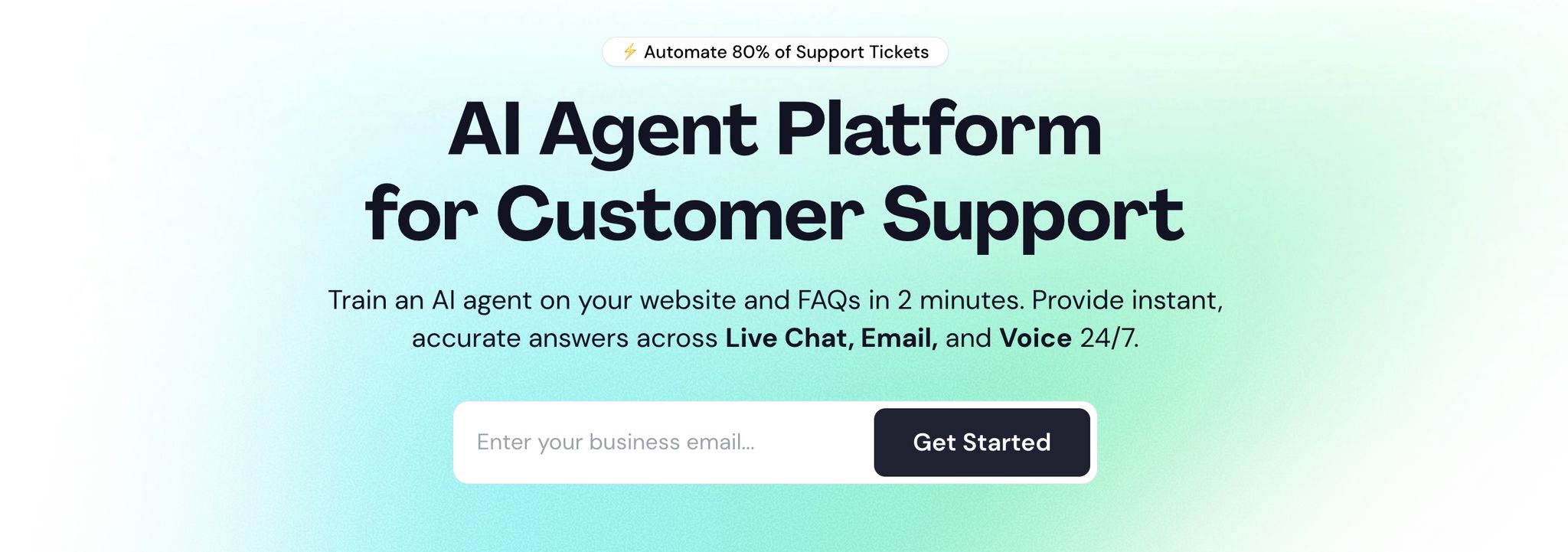
Quidget is built for teams that want to automate customer support quickly without dealing with enterprise-level complexity. It trains on your website, FAQs, and uploaded documents, then delivers instant answers across live chat, email, and voice. The platform also supports human handoff with full conversation context, works in 45+ languages, and connects with tools like Zendesk, Freshdesk, Slack, WhatsApp, and Calendly. Quidget positions itself as a no-code solution with setup in about 2 minutes, which makes it especially appealing for lean support and growth teams that need speed, multilingual coverage, and a simple launch process.
Pricing starts with a Pro plan at $99/month in Quidget’s savings calculator example, while the pricing page also offers a 7-day free trial, annual discounts, and an Enterprise plan starting at $599/month for higher-volume teams with custom integrations and onboarding. The paid plans include live chat, human handoff, multilingual AI, templates, integrations, instant translation, AI summaries, and API access, with higher tiers adding concierge setup, priority support, and a dedicated Slack channel.
The results already look strong. Softorino reduced overall support ticket volume by 35%, and Quidget now handles 60% of first-level responses for them. Sorare reported 30%+ fewer escalations after launching Quidget with Zendesk. JJESIM cut inbox volume by 40% and now resolves 75% of questions automatically, while also providing support in 45 languages. These examples position Quidget as a practical option for companies that want measurable reductions in repetitive support load without rebuilding their whole support stack.
Quidget is a strong fit for growing SaaS, eCommerce, and customer support teams that want fast deployment, hybrid AI + human support, and solid multilingual coverage. It looks especially well suited to businesses that are tired of repetitive Tier-1 questions and want to automate them without adding a heavy implementation project. The main tradeoff is that Quidget is still a newer, more focused platform compared with large legacy vendors, so organizations with very deep enterprise requirements may need the Enterprise tier or custom setup to match more complex internal workflows. That said, its positioning is clearly about getting value fast rather than forcing teams through a long rollout.
A short quote you can use at the end:
“Setting up Quidget was surprisingly quick … it’s been a game-changer for us.” — Alex Novak, Customer Success Manager at Softorino
2. Tidio
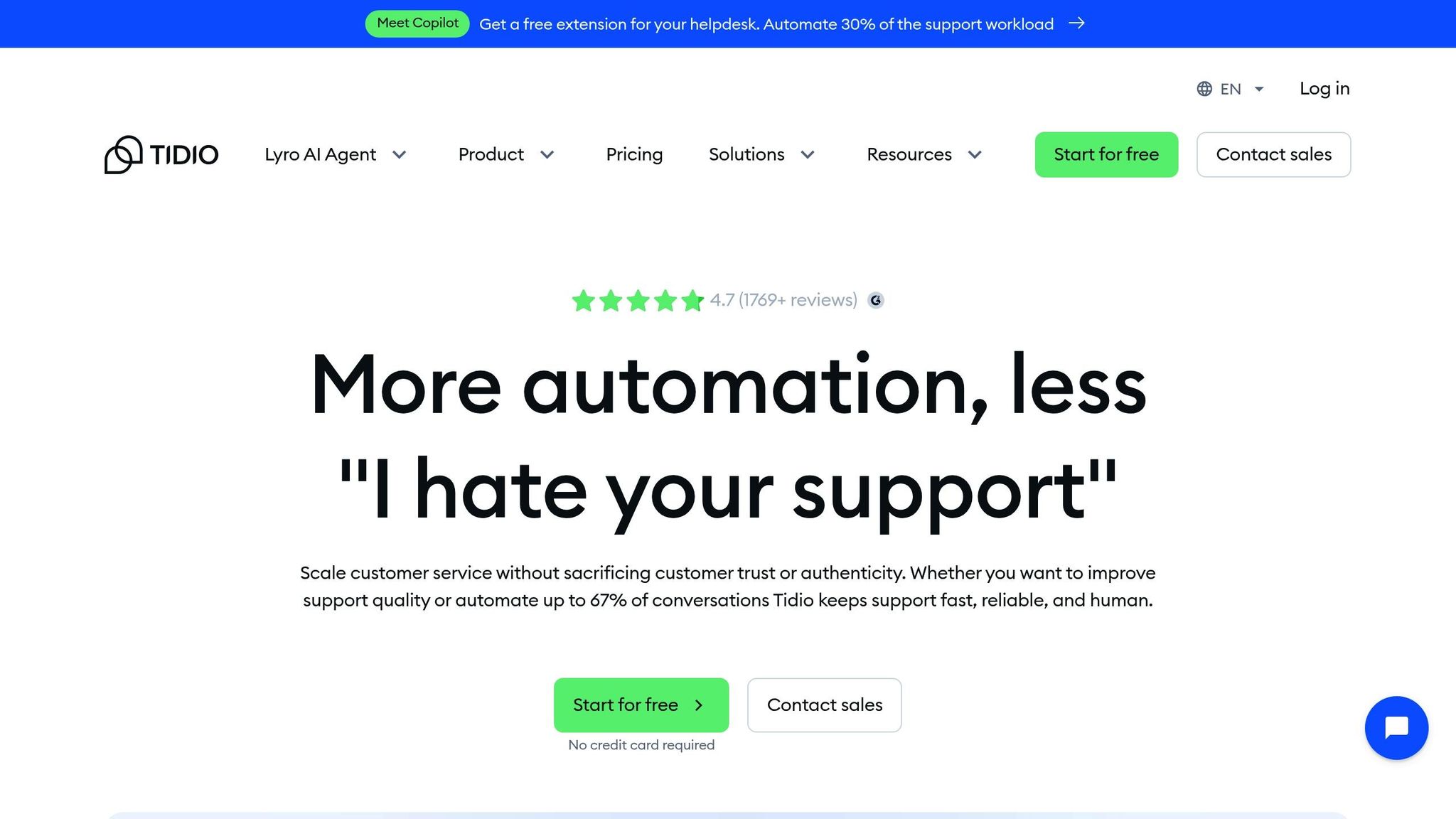
Tidio takes a different approach to pricing by focusing on conversation-based plans rather than charging per agent. This means you can add as many team members as you need without increasing costs – provided your conversation volume stays within your plan’s limits. Here’s a quick breakdown of the pricing:
- Free Plan: Includes 50 conversations.
- Starter Plan: Costs $24/month (billed annually) or $29/month for 100 conversations.
- Growth Plan: Around $180/month for 1,000 conversations.
- Plus Plan: Approximately $749/month for 5,000 conversations.
These plans grant access to Tidio’s multichannel features, making it a versatile option for businesses.
Tidio combines live chat, its AI tool Lyro, and multichannel messaging into a single inbox, integrating platforms like Instagram, Messenger, WhatsApp, and email. For ecommerce, it offers prebuilt workflows for tasks like abandoned cart recovery and order tracking. Its "Lyro Actions" feature allows the AI to retrieve order details or manage account-related tasks. For example, Swedish store Wulff Beltton improved customer satisfaction to 4.5/5 in 2025 by using Tidio’s AI for personalized user journey techniques like product recommendations and cart abandonment recovery. Similarly, UK-based eCatering automated 70% of inquiries about delivery and order tracking, enabling them to handle peak-hour demands without hiring extra staff.
With these features, Tidio is an excellent choice for small to mid-sized ecommerce teams aiming to streamline operations without increasing headcount (see more AI support tips for growing teams). Its no-code visual flow builder is user-friendly, allowing most stores to get up and running in about 20 minutes. However, the AI’s performance relies heavily on the quality of your existing FAQs and documentation. A weak knowledge base will limit its effectiveness. Additionally, Tidio doesn’t offer live product catalog syncing; instead, it uses keyword-based rules, which can restrict the flexibility of product recommendations.
"Tidio stands out because it avoids per-seat billing on core plans and scales primarily by conversations, which simplifies growth budgeting." – Jelisaveta Sapardic, Author
Keep an eye on your conversation volume – higher traffic could push you into a more expensive tier. For businesses with heavy traffic, it’s worth comparing Tidio’s conversation-based costs with seat-based alternatives like Zendesk ($19/seat) or Intercom ($29/seat).
3. Intercom
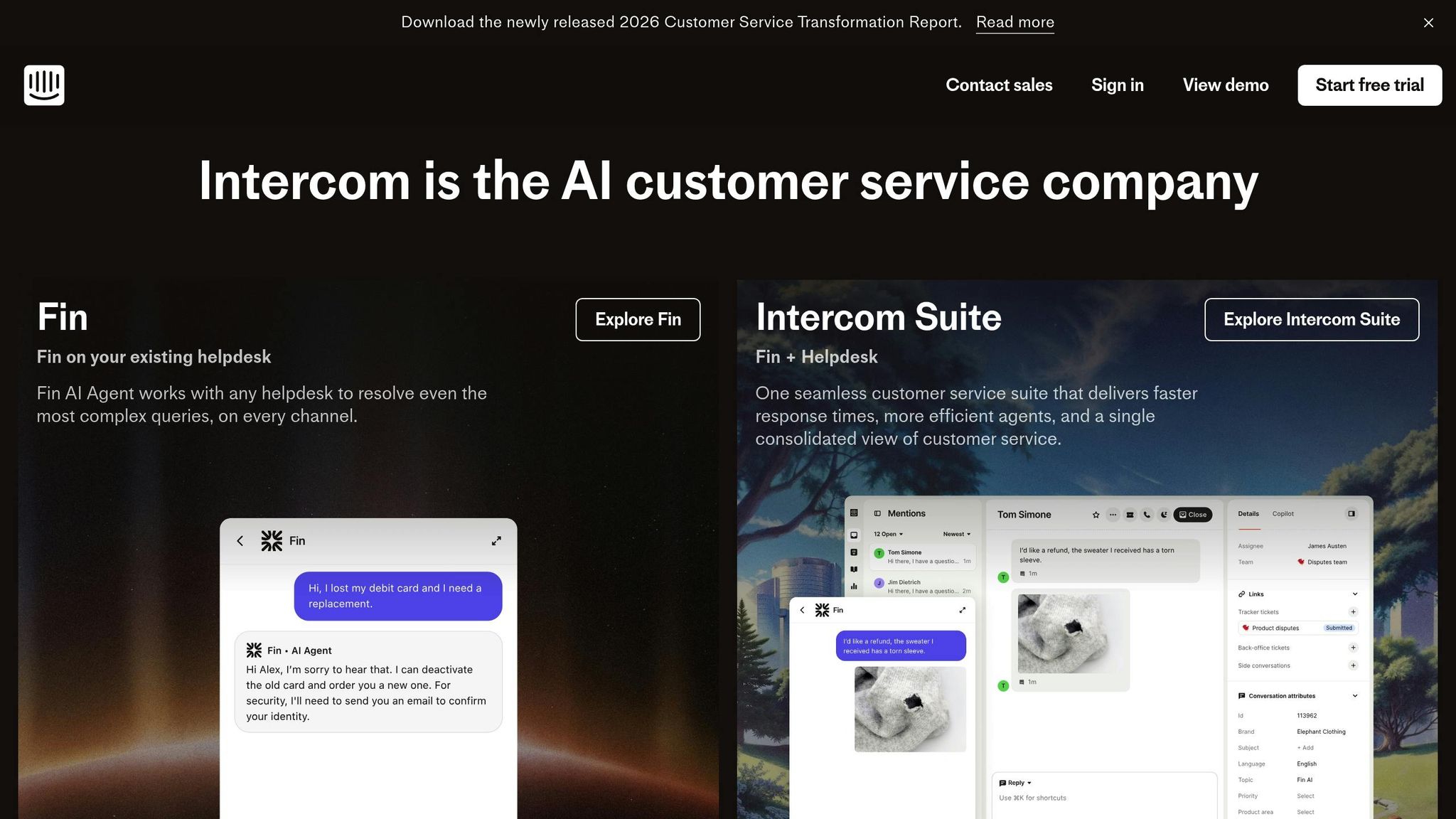
Intercom uses a seat-based pricing model divided into three tiers: Essential, Advanced, and Expert. Pricing starts between $39 and $74 per month, depending on the tier and team size. Here’s a quick breakdown of what each tier offers:
- Essential: Includes AI Compose and basic ticketing features.
- Advanced: Adds team inboxes and workflow automation.
- Expert: Offers custom reports, roles, and single sign-on capabilities.
Additionally, Intercom’s Fin, a GPT-4-powered assistant, bills per interaction. While it’s a powerful tool, costs can increase as interaction volume grows, making it better suited for teams comfortable with managing seat-based pricing and scaling costs.
One of Intercom’s standout features is its unified inbox, which merges customer conversations from multiple channels – like web chat, email, and WhatsApp – into a single view. This feature ensures support teams can maintain context, even during handovers. The platform also includes a workflow builder that automates tasks such as sending review requests, running upsell campaigns, or recovering abandoned carts. For detailed customer queries, Fin can pull answers directly from your help center, provided the documentation is thorough.
Intercom shines for mid-market and enterprise ecommerce teams, especially those needing advanced segmentation, detailed reporting, and integrations with platforms like Salesforce or HubSpot. However, for smaller stores generating less than $50,000 in monthly revenue, the platform might feel excessive. Smaller teams may also find its setup process challenging compared to simpler, plug-and-play solutions.
A potential downside is the complexity of setting up workflows or integrations, which can take days rather than hours. Costs can also escalate quickly with higher conversation volumes. Additionally, integration with certain third-party tools may be limited, so it’s worth evaluating compatibility before committing.
If you’re using Fin, keep an eye on per-interaction costs, especially as your traffic grows. These charges can add up fast, affecting your overall budget.
4. Ada CX
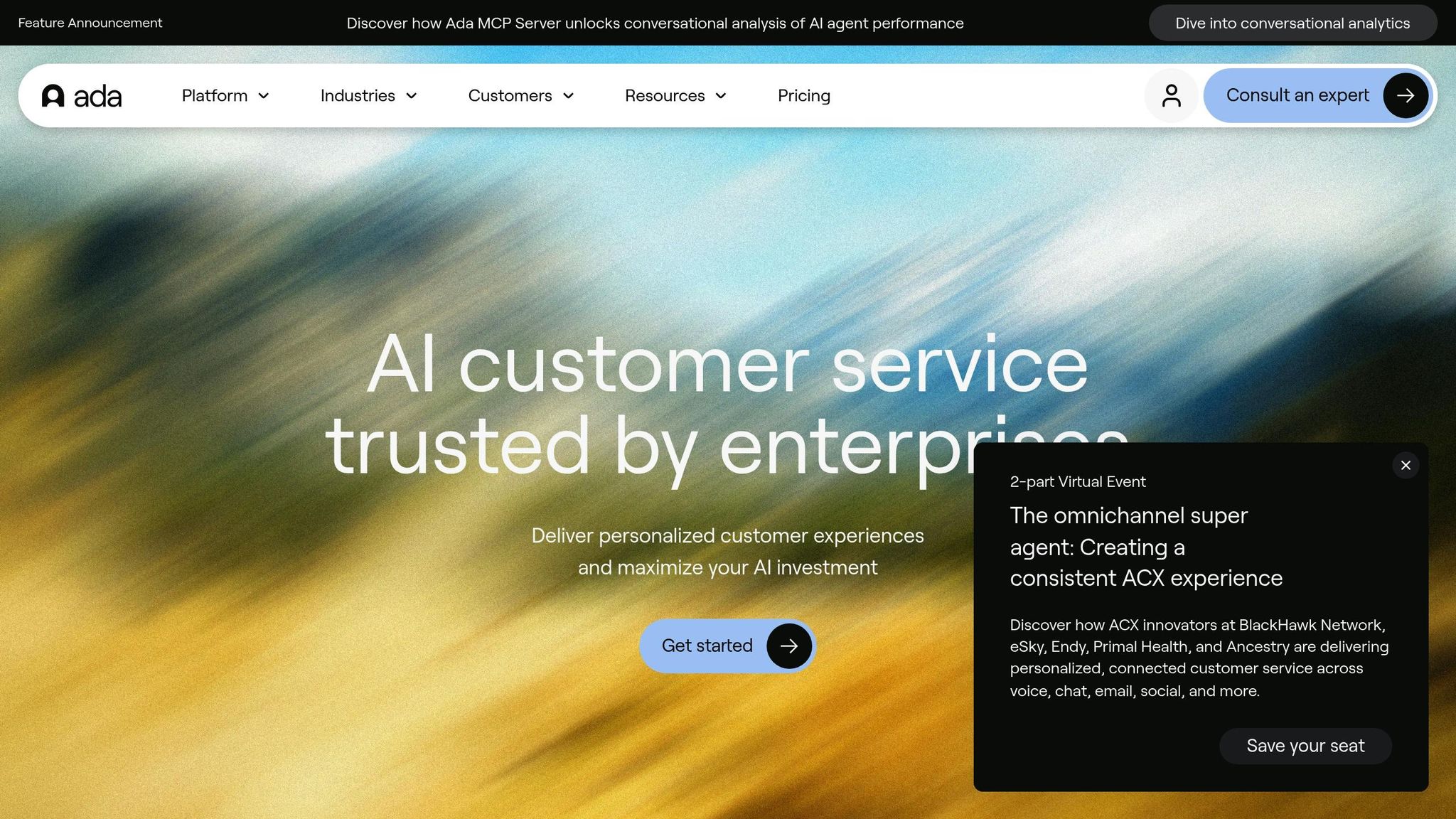
Ada CX follows a custom enterprise pricing model based on factors like monthly ticket volume and team size. According to industry reports, costs for high-volume ecommerce businesses can surpass $10,000 per month. The lack of transparent pricing often makes Ada one of the more expensive options in the market.
The platform supports multilingual engagement, claiming compatibility with over 50 languages (some sources suggest more than 100). It can be deployed across various channels, including web chat, WhatsApp, WeChat, and social media. Ada integrates with platforms like Shopify, Zendesk, and several CRMs, though it notably excludes WooCommerce. For businesses handling sensitive data, Ada ensures compliance with PCI, GDPR, and PIPEDA standards, making it a solid choice for enterprises requiring strict data security and governance.
Ada is particularly geared toward large-scale enterprise operations that need to handle massive customer interaction volumes while maintaining robust governance. However, for smaller businesses or those with lower interaction volumes, Ada’s enterprise-level focus may feel excessive.
Despite being marketed as a "no-code" solution, the platform requires weeks for setup. Many non-technical users report a steep learning curve. Time and effort are needed to design conversation flows and maintain a well-organized knowledge base. Additionally, its integration capabilities are less extensive compared to mid-market tools, which could pose challenges for businesses relying on niche third-party systems.
Another consideration is Ada’s AI accuracy, which can vary across different languages. This inconsistency may affect the quality of responses and, in turn, customer satisfaction in certain regions (learn how AI chatbots boost CSAT scores). For businesses needing quick implementation or operating on a smaller scale, Ada’s enterprise-oriented approach and lengthy setup process might not be the best fit.
5. Zendesk AI
Zendesk AI offers a tiered pricing structure, starting at $19 per agent per month for basic plans, which lack advanced automation. For more sophisticated features, plans begin at $55 per agent per month. These packages include a full customer service suite with ticketing, a knowledge base, phone support, and live chat.
One of Zendesk’s standout tools is the Answer Bot, which helps reduce repetitive queries by improving customer self-service. Additionally, the Flow Builder allows businesses to design custom conversation paths, enabling smoother interactions. When implemented well, Zendesk can handle up to 40% of recurring questions automatically. Major companies like Decathlon and L’Oréal use Zendesk to streamline complex support needs across multiple channels. However, achieving these results requires a significant setup effort.
Setting up Zendesk can be challenging. It often requires careful planning and configuration, taking about one to two weeks to get everything running. Integrating with platforms like Shopify or Magento may involve manual adjustments or custom API work. Teams without technical expertise might find the learning curve steep.
For businesses evaluating Zendesk, the trade-off lies between cost and ease of use. It’s a strong choice for growing companies and large retailers that need omnichannel support. However, smaller businesses may find themselves paying for features they don’t fully use, like phone support or advanced ticketing. The Answer Bot also struggles with open-ended customer questions unless paired with higher-tier automation or external AI tools.
Zendesk is well-suited for operations managing high volumes of support across email, chat, social media, and phone. Its unified Agent Workspace and detailed reporting tools can justify the cost for larger teams. On the other hand, smaller businesses focused mainly on chat might benefit from simpler, more affordable alternatives.
6. Shoply AI
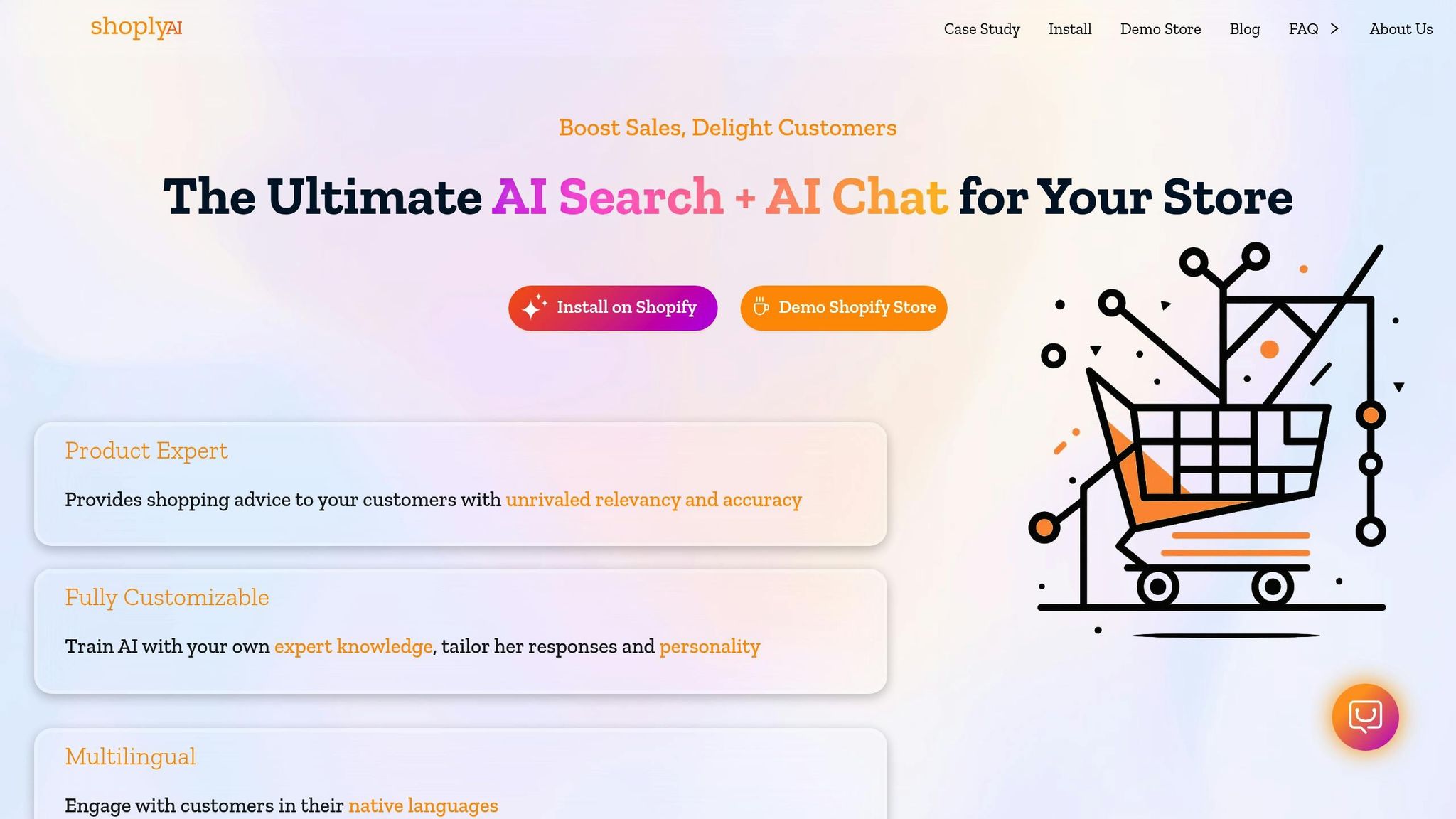
Shoply AI is a chatbot designed specifically for Shopify stores. It connects directly with Shopify, making it easy to handle tasks like automated product recommendations, cart recovery, and customer inquiries about inventory, shipping, and order status. The platform operates on a tiered pricing system.
For Shopify merchants, setting up Shoply AI is simple. Once the store is connected, the chatbot uses data from Shopify catalogs to provide answers to common customer questions. This seamless integration also enables key features like cart recovery, which is one of the platform’s standout offerings.
Cart recovery works by identifying abandoned carts and sending follow-up messages through chat or email. However, to maximize its effectiveness, merchants should invest time in customizing these messages to better engage customers.
While Shoply AI is a solid choice for small to mid-sized Shopify stores, it might not meet the needs of larger businesses. Its reporting tools and customization options are less robust compared to enterprise-level solutions. This makes it a trade-off between ease of use and the advanced features that bigger operations often require.
One limitation to keep in mind is scalability during high-traffic periods. Some users have noted slower response times during major sales events when customer interactions surge. If your store frequently runs promotions, it’s a good idea to test Shoply AI’s performance under heavy traffic before fully committing.
7. Engaige
As of February 2026, Engaige suffers from a lack of adequate documentation, which makes it challenging to evaluate. It’s often mistaken for Engati, a multi-channel platform starting at $12/month that supports both voice and text across more than 14 platforms. This review aims to address common questions for those considering Engaige.
If you’re exploring chatbot options, it’s essential to review the most up-to-date documentation from the provider. With newer or less-established platforms, public information can be scarce, making it tricky to assess critical ecommerce features like cart recovery tools or platform integrations.
Engaige currently lacks transparency in key areas like pricing, feature breakdowns, and user feedback. This makes it difficult to recommend for businesses of any size, as these gaps could negatively impact customer experience and revenue.
For ecommerce stores, it’s best to stick with chatbots that have a proven track record and well-documented capabilities. If you’re still considering Engaige, ensure you request a comprehensive demo and ask for case studies from businesses that match your store’s size and industry.
8. Tolstoy
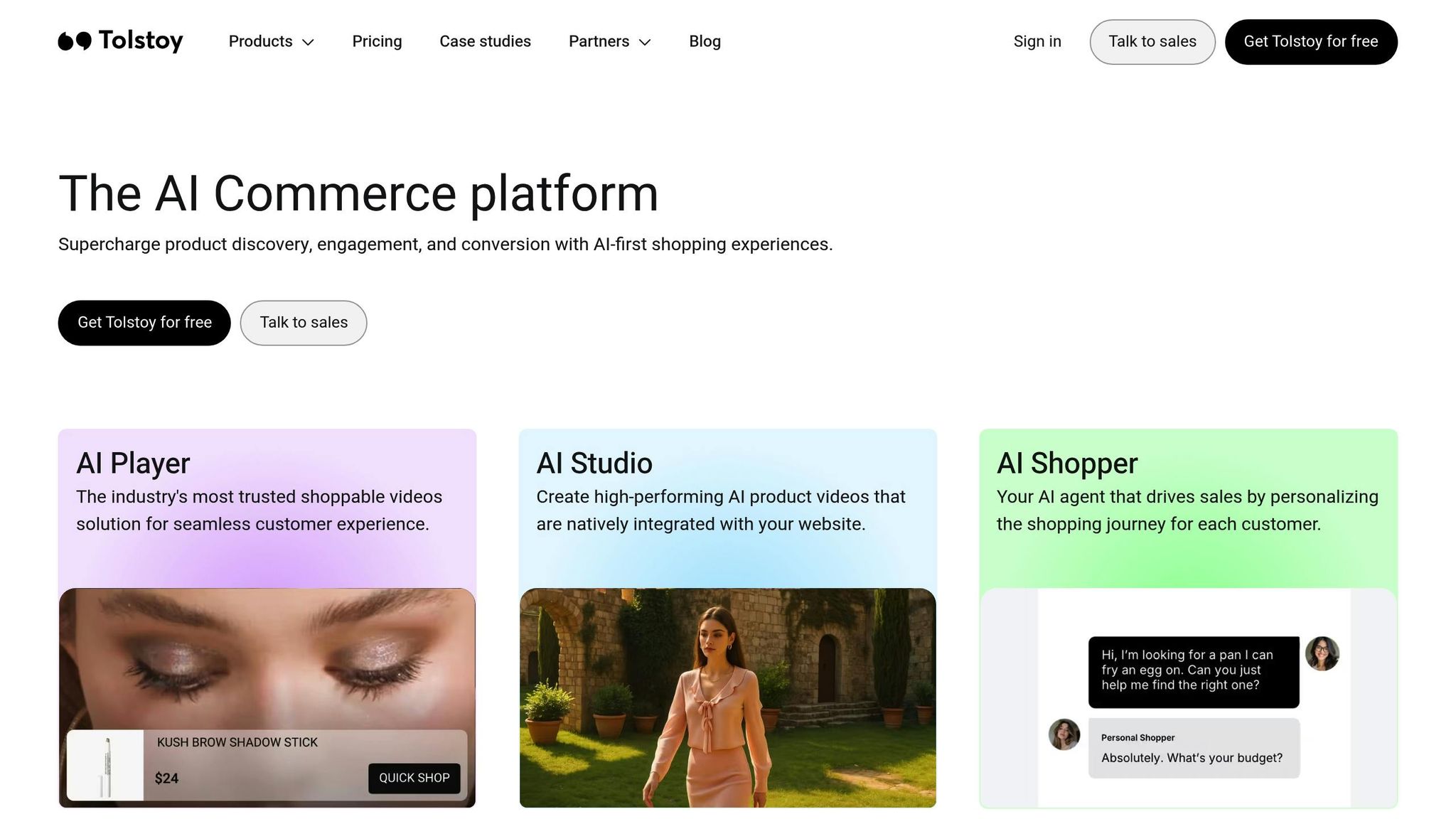
Tolstoy positions itself as an AI Sales Agent, focusing on pre-purchase interactions rather than acting as a traditional support chatbot. It’s designed to guide shoppers through finding products, selecting sizes, and completing purchases. With a free tier and a SaaS-based pricing model for advanced features, it’s a flexible option for businesses exploring AI-driven sales tools.
Its features are tailored for sales, including AI Shopper (for conversational product recommendations), AI Search, virtual try-on capabilities, and measurement-based sizing suggestions. Shoppers can even add items to their cart directly within the chat, streamlining the buying process. Additional tools like "Top Questions" on product pages and "Complete the Look" cross-sells are designed to boost average order values.
Tolstoy integrates seamlessly with Shopify and supports connections to platforms like Klaviyo, Gorgias, Attentive, GA4, and Tapcart. With its "zero setup" approach, it learns directly from your product catalog and brand guidelines, eliminating the need for time-consuming manual configurations.
This tool is particularly effective for apparel and fit-sensitive categories, where visual confidence and sizing guidance are crucial. For fashion brands struggling with fit-related returns, features like virtual try-ons and precise sizing recommendations can help address these challenges. However, Tolstoy is not designed to replace a full helpdesk. Tasks like order cancellations or shipping updates require integration with platforms like Gorgias.
One key limitation is its Shopify-first approach. If your store operates on WooCommerce, Magento, or other platforms, integration options are more restricted. Additionally, it lacks advanced ticketing and order management features found in tools like Zendesk or Gorgias. Tolstoy excels as a sales assistant while leaving complex support tasks to dedicated helpdesk solutions.
9. YourGPT
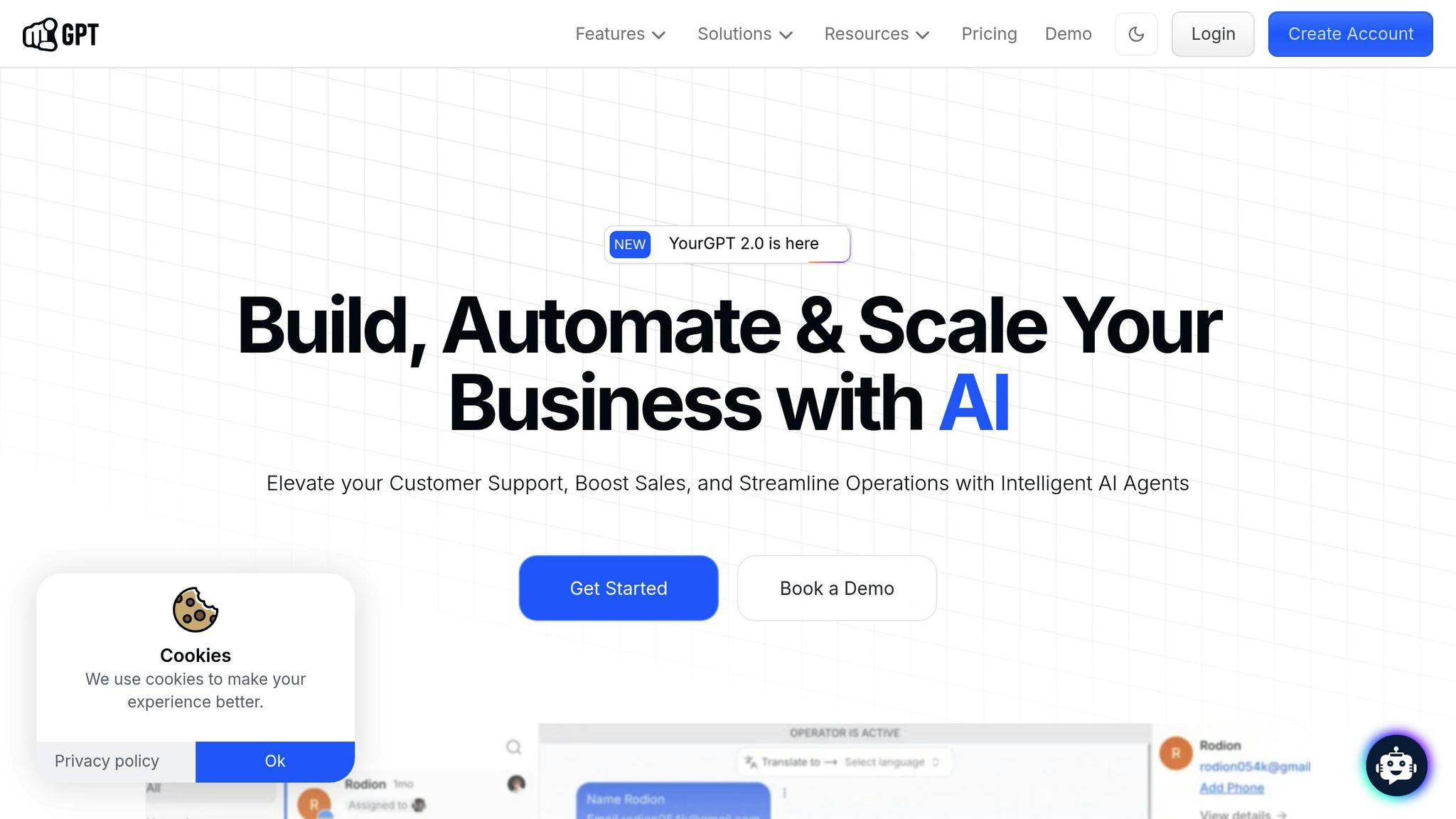
YourGPT is an AI platform designed to create autonomous agents for tasks like customer service, sales, and operations. Pricing starts at $39/month when billed annually. There’s also a free plan and a 7-day free trial, though advanced features are limited during the trial period.
One standout feature is its Voice AI, which handles both inbound and outbound calls. The platform can be deployed across multiple channels, including WhatsApp, Instagram, Facebook Messenger, Telegram, email, and mobile apps, and it supports over 100 languages.
YourGPT integrates seamlessly with Shopify, WooCommerce, and PrestaShop. Its no-code AI Studio allows users to create workflows for tasks like abandoned cart recovery and order status updates. The platform can also train its AI using data from sources like PDFs, Google Sheets, Notion, Confluence, and website URLs, ensuring alignment with your product catalog and brand guidelines. These features make it a versatile choice for ecommerce businesses.
This platform is particularly suited for small and midsize businesses that lack a dedicated technical team. However, the limited access to advanced features during the free trial might make it harder to evaluate complex workflows before upgrading to a paid plan. Users appreciate the convenience of having chat, voice, helpdesk, and analytics bundled into a single subscription.
If your business requires robust phone support and multilingual capabilities, YourGPT could be a great fit. On the other hand, businesses that prioritize web chat or advanced helpdesk integrations might find other platforms more suitable.
10. Amio
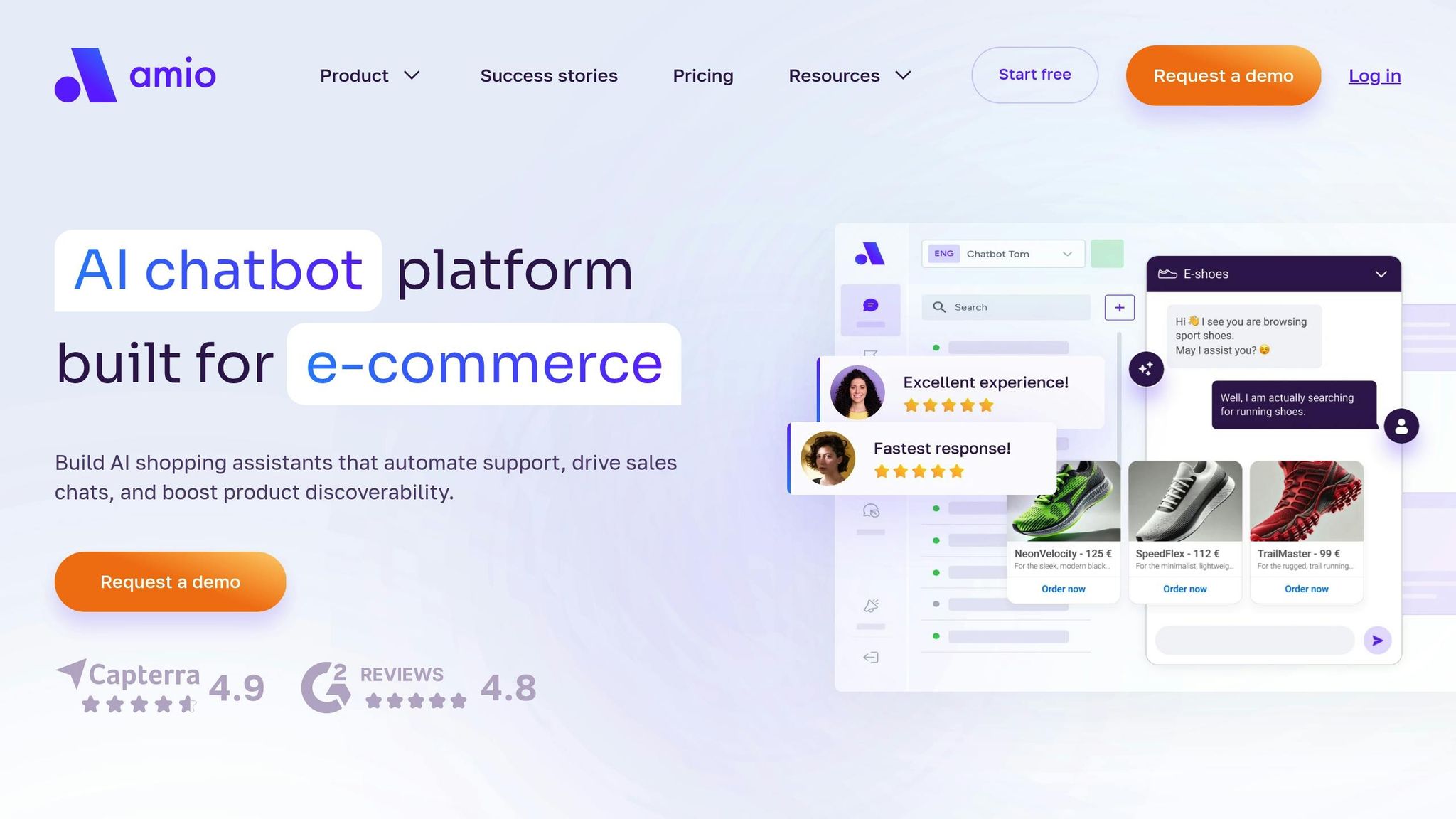
Amio is tailored for mid-sized ecommerce shops looking for a straightforward solution. Pricing starts at €150 per month (roughly $162), with costs based on message volume rather than the number of agent seats.
This platform connects directly to live product feeds and order systems, enabling it to answer questions like, "Are black jackets in size M available?" by pulling real-time inventory data. It automates up to 95% of customer inquiries, providing the benefits of 24/7 AI customer support, covering tasks like order tracking, returns, exchanges, and refunds. With native integrations for Shopify, Magento, and WooCommerce, as well as helpdesk tools like Zendesk and Gorgias, Amio is equipped to handle diverse ecommerce needs.
Designed for stores managing 50 to 500 support tickets per week, Amio may not be the best fit for shops handling fewer than 50 tickets weekly, as its starting price might seem steep compared to simpler tools. Additionally, it requires a 5 to 10-day deployment period with guided onboarding to get started.
The bot supports over 80 languages, including Spanish, French, Czech, and Swahili, and operates across web chat, WhatsApp, and Facebook Messenger. This makes it especially useful for brands expanding internationally or needing multilingual support.
For stores experiencing rapid growth and requiring robust automation without the complexity of enterprise-level solutions, Amio is a strong option. However, businesses needing instant setup or managing very low ticket volumes might find quicker or more budget-friendly alternatives more suitable.
What Most Companies Get Wrong When Choosing Ecommerce Chatbots
A common misstep for many ecommerce businesses is basing their chatbot choice solely on the monthly price. While cost is important, this approach often backfires when the bot lacks essential capabilities, like accessing real-time inventory data or processing refunds automatically. When these features are missing, support teams end up handling tasks that could – and should – be automated.
Another frequent mistake is opting for rule-based bots instead of AI-driven agents. Rule-based bots rely on rigid if/then logic, which struggles with natural language queries. For example, if a customer asks, "Do you have this in blue?" a rule-based bot might fail to understand the intent, whereas an AI agent can interpret the question and provide a relevant response.
Channel coverage is another area businesses tend to overlook. Many companies choose bots that only work on their websites, ignoring that 30–40% of customer inquiries now come through platforms like Instagram DMs, WhatsApp, and Facebook Messenger. If your chatbot isn’t equipped to engage customers on these channels, your team will need to rely on additional human support, creating inefficiencies.
Poor human handoff is yet another blind spot. Many budget-friendly bots can’t transfer the full conversation history to a live agent, forcing customers to repeat themselves. This can be frustrating for users, especially when "89% of consumers prefer support that combines AI efficiency with human empathy", as noted by YourGPT. Without seamless escalation, the overall customer experience takes a hit.
Lastly, many businesses see chatbots purely as support tools and miss out on their potential to drive sales. Features like abandoned cart recovery and personalized product recommendations can significantly boost revenue. Ecommerce stores that leverage chatbots for both support and sales often see 20–30% fewer abandoned carts and save up to 30% on support costs. Ignoring these capabilities means leaving money – and efficiency – on the table.
Key Takeaways
For smaller stores generating under $50,000 in monthly revenue, budget-friendly platforms like Tidio or Willdesk are worth exploring. Willdesk, for instance, starts at just $16.90/month and even offers a free plan for those keeping costs low.
As businesses grow, their needs shift. Mid-market and enterprise-level companies often require platforms with broader integrations and higher capacity. Options like Gorgias start at $10/month for 50 tickets, while Zendesk and Intercom begin around $55/month per agent. Keep in mind, setting up these platforms can take one to two weeks, but they come with advanced automation capabilities like order tracking and refund processing.
When making your final decision, here are some key points to keep in mind:
- Response Limits: Many free or lower-tier plans cap AI-driven interactions, which could leave you unprepared during traffic surges.
- Ecommerce Integration: Ensure the platform integrates seamlessly with your ecommerce system (e.g., Shopify, WooCommerce, Magento, or BigCommerce) to avoid additional development expenses.
- Human Handoff: During free trials, test how well the bot transitions conversations to live agents. A smooth handoff that includes the full conversation history is crucial – 89% of consumers value support that combines AI efficiency with human empathy.
Finally, consider bots that actively boost sales. Features like abandoned cart recovery and personalized product recommendations can reduce cart abandonment rates by 20–30% and cut support costs by up to 30%. Choose a platform that aligns with your business size, preferred channels, and growth plans.


