


Companies in 2026 are increasingly relying on AI customer service software to handle repetitive inquiries like "Where is my order?" or "How do I reset my password?" These tools automate up to 80% of support tasks, reducing costs and freeing up human agents for complex issues. With 91% of customer service leaders under pressure to adopt AI, platforms like Quidget, Intercom, Zendesk AI, Tidio, Freshdesk AI, Ada, Drift, and HubSpot AI are leading the way.
Key Features of Top Platforms:
- Quidget: Quick setup, multilingual support (45+ languages), and affordable plans starting at $79/month.
- Intercom: Advanced AI workflows, 80+ language support, and outcome-based pricing at $0.99/resolution.
- Zendesk AI: Deep integration with existing workflows, real-time translation, and pricing from $55/agent/month.
- Tidio: Budget-friendly, ideal for small businesses, with plans starting at $39/month.
- Freshdesk AI: Strong agent-assist tools and integration with Freshworks, starting at $15/agent/month.
- Ada: Enterprise-focused with robust multilingual capabilities and custom pricing.
- Drift: Designed for B2B lead generation, starting at $2,500/month.
- HubSpot AI: CRM-linked workflows, multilingual tools, and plans starting at $100/month.
Quick Comparison
| Platform | AI Handoff | Multilingual Support | Channels Supported | Pricing (Starting) | Best For |
|---|---|---|---|---|---|
| Quidget | Confidence-based | 45+ languages | Live chat, email, voice, WhatsApp | $79/month | SMBs, SaaS, e-commerce |
| Intercom | Seamless | 80+ languages | Web, mobile, in-app, email | $29/seat + $0.99/res | High-growth SaaS |
| Zendesk AI | Agent Copilot | Real-time translation | Email, chat, voice, social media | $55/agent/month | High-volume support teams |
| Tidio | Built-in live chat | Basic | Web, Facebook, Instagram, email | $39/month | Startups, small businesses |
| Freshdesk AI | Contextual | Real-time translation | Email, chat, phone, social | $15/agent/month | Mid-market teams |
| Ada | Confidence-based | 50+ languages | Chat, voice, email, SMS, social | Custom pricing | Enterprises with global presence |
| Drift | Lead routing | Limited | Website, in-app | $2,500/month | B2B sales teams |
| HubSpot AI | CRM-linked | Basic | Web chat, email | $100/month | HubSpot users |
Choose based on your business size, support volume, and specific needs like multilingual support or CRM integration.
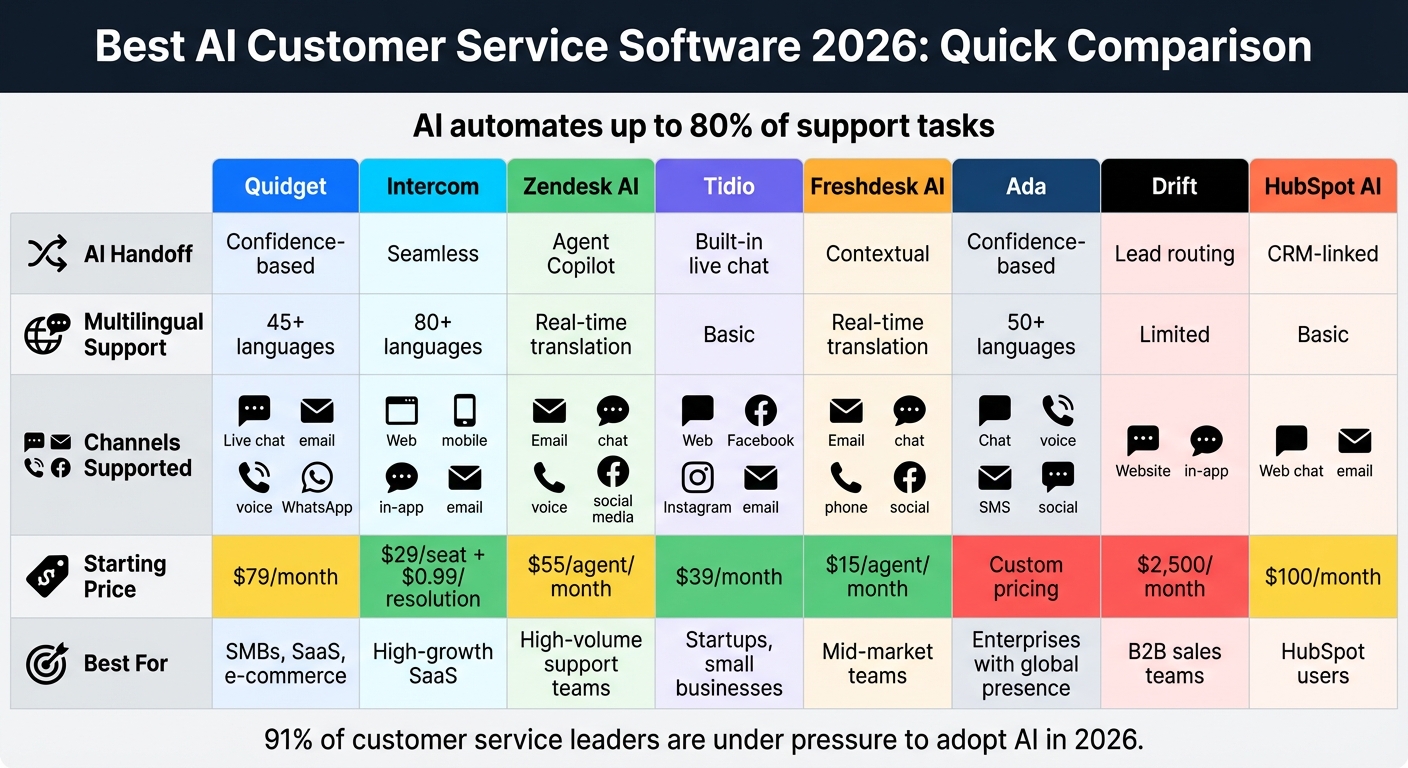
AI Customer Service Software Comparison 2026: Features and Pricing
9 Best AI Customer Service Software 2025 (AI Agents, Helpdesk, Voice Agents & More)
sbb-itb-58cc2bf
1. Quidget
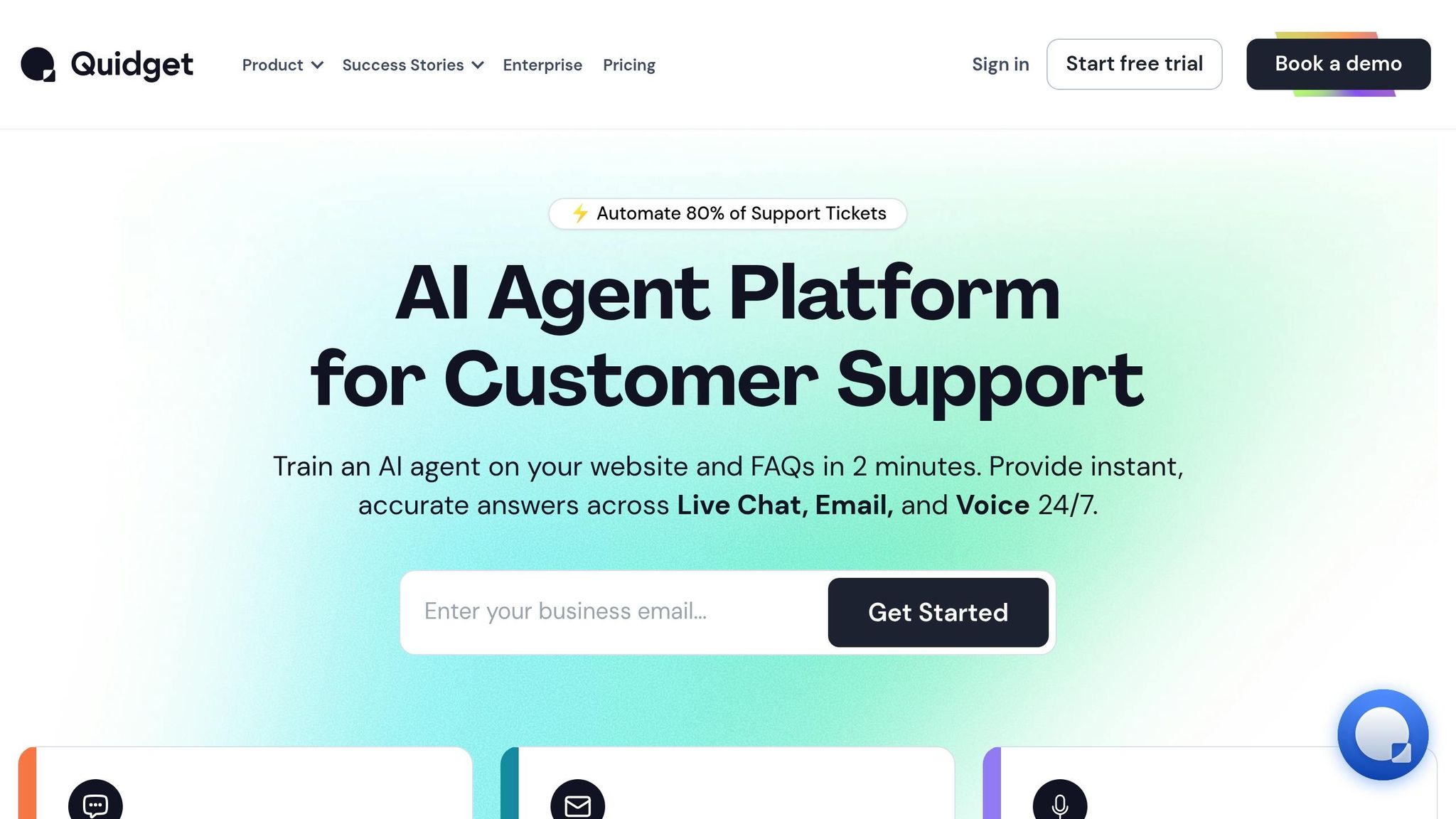
Quidget is an AI agent platform developed by SupportYourApp, a company with over 15 years of experience providing customer support to more than 250 businesses. Designed for small to mid-sized teams, Quidget automates repetitive support tasks with 24/7 AI customer support by training on your website content, FAQs, and documentation in about 2 minutes. It can handle up to 80% of common queries, such as "Where is my order?" or "How do I reset my password?"
What makes Quidget stand out is its hybrid AI + human model. When the AI encounters uncertainty, it immediately escalates the query to a live agent. This can be done through your existing helpdesk tools like Zendesk or Freshdesk, email, or Quidget’s built-in live chat. The conversation history is transferred seamlessly, so customers don’t have to repeat themselves.
"Setting up Quidget was surprisingly quick – It now handles 60% of our first-level responses, slashing wait times and letting our team focus on real customer needs. It’s been a game-changer for us."
– Alex Novak, Customer Success Manager, Softorino
AI + Human Handoff
Quidget uses confidence-based triggers to decide when to escalate a conversation. If the AI feels uncertain or encounters a query requiring empathy or nuanced understanding, it hands off the interaction to a human agent, complete with full conversation context. This approach helps avoid inaccurate responses and ensures customers get the right answers.
Multilingual Support & Omnichannel Deployment
Quidget supports over 45 languages with automatic language detection. It works across various channels, including website live chat, email (Gmail), voice, and messaging apps like WhatsApp, Slack, Telegram, and Viber, all while maintaining conversation context. If a customer starts chatting in Spanish, French, Japanese, or another language, Quidget continues in that language – even during handoffs to human agents.
Integration Ecosystem
Quidget integrates effortlessly with popular tools like Zendesk, Freshdesk, Calendly, Slack, and CRMs, making it easy to fit into your existing workflow. For example, its Calendly integration can qualify leads and schedule meetings automatically, while escalations to Zendesk or Freshdesk include full conversation histories. Additionally, Quidget prioritizes security with GDPR, ISO, and PCI compliance and end-to-end encryption.
Pricing Flexibility
Quidget provides a free tier for testing, with paid plans starting at $79/month for the Pro plan. This plan includes 10,000 AI responses, 5 chatbots, and 3 seats per chatbot. The Pro Plus plan is priced at $210/month, offering 50,000 responses, 50 chatbots, and branding removal. For larger needs, the Enterprise plan starts at $599/month and features custom limits and dedicated support. All plans come with a 7-day free trial, require no credit card for signup, and can be canceled anytime.
With its quick setup and strong integrations, Quidget is a great option for teams looking for efficient, no-code AI customer service solutions. Up next, we’ll explore how Quidget’s features compare to other AI tools in the market. You can also explore other AI-powered tools for customer service to see how they stack up.
Best for: Small businesses, SaaS companies, and e-commerce teams seeking fast implementation, multilingual capabilities, and smooth AI-to-human transitions without overhauling their current tools.
2. Intercom
Intercom is a customer service platform powered by AI, with its standout agent, Fin, designed to tackle complex, multi-step queries. By utilizing resources like help center articles, developer guides, and internal protocols, Fin manages to resolve over 81% of interactions. This capability has allowed teams to handle a 300%+ increase in customer demand without adding extra staff, resulting in annual savings estimated between $7.5M and $9M.
Fin excels in handling detailed workflows, such as processing refunds, updating account details, and troubleshooting technical problems through its specialized Fin Tasks and Procedures. For instance, Synthesia, an AI video company, scaled from 40,000 to 316,000 support requests in just four months. In six months, Fin resolved over 6,000 conversations, saved 1,300+ hours, and boosted self-serve support rates to an impressive 87%.
"Within six months, Fin had resolved over 6,000 conversations, saved the team over 1,300 hours and pushed self-serve support rates as high as 87%."
– David Morgan, Revenue Operations Manager, Synthesia
AI + Human Handoff
When Fin encounters an issue it can’t resolve or when a customer specifically requests a human, it initiates a handoff process. This workflow collects all relevant context before routing the query to a human agent via the Intercom Inbox. During this transition, the AI Copilot steps in to provide conversation summaries, suggest responses, and adjust tone, ensuring the handoff feels seamless. Additionally, Intercom supports external handoffs to tools like Zendesk, using API requests to create tickets in those systems.
Linktree experienced impressive results with Fin, resolving 42% of customer conversations within just six days. Similarly, Robin, a technical support provider, used Fin to achieve a 50% resolution rate for technical inquiries.
Multilingual Support & Omnichannel Deployment
Intercom supports 95 languages, offering real-time translation through its AI Inbox for agents. Fin operates seamlessly across multiple channels, including web chat, mobile apps (iOS/Android), email, WhatsApp, Facebook Messenger, Slack, SMS, and even phone support via Fin Voice, which handles calls with real-time listening and replies. This omnichannel capability ensures consistent support quality even as customer demand grows.
Integration Ecosystem
Intercom integrates with over 450 apps, including Salesforce, Jira, Shopify, Stripe, and Amazon S3. Its Data Connectors enable workflows to trigger actions in third-party systems, making it easy to fit into existing tech setups. The platform also employs the Fin Flywheel, a learning system that continuously trains on company-specific procedures and deploys updates across all channels. This integration-friendly design complements its ability to manage complex workflows effectively.
Pricing Flexibility
Intercom offers outcome-based pricing, where Fin costs $0.99 per successful resolution. A resolution is defined as a conversation not escalated to a human within 24 hours or one confirmed as resolved by the user. Base plans start at $29/month, with the AI Copilot available as an add-on for $35/month per user. While this model can be cost-efficient for teams with well-organized help centers, some users have noted challenges with unpredictable billing due to the per-resolution pricing structure.
Best for: High-growth tech companies, product-led SaaS businesses, and teams with a strong knowledge base seeking advanced AI workflows and extensive integrations. For organizations facing a surge in support requests, Fin provides scalable, efficient solutions to manage complexity without increasing team size.
3. Zendesk AI
Zendesk AI integrates directly into your existing Zendesk workflows, enhancing automation without requiring a separate AI platform. Instead of operating as a standalone tool, it works seamlessly within tickets, macros, and agent workspaces. This makes it a great fit for businesses that want to improve their support systems without transitioning to an entirely new platform.
With proper training on help center content and internal documentation, the AI agent can handle over 80% of customer interactions independently. A Forrester Total Economic Impact study found that organizations using Zendesk AI achieved a 301% ROI over three years. Additional benefits include a 92% reduction in email handling time and a 20% productivity boost for human agents using the Agent Copilot feature. Supporting 65 languages, the platform can detect a user’s native language through browser settings or input, enabling instant localized interactions. The next section explores how Zendesk AI’s deep integration enhances efficiency compared to traditional add-on AI solutions.
AI + Human Handoff
Zendesk takes a thoughtful approach to handing off tasks between AI and human agents. When specific triggers occur – like mentions of "fraud", "chargeback", or high frustration detected via sentiment analysis – the AI agent steps aside as the primary responder, seamlessly transitioning the case to a live agent through established routing processes. To ensure continuity, the platform passes along complete conversation transcripts, AI-generated summaries, detected intent, and customer sentiment to the agent workspace. Once the human agent resolves the issue and the ticket status changes from "Solved" to "Closed", the AI agent automatically resumes its role as the first responder for any follow-up interactions.
"Escalation is not failure. It’s the AI agent’s most important decision." – Ashu Dubey, CEO, Alhena
Integration Ecosystem & Pricing Flexibility
The Zendesk Marketplace provides access to thousands of prebuilt integrations, making it easy to connect with CRMs, ERPs, and documentation systems. Using intent and sentiment detection, Zendesk AI efficiently assigns tickets to the appropriate channels. This native integration ensures consistent performance across all communication platforms.
Pricing begins at $55 per agent per month for the Zendesk Suite Team plan, with advanced AI features available for an additional $50 per agent per month. While costs can increase for larger teams, the platform’s deep integration with tickets, macros, and reporting often delivers measurable returns that surpass standalone AI tools.
Best for: Businesses already using Zendesk that want an easy upgrade for their current workflows, high-volume support teams needing reliable enterprise-level performance, and organizations requiring omnichannel support across email, chat, voice, and social media.
4. Tidio
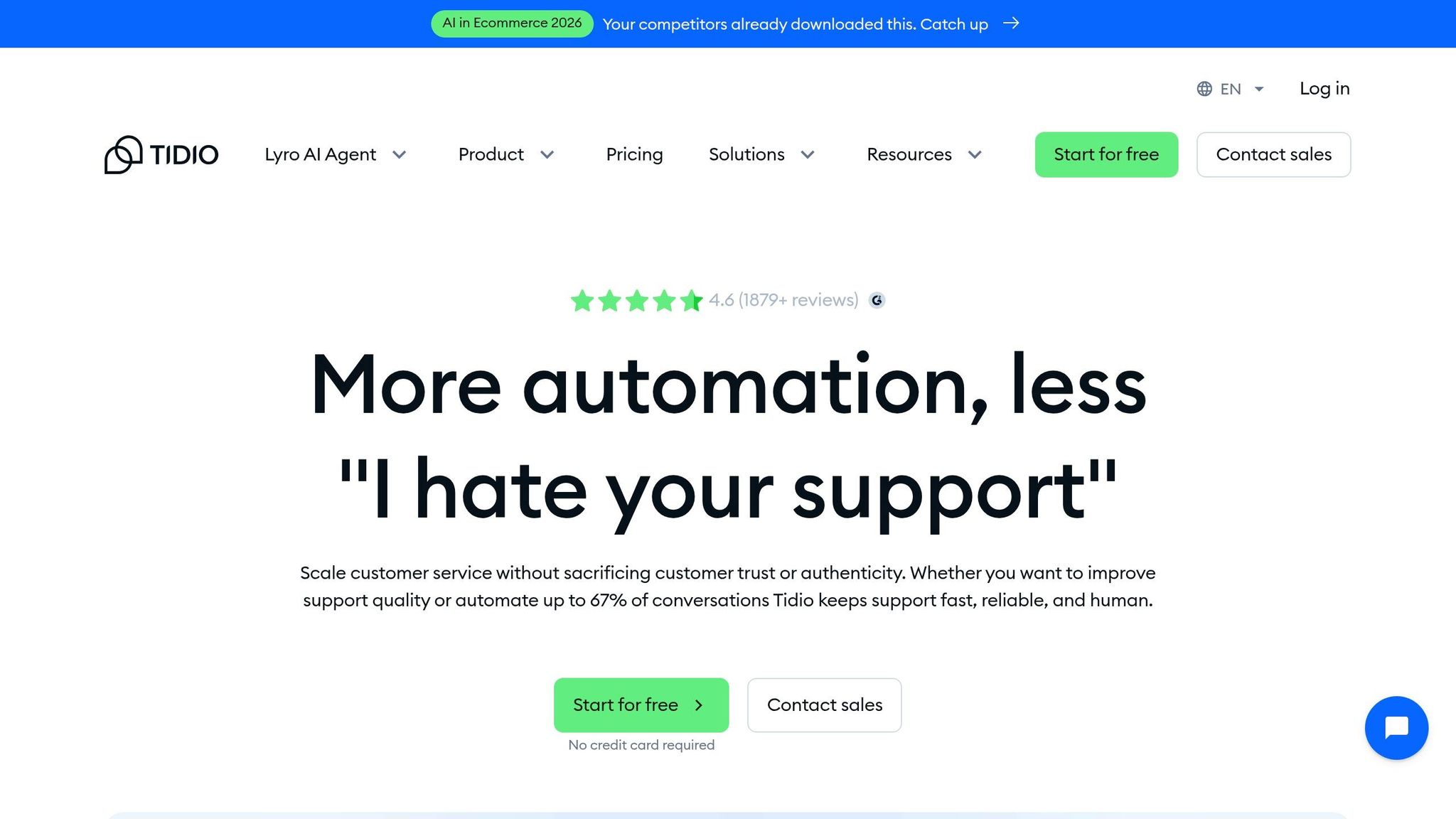
Tidio offers an affordable solution for small businesses and startups looking to incorporate AI automation without breaking the bank. Its standout AI feature, Lyro, uses Anthropic’s Claude to learn from your existing content and support tickets, enabling it to automatically handle FAQ queries. With over 300,000 active users as of 2026, Tidio has earned a reputation for being deployable in a single day.
The platform combines a visual, no-code chatbot builder for creating structured workflows with Lyro’s natural language capabilities for handling open-ended queries. This hybrid setup allows businesses to design rule-based flows for tasks like lead qualification while leaving complex customer questions to the AI. Reported automation rates range from 40% to 89%, averaging 67%. For instance, Tailfin achieved a 71% resolution rate, saving 400 hours of manual support in just 30 days after implementing Lyro. Similarly, Your KAYA automated 75% of inquiries, and ADT Security increased conversion rates from 44% to 61%.
AI + Human Handoff
Tidio’s hybrid design ensures smooth transitions between AI and human agents. When Lyro encounters a query outside its training or requires specialized attention, it seamlessly routes the conversation to a live agent. Importantly, it maintains the conversation’s context, allowing human agents to pick up without missing a beat. Tidio’s pricing model is conversation-based, starting at $39 per month for 100 Lyro conversations, making it scalable based on usage rather than team size.
Omnichannel Deployment & Integration Ecosystem
Tidio supports multiple communication channels, including website chat, Facebook Messenger, Instagram, Email, and WhatsApp. It also integrates directly with platforms like Shopify, WooCommerce, WordPress, and BigCommerce, which is particularly useful for e-commerce businesses needing order-related integrations. Additional connections with HubSpot, Salesforce, and Mailchimp streamline CRM and marketing workflows. With setup taking just 30 minutes, Tidio emphasizes efficiency. A free tier covering 50 conversations is also available, so businesses can test its capabilities before committing to a paid plan.
Best for: Startups and small-to-medium businesses looking for cost-effective AI automation with quick setup, especially e-commerce stores on platforms like Shopify or WordPress that need native integrations for order tracking and product inquiries. Teams seeking to implement AI support without technical hurdles will also find Tidio’s rapid deployment appealing.
5. Freshdesk AI
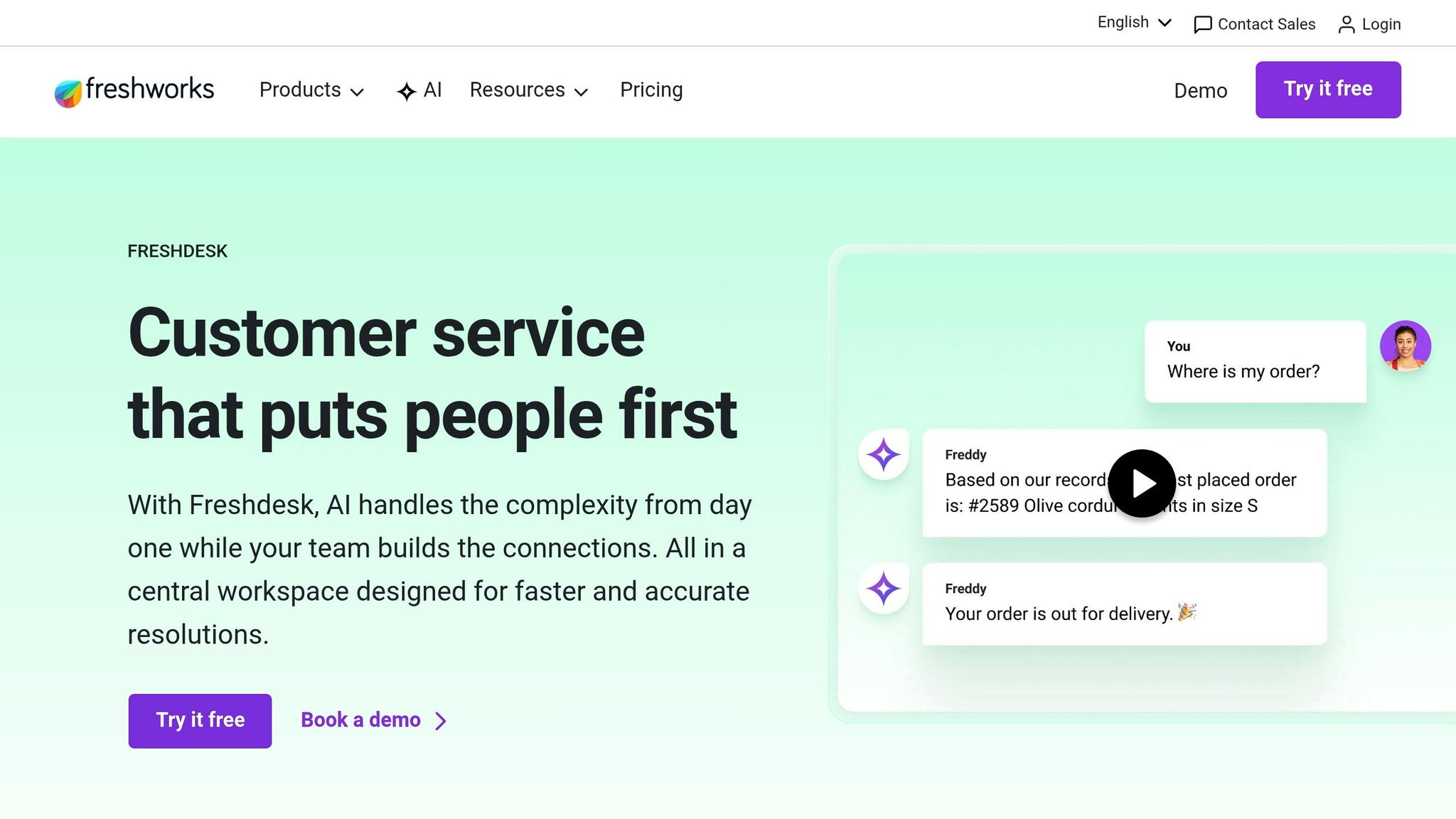
Freshdesk AI, powered by Freddy AI, is tailored for mid-market teams and trusted by over 60,000 companies worldwide. It combines traditional helpdesk ticketing with advanced AI tools to streamline support operations. With Freddy Copilot, agents get quick access to summaries, sentiment analysis, and suggested replies, offering a strong starting point when transitioning from bot-handled interactions.
The AI Agent takes care of over 80% of routine tasks, such as password resets, order status inquiries, and refunds. For example, iPostal1 reported a 99% reduction in customer interaction time after implementing Freshdesk’s automation tools. The platform also uses intelligent routing to categorize and prioritize tickets, ensuring agents can focus on what matters most.
AI + Human Handoff
Freshdesk excels in managing the shift from AI to human agents. Its contextual escalation ensures customers never have to repeat themselves. When Freddy AI encounters a complex query, it transfers the full conversation history – complete with summaries and sentiment analysis – to a human agent. This smooth handoff works across email, chat, and social media, providing a consistent experience no matter the channel. To maximize its efficiency, it’s crucial to keep your knowledge base updated, as Freddy AI relies heavily on existing documentation.
Integration Ecosystem & Pricing Flexibility
Freshdesk AI’s integration options and pricing structure add to its appeal. The platform supports over 1,000 pre-built integrations with tools like Salesforce, HubSpot, Shopify, Slack, and Jira. It also works seamlessly within the broader Freshworks ecosystem, including Freshchat and Freshservice, for a unified support experience. Pricing starts with a free tier (up to 2 agents) and scales to plans costing $15, $49, and $79 per agent/month. AI usage is billed separately at approximately $100 per 1,000 Freddy AI Agent sessions. Basic configurations can be set up in just 2 to 4 hours, making deployment quick and straightforward.
Best for: Mid-market teams and growing businesses seeking affordable AI automation paired with strong agent-assist features. Companies already using Freshworks products or those needing extensive third-party integrations will find it particularly beneficial. With a 4.4/5 G2 rating, Freshdesk AI strikes a good balance between cost and functionality, though some advanced AI features are only available in higher-tier plans.
6. Ada
Ada has earned its place among leading AI customer service platforms, delivering enterprise-level performance. Supporting over 350 companies and handling 5.5 billion interactions worldwide, it’s a trusted choice for large-scale operations. Its Reasoning Engine™ ensures consistent logic and brand tone across multiple channels like voice, email, SMS, WhatsApp, and web chat. Ada boasts an 83% automated resolution rate (though real-world results are often 30–50%), with success stories such as Tilt (84%) and Life360 (70%) showcasing its capabilities.
AI + Human Handoff
Ada simplifies the transition from AI to human agents with its "Fetch Chat Metadata" block, which collects transcripts, summaries, and customer details for smooth handoffs. The platform integrates seamlessly with tools like Zendesk and Salesforce, enabling real-time chat transfers or asynchronous ticket creation. For email, Ada’s SMTP Connector supports thread continuation, ensuring human agents can respond directly from the same support address without disrupting conversations. On voice channels, the "Transfer Call" block routes calls to contact centers via phone numbers, SIP addresses, or integrations with systems like Amazon Connect and Aircall.
Multilingual Support
Ada shines in its multilingual capabilities, offering support for 63 web chat languages, around 50 for email, and 8 for voice (including English, Dutch, French, German, Italian, Spanish, Swedish, and partial support for others). For key languages like Arabic, Chinese Simplified, and Portuguese, Ada uses LLM-based translation to ensure greater contextual accuracy compared to standard machine translation. The platform automatically detects languages and even allows users to switch mid-conversation. Right-to-left languages, such as Arabic and Hebrew, benefit from tailored UI adjustments, including flipped interface components.
Omnichannel Deployment & Integration Ecosystem
Ada’s Conversation Hub and Reasoning Engine™ ensure consistent responses across platforms like WhatsApp, SMS, Instagram, and in-app messaging. It integrates with over 17 knowledge sources, including Zendesk Guide, Salesforce, Guru, and Shopify, enabling AI agents to handle complex tasks like processing refunds, verifying identities, and updating orders. For instance, Cebu Pacific revamped its AI agent "Charlie" with Ada, cutting wait times to under one minute and achieving a 50% boost in CSAT scores. Similarly, IPSY leveraged Ada’s integration with Medallia to streamline workflows and deliver personalized customer care.
Here’s how Ada has impacted users:
"By transforming Charlie into a generative AI agent, we’ve achieved faster resolutions, reduced wait times to under a minute, and over 50% higher CSAT."
- Candice Iyog, Chief Marketing & Customer Experience Officer, Cebu Pacific
Pricing Flexibility
Ada operates on a quote-based enterprise model, with annual costs typically ranging from $30,000 to over $300,000. Its consumption-based pricing ranges from $1.00 to $3.50 per AI resolution. Full-scale enterprise implementation takes 8–16 weeks, but Ada’s drag-and-drop builder has earned a 9.0/10 ease-of-use rating on G2. The platform also holds an impressive 4.6/5 G2 rating from 169 reviews, with customer success support scoring 9.4/10.
Best for: Large enterprises handling 300,000+ annual conversations and relying on tools like Zendesk or Salesforce. It’s particularly suitable for companies needing advanced multilingual support and complex workflow automation. However, its high cost and lack of a self-serve free trial may deter smaller businesses.
7. Drift
Drift is built specifically for conversational marketing, prioritizing lead qualification, intent detection, and pipeline development for B2B sales teams. With over 5,000 companies in the B2B SaaS space using Drift, it has become a tool of choice for identifying high-intent visitors and connecting them with sales representatives. This focus on lead generation makes Drift stand out in the realm of sales pipeline tools.
AI + Human Handoff
Drift’s AI is equipped with intent detection to identify valuable visitors the moment they arrive on your site. Once a lead is qualified or a need is identified, the system routes them to the appropriate sales or support representative. This combination of AI and human interaction ensures that the initial qualification and scheduling of meetings are automated, while human agents can step in for more complex interactions. This approach reflects Drift’s commitment to making B2B sales processes more efficient.
Multilingual Support
Drift supports over 50 widget languages, but its core AI and admin features are primarily available in English. While you can customize the widget’s text and features like meeting scheduling, bot flows and message nodes must be manually translated for each language. Default fallback messages are in English, requiring manual adjustments for localization. Compared to platforms like Zendesk or Intercom, this makes Drift less equipped for handling multilingual workflows.
Integration Ecosystem
Drift integrates seamlessly with popular tools like Salesforce and HubSpot, enabling features such as account-based marketing and real-time lead scoring. It has received a 4.4/5 rating on G2 (based on over 1,100 reviews) and 4.5/5 on Capterra (from more than 190 reviews). While users appreciate its strong focus on B2B sales and CRM capabilities, some have noted its high cost and limited suitability for customer support tasks. These integrations and advanced features help position Drift as a premium platform, reflected in its pricing.
Pricing Flexibility
Drift’s pricing starts at $2,500 per month, making it one of the more expensive options on the market. Its pricing is based on the platform’s ability to deliver sales ROI rather than a per-user model. Multi-language functionality requires the FY22 Premium plan or higher, and setup typically takes a few days, which might not suit smaller teams or startups with limited resources. Drift is ideal for B2B SaaS companies with active sales teams that rely on website conversations as a key sales channel.
Best for: B2B SaaS companies with dedicated sales teams aiming to convert website visitors into qualified leads. Drift shines in conversational marketing and lead routing but may not be the best choice for teams focused on handling customer support tickets or managing high inquiry volumes.
8. HubSpot AI

HubSpot AI, branded as Breeze, is tailored for businesses already using HubSpot’s CRM ecosystem. It integrates customer service tools directly with your marketing, sales, and service data. The standout feature? Unified customer context. When a conversation escalates to a human agent, they instantly access the full customer history – no need to juggle multiple tools. This makes HubSpot AI a strong choice for teams seeking AI assistance without adding another vendor to their tech stack.
AI + Human Handoff
HubSpot AI simplifies transitions between AI and human agents with automatic ticket summaries, saving agents from sifting through lengthy chat histories. By leveraging CRM data – like deal status, lifecycle stage, and account history – it ensures escalations are routed to the right person efficiently. The "Smart Handoff" feature steps in when the AI’s confidence is low or when specific conditions are met, ensuring complex issues land with the appropriate representative. This feature is particularly useful for teams managing both sales and support, as the AI distinguishes between prospects and existing customers. Combined with multilingual and integration capabilities, the handoff process feels seamless.
Multilingual Support
Breeze Customer Agent detects a visitor’s language from their first message and responds in kind. Teams can also customize the AI to handle specific languages based on their operational needs. Beyond conversations, Breeze AI uses DeepL to translate website pages and blog posts into over 30 languages, enabling teams to review and publish localized content. This multilingual efficiency delivers measurable results: support teams using Breeze AI resolve tickets 39% faster, with top performers automating over 65% of conversations – and some reaching an impressive 90%.
"We have lowered the number of tickets handled by customer support by 77% while simultaneously improving the conversion rate through 24-hour support. Breeze customer agent is a key tool for generating revenue and increasing customer satisfaction."
– Pietro Ripanti, Chief Marketing Officer, Nutribees
Integration Ecosystem
HubSpot AI’s integration capabilities take its efficiency to the next level. By natively connecting Marketing, Sales, Service, Content, and Data Hubs, the platform ensures every customer interaction is linked, giving the AI full context of prior touchpoints. It also syncs with over 2,000 third-party tools, including Jira, SurveyMonkey, Facebook Messenger, and Salesforce (for Professional and Enterprise users). The results speak for themselves: Agicap saved 750 hours per week and boosted deal velocity by 20%, while Sandler experienced 25% more engagement and a 4x increase in sales leads.
Pricing Flexibility
HubSpot AI offers pricing options to suit different needs. The free tier includes basic CRM features, live chat, and a simple AI chatbot builder. For more advanced tools, Service Hub Professional starts at $100/month per seat, offering the Breeze Customer Agent and Knowledge Base features. Service Hub Enterprise, at $150/month per seat, adds advanced features like skills-based routing and interactive voice response. AI features operate on HubSpot Credits, which are included in Professional and Enterprise plans, with additional credits available for purchase. Though HubSpot’s AI customer service rating is 3.8/5 – lower than platforms like Intercom (4.5/5) – it stands out for its unified approach, ideal for teams already using HubSpot.
Best for: Businesses already leveraging HubSpot for marketing or sales and looking to integrate AI customer service without adopting a separate platform. While it may not rival Zendesk or Intercom for dedicated support features, its CRM-linked workflows and unified customer data offer strong value.
Feature Comparison
When it comes to choosing an AI customer service platform, the right fit depends on the features that align with your priorities. The eight platforms we’ve discussed offer distinct approaches to AI and human collaboration, multilingual capabilities, deployment options, integrations, and pricing models. These features tie directly to factors like ease of setup, training efficiency, handoff quality, and scalability.
AI + human handoff is a key indicator of platform maturity. Solutions like Quidget, Intercom, and Ada ensure that human agents receive the full conversation history, sparing customers from repeating themselves. Zendesk and Freshdesk take it a step further with Agent Copilot features, which provide summaries and suggested replies to assist agents. Drift, on the other hand, is designed to route high-intent leads directly to sales teams.
Multilingual support is essential for companies with a global presence. Intercom leads the pack with support for over 80 languages, while Ada supports 50+ languages and Quidget offers 45+ with automatic detection. Zendesk and Freshdesk include real-time translation, while HubSpot AI provides basic multilingual tools. These features enable businesses to cater to diverse audiences effectively.
Omnichannel deployment separates platforms meant for enterprises from those better suited for smaller businesses. Zendesk AI and Ada cover a wide range of channels, including email, chat, voice, SMS, and social media. Quidget supports live chat, email, voice, WhatsApp, Slack, Telegram, and Viber. Meanwhile, Tidio and HubSpot AI focus on web chat and email, and Drift specializes in website and in-app conversations. This variety ensures that businesses of all sizes can find a platform that fits their communication needs.
Pricing models also vary significantly. Zendesk and Freshdesk use per-agent pricing, with costs ranging from $55–$115 per agent/month and $15–$79 per agent/month, respectively, often with additional fees for AI features. Intercom adopts an outcome-based model, charging $29–$85 per seat plus approximately $0.99 per AI resolution. Quidget offers a free tier and paid plans starting at $79/month for 10,000 AI responses, while Drift is geared toward larger budgets with plans starting at $2,500/month. For cost-conscious SMBs, Tidio and Quidget provide more affordable options.
| Platform | AI + Human Handoff | Multilingual Support | Omnichannel Deployment | Key Integrations | Pricing (Starting) |
|---|---|---|---|---|---|
| Quidget | Passes full conversation history to helpdesks or built-in chat | 45+ languages (auto-detect) | Live Chat, Email, Voice, WhatsApp, Slack, Telegram, Viber | Zendesk, Freshdesk, Slack, WhatsApp, Calendly | Free tier available; Plans from $79/mo |
| Intercom | Seamless handoff with full history preservation | 80+ languages | Web, Mobile, In-app, Email | Salesforce, HubSpot, Jira, 450+ apps | $29/seat + $0.99/resolution |
| Zendesk AI | Agent Copilot offers context and insights for human takeover | Real-time translation support | Email, Chat, Voice, Social, Messaging | 1,000+ Marketplace apps | $55/agent + $1.00/resolution |
| Tidio | Seamless escalation via built-in live chat | Basic multilingual support | Web, Facebook, Instagram, Email | Shopify, WordPress, WooCommerce | $29/mo + $39/mo for AI |
| Freshdesk | Freddy Copilot assists agents with summaries | Real-time translation | Email, Chat, Social, Phone | 1,000+ apps in Freshworks ecosystem | $15/agent + usage fees |
| Ada | Handoff triggered by low AI confidence and emotion | 50+ languages natively | Chat, Voice, Email, SMS, Social | Salesforce, Zendesk, Shopify | Custom pricing |
| Drift | Routes high-intent leads to sales reps | Not specified | Website, In-app | Salesforce, Marketo | $2,500/month |
| HubSpot AI | Unified with CRM for full customer context | Basic multilingual support | Web Chat, Email | Native HubSpot Ecosystem | Free CRM; Service Hub from $100/mo |
Next, we’ll break down how these features translate into value for various business needs.
How to Choose the Right AI Customer Service Software
Picking the best AI customer service platform starts with assessing your current support needs and where you’re headed. If your monthly conversation volume is under 200, look for affordable tools that can be deployed quickly. For 200–1,000 conversations, focus on balancing cost and quality. If you’re handling over 1,000 conversations, prioritize solutions with enterprise-level reliability and omnichannel capabilities. This step-by-step approach ensures your choice aligns with your team’s technical skills and resources.
Your team’s technical expertise is just as important as your budget. Smaller teams without developers should lean toward no-code platforms like Quidget or Tidio, which can be up and running in under an hour. These tools are perfect for teams that need fast, hassle-free implementation. On the other hand, larger organizations with IT support can manage platforms that require more setup time but offer advanced customization options.
Before making a commitment, take a closer look at your support data from the past 90 days. Identify the 20% of inquiries that take up 80% of your agents’ time. These repetitive, straightforward issues – like order tracking or password resets – are ideal for automation. Start small with a pilot program targeting one use case to test the system’s accuracy. During this phase, challenge the AI with complex questions to ensure it can handle them and transition smoothly to human agents when needed.
"The difference between a good and bad deployment is not the model. It is how the system handles confidence, routing, and knowledge freshness."
Another critical step is preparing your content. Clean up your FAQs and documentation to remove inconsistencies, as the AI’s performance relies heavily on the quality of your source material. Allow a few weeks for the system to adjust and fine-tune itself. To make an informed decision, test two or three platforms side by side. Compare their resolution rates, setup times, and how well they integrate with your CRM or helpdesk. Pricing structures can vary significantly, so consider whether per-agent fees, per-resolution charges, or flat monthly rates work best for your business.
Lastly, focus on features that meet your specific needs. For instance, if you only need web chat, avoid spending extra on platforms with full omnichannel support. This tailored approach not only reduces costs but also boosts efficiency and customer satisfaction. If you’re in e-commerce, look for tools that integrate seamlessly with your platform. For global businesses, multilingual support with automatic language detection is a must. And if phone support is part of your service, choose voice AI solutions with response times under 800ms to keep conversations natural and fluid.
FAQs
How do I know if AI support is right for my business size?
AI support works perfectly for businesses dealing with repetitive questions, looking to grow without adding too much overhead, or needing a solution that can be deployed quickly. For small businesses or startups, tools like Quidget stand out because of their no-code setup, ability to scale, and capacity to handle large volumes of inquiries without hiring additional staff. While larger companies with more intricate workflows might require enterprise-level solutions, SMBs can use AI support as an affordable way to improve customer interactions.
What content is needed to train an AI support agent effectively?
To get the best results from an AI support agent, you need to feed it the right kind of content. This includes resources like your website, FAQs, help center articles, and documentation. By providing these materials, the AI can learn how to handle customer support questions accurately and in a way that aligns with your brand’s voice.
How can I prevent the AI from giving wrong answers?
To minimize mistakes in AI outputs, it’s essential to verify its responses against reliable and trusted sources. Avoid depending entirely on AI for making critical decisions. Instead, use AI as a tool for drafting or generating ideas, leaving the final judgment to human expertise.
For chat-based AI systems, giving clear and specific instructions helps keep the responses aligned with the intended context. Additionally, incorporating human oversight and cross-checking information ensures greater accuracy and reduces the chances of errors or misleading outputs.


