


Choosing between Quidget and LiveChat comes down to automation vs. human interaction. Quidget leverages 24/7 AI customer support to handle up to 80% of repetitive support tasks, making it ideal for businesses looking to reduce workload and costs. LiveChat, on the other hand, focuses on real-time, human-driven customer support, offering collaborative tools for teams.
Key differences:
- Automation: Quidget uses AI to manage common queries; LiveChat relies on human agents.
- Setup: Quidget requires no coding and is ready in 2–5 minutes; LiveChat involves more configuration.
- Cost: Quidget’s flat pricing starts at $79/month, while LiveChat charges per agent, starting at $25/month.
- Scalability: Quidget scales with automation, while LiveChat scales by adding agents.
- Use Case: Quidget excels in handling repetitive tasks and reducing ticket volume; LiveChat is better for personalized, real-time interactions.
Quick Comparison Table:
| Feature | Quidget | LiveChat |
|---|---|---|
| Best For | Automating repetitive tasks | Real-time human interaction |
| Setup Time | 2–5 minutes (no coding) | Requires manual configuration |
| Pricing | Flat $79/month (Pro plan) | Starts at $25/month per agent |
| Language Support | 45+ languages with auto-detection | Depends on agent capabilities |
| Scalability | AI-driven | Add more agents |
Quidget is ideal for businesses prioritizing efficiency and cost savings, while LiveChat suits those focusing on personalized customer experiences.
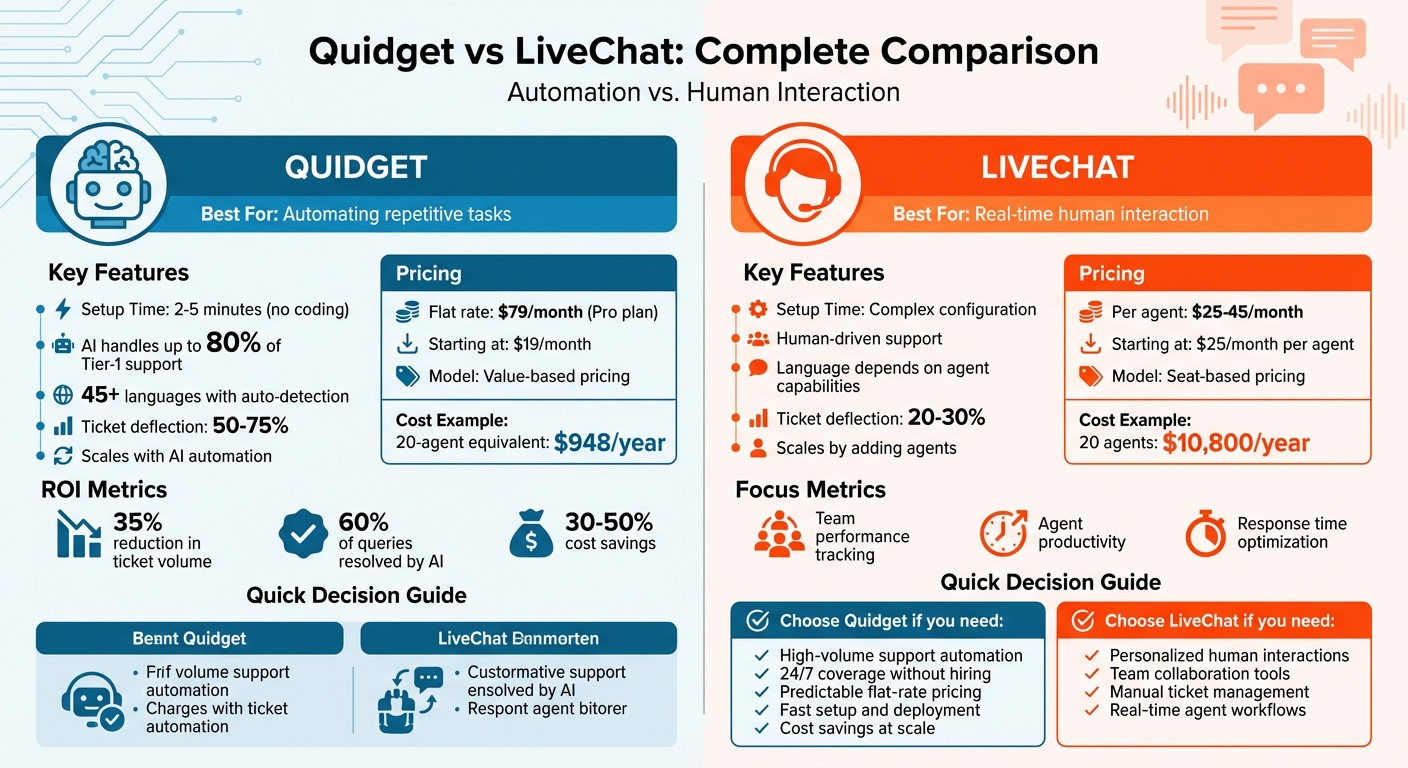
Quidget vs LiveChat: Feature and Pricing Comparison
Quick Comparison Overview
Quidget vs LiveChat: Quidget uses AI to handle up to 80% of repetitive queries, while LiveChat relies on manual, human-driven support. LiveChat is designed around real-time interactions, where support agents manage chats manually, scaling by adding more team members. In contrast, Quidget operates as an AI chatbot platform, automating routine tasks so your team can focus on more complex customer needs.
Quidget stands out with its fast setup. Its no-code deployment takes just 2 to 5 minutes, and the AI pulls information directly from your website, FAQs, and documentation to provide accurate, consistent answers. On the other hand, LiveChat requires more intricate setup and ongoing manual adjustments as your team expands. This streamlined setup for Quidget not only saves time but also lays the groundwork for advanced automated customer support, which can significantly affect pricing and scalability.
When it comes to customer support automation, Quidget uses a hybrid approach: AI manages common queries and seamlessly routes complex issues to human agents through platforms like Zendesk or Freshdesk, complete with the full chat history. LiveChat, in contrast, functions as live chat software, where human agents handle conversations from start to finish.
Side-by-Side Comparison Table
| Category | Quidget | LiveChat |
|---|---|---|
| Best for | AI-driven automation, scaling without headcount | Real-time human chat, team collaboration |
| Setup time | 2–5 minutes (no-code) | More complex configuration |
| Core strength | Automates up to 80% of Tier-1 support tasks | Live agent workflows and help desk features |
| Automation depth | High (AI learns from your content) | Low (primarily human-driven) |
| Scaling method | AI handles more volume automatically | Add more paid agents as volume grows |
| Language support | 45+ languages with auto-detection | Depends on agent capabilities |
| Reporting | Business outcomes, deflection, automation ROI | Team performance, chat metrics |
| Pricing model | Starts at $19/month (total) | Starts at $19/month per agent |
These differences have a direct impact on costs and scalability. For instance, LiveChat’s per-agent pricing can become expensive as your team grows, while Quidget’s flat monthly fee – starting at $19/month – remains consistent. For businesses seeking LiveChat alternatives, this cost structure is crucial, especially when scaling from a small team to a larger operation. A real-world example? Softorino managed to cut ticket volume by 35% while maintaining high-quality support using Quidget.
sbb-itb-58cc2bf
Feature Comparison: Quidget vs LiveChat
Support & Ticketing Capabilities
When it comes to support and ticketing, Quidget and LiveChat take different approaches to managing customer interactions. LiveChat is tailored for teams that prioritize quick, human responses and real-time collaboration. It revolves around help desk workflows, where agents manually handle conversations, assign tickets, and monitor ongoing interactions.
Quidget, on the other hand, focuses on reducing the number of tickets before they even reach your team. Its AI support agents tackle repetitive inquiries like "How do I reset my password?" or "Where’s my order?" automatically. For example, Softorino implemented Quidget for Tier-1 support and experienced a 35% drop in overall ticket volume, with the AI resolving 60% of first-level queries. This AI-first approach minimizes the need for manual intervention, making it an efficient choice for scaling customer support.
For businesses that require immediate, personalized interactions – such as those in eCommerce – LiveChat shines. Meanwhile, Quidget excels in deflecting tickets through automation and self-service. For complex issues, Quidget ensures a seamless handoff by routing the entire conversation history to human agents via platforms like Zendesk or Freshdesk, sparing customers from repeating their concerns.
AI Automation & Chatbot Features
The difference in AI automation between these platforms is striking. Quidget functions as a dedicated AI chatbot platform, with agents that learn from interactions and independently resolve issues. It handles tasks like instant responses, lead qualification, guided support flows, and even proactive outreach.
LiveChat, by contrast, offers chat automation tools like automated greetings, canned responses, and basic routing rules. These features are designed to assist human agents rather than replace manual processes. As a result, Quidget users often see a 30–50% reduction in support costs due to autonomous resolution, while LiveChat focuses on improving agent productivity and speeding up response times.
Quidget’s no-code setup is a breeze, taking just 2–5 minutes. The AI learns directly from your website, FAQs, and documentation. LiveChat’s setup, on the other hand, centers on live agent workflows, team assignments, and chat routing rules . For companies aiming for quick returns on customer support automation, Quidget’s AI-first model can deliver measurable results in as little as one to two weeks.
Additionally, Quidget supports over 45 languages with automatic detection, providing 24/7 coverage without needing agents across multiple time zones. For a company using LiveChat to maintain round-the-clock support, this could mean hiring 6–8 agents at an annual cost of $300,000–500,000. In comparison, Quidget can achieve the same coverage for $50,000–100,000 annually.
Reporting & Analytics Tools
The reporting capabilities of Quidget and LiveChat reflect their distinct focuses. Quidget tracks metrics that directly measure business outcomes, such as ticket deflection rates, automation resolution rates, cost per ticket, customer satisfaction by automation type, and overall ROI on support automation. These insights help leadership understand how much manual work is being replaced.
LiveChat, on the other hand, emphasizes team and conversation analytics. It tracks metrics like average response times, agent productivity, chat volume, customer satisfaction scores, and team performance. While Quidget’s reporting highlights the impact of automation, LiveChat focuses on team efficiency and responsiveness.
For teams focused on revenue, Quidget’s AI agents add another layer of value by autonomously qualifying leads. They ask key questions, score lead quality, and route high-value prospects to sales teams, while managing low-intent queries through self-service. This approach can generate 20–30% more qualified leads from the same support volume.
Both platforms integrate seamlessly with existing tech stacks. Quidget connects with tools like Zendesk, Freshdesk, Slack, WhatsApp, and Calendly, enabling end-to-end automation. LiveChat integrates with CRM systems, team collaboration tools, and help desk software, enhancing human efficiency. The key distinction lies in their purpose: Quidget drives automation, while LiveChat optimizes human workflows.
Pricing Models and Cost Comparison
When comparing Quidget’s pricing with LiveChat’s, the difference in approach is clear. Quidget prioritizes automation and efficiency, while LiveChat relies on scaling through additional human agents. LiveChat uses a seat-based pricing model, starting at $25 per agent for the Team plan and $45 per agent for the Business plan. For example, a 10-agent team on the Business plan would pay about $450 per month (billed annually). If that team grows from 5 to 20 agents, monthly costs would jump from $225 to $900.
Quidget, on the other hand, uses a value-based pricing model that starts at $79 per month for the Pro plan. This includes 10,000 AI responses and 5 AI chatbots. Instead of charging per seat, Quidget scales based on automation capacity and support volume. To illustrate the difference, a 20-agent team using LiveChat’s Business plan would pay around $10,800 annually, while Quidget’s Pro plan costs only $948 per year – saving over $9,800.
These examples highlight the cost savings of AI-driven support. The gap becomes even more pronounced as businesses scale. For instance, a mid-sized SaaS company reduced its monthly support costs from ~$6,000 (for 24 LiveChat seats) to a fixed $1,200 with Quidget. Similarly, an eCommerce brand saw substantial savings by using Quidget to handle 24/7 inquiries without hiring additional staff.
For businesses with high support volumes, the pricing models diverge sharply. LiveChat’s costs increase directly with the number of agents, which works well for teams focused on live interactions but becomes expensive for handling large volumes. In contrast, Quidget’s flat pricing allows companies to manage rising support demands without adding more agents. With Quidget’s AI resolving 60–80% of routine tickets, a 10-person team could save over $10,000 annually.
According to industry analysts, AI-first platforms offer better overall cost efficiency for high-volume support by deflecting more routine queries than traditional agent-led models. Ultimately, the choice depends on scalability: LiveChat requires more human resources as support needs grow, while Quidget’s AI-powered solution adapts seamlessly to your business’s evolving demands.
When Quidget Works Better Than LiveChat
Quidget shines over LiveChat when your business needs to automate repetitive support tasks instead of relying on manual ticket routing. For SaaS teams dealing with common questions like "How do I reset my password?" or "Where can I find this feature?", Quidget’s AI support agent can handle up to 80% of Tier-1 tickets on its own. By training on your knowledge base, it delivers instant, automated responses in less than 2 minutes. For example, a project management software company used Quidget to automate onboarding queries, resulting in 40% faster resolution times and a 25% increase in customer satisfaction.
eCommerce brands also see major benefits with Quidget’s 24/7 chat automation. Instead of depending on live agents for real-time responses, Quidget offers instant help for tasks like order tracking, cart abandonment recovery, and product recommendations – even during off-hours. One eCommerce company cut support costs by 35% and boosted conversions by 20% by ensuring customers received immediate assistance when human agents weren’t available. This kind of efficiency can be a game-changer for businesses in similar industries.
For growing companies, Quidget is a lifesaver when scaling support without adding more staff. Take Softorino, for instance. After adopting Quidget to manage Tier-1 support, they reduced their overall ticket volume by 35%, with the AI handling 60% of first-level queries around the clock. This freed up their team to focus on more complex customer issues without compromising the quality of their support.
Beyond just automation, Quidget achieves 50–75% ticket deflection by using proactive AI agents. In comparison, LiveChat’s basic automation typically deflects only 20–30%. For support teams aiming to improve deflection rates and productivity, the numbers make a strong case. A mid-sized SaaS firm, for example, reported a 45% reduction in resolution times and deflected 65% of routine tickets with Quidget. Its intelligent support ticket routing ensures that only issues requiring human expertise are escalated, all while maintaining a complete conversation history. Ultimately, the choice between Quidget and LiveChat boils down to AI-driven automation versus agent-reliant workflows.
Choosing the Right Platform
The choice between Quidget and LiveChat really comes down to your support strategy. If your team thrives on real-time, human-led conversations, LiveChat might seem like the natural fit. It’s designed for businesses that prioritize personal interaction, offering shared inboxes and live routing to keep everything flowing smoothly. But if automation and efficiency are at the top of your list, Quidget has some clear advantages.
Here’s why: Quidget focuses on automating support, allowing your human agents to dedicate their time to more complex issues. With the ability to handle repetitive questions and reduce routine ticket volume by up to 80%, Quidget’s AI-powered support agent brings a level of efficiency that LiveChat’s human-centric model just can’t match. By autonomously managing Tier-1 queries, Quidget frees up your team to tackle problems that require critical thinking and expertise.
Cost is another area where Quidget stands out. LiveChat’s seat-based pricing means your costs rise as your team grows. In contrast, Quidget offers flat pricing, scaling with the value of automation rather than headcount. For SaaS teams and eCommerce brands managing high query volumes, this means you can handle more without the need to hire additional agents. Where LiveChat might require you to expand your team to manage increased demand, Quidget leans on chat automation to handle the load seamlessly.
When it comes to performance, Quidget takes the lead by boosting deflection rates, speeding up resolutions, and delivering better ROI. Its AI-first design transforms help desk workflows, cutting out manual work on repetitive tasks. This keeps your agents focused on the challenges that truly need human attention. For businesses aiming to scale their support operations while boosting team productivity, Quidget offers the kind of automation and efficiency that traditional live chat software struggles to achieve.
FAQs
Is Quidget more expensive than LiveChat at scale?
Quidget tends to be a more budget-friendly option as your team grows, especially when compared to LiveChat. LiveChat’s pricing is based on the number of seats, which can quickly add up as you expand your support staff. On the other hand, Quidget’s model focuses on automation, meaning its costs align more closely with the value it provides. By using AI to handle repetitive tasks, Quidget helps SaaS teams and eCommerce businesses cut down on manual support costs and boost overall efficiency, delivering a stronger return on investment.
Which is better for AI automation: Quidget or LiveChat?
Quidget takes AI automation to the next level by deploying AI-powered support agents that handle repetitive tasks efficiently while driving better business results. Unlike LiveChat, which emphasizes real-time human interactions, Quidget focuses on automation. It can manage up to 80% of support tickets, offering features like intelligent routing, self-service options, and multi-language support.
This makes Quidget a smart choice for teams looking to scale their operations, cut down on ticket volume, and boost overall support efficiency. If automation and streamlined workflows are your priorities, Quidget delivers exactly what you need.
Can I set up Quidget without a dedicated developer?
Quidget provides a simple 2-minute no-code setup, perfect for teams without technical skills. This quick and easy process lets businesses deploy AI-powered support automation and chatbots in no time. By skipping the need for development resources, teams can scale faster and boost operational efficiency effortlessly.
How long does it take to migrate from LiveChat to Quidget?
Migrating from LiveChat to Quidget is incredibly quick – just about 2 minutes! Thanks to Quidget’s simple, no-code setup, support teams can make the switch effortlessly. There’s no need for technical know-how or time-consuming processes, making the transition smooth and stress-free.
Is Quidget better than LiveChat for outbound sales?
Yes, Quidget works best for outbound sales when automation and scalability are top priorities. Its advanced AI handles proactive engagement, lead qualification, and customer nurturing without needing continuous human input. While LiveChat emphasizes real-time human interactions and support workflows, Quidget’s AI-driven features make it a more efficient choice for automating outbound sales processes at scale.
Why are companies switching from LiveChat to Quidget?
Companies are turning to Quidget because of its AI-powered automation, which helps cut down on manual tasks and streamlines support operations. While LiveChat prioritizes real-time, human-centered interactions, Quidget stands out by enabling its AI agents to handle up to 69% of inquiries without human intervention. The result? Fewer support tickets, quicker resolutions, and reduced costs. This makes Quidget a popular option for SaaS and eCommerce brands looking to boost efficiency and enhance the customer experience with smart automation.


