


When it comes to AI-powered customer support tools, Quidget and Tidio are two popular options. Here’s the quick breakdown:
- Quidget focuses on autonomous AI agents capable of handling up to 80% of routine customer queries. It offers fast, no-code setup (around 2 minutes) (see our AI support guides for more setup tips) and bundles features like AI Assistant, Web Chat, and Custom Flow Builder in all plans, starting at $79/month.
- Tidio is primarily a live chat platform with AI enhancements. It relies on rule-based workflows and separates features like AI, live chat, and automation into different pricing tiers, starting at $24/month.
Key differences include:
- Automation: Quidget automates more tasks with AI, while Tidio relies on manual workflows.
- Pricing: Quidget includes API access at $99/month, while Tidio charges $749/month for similar functionality.
- Customization: Quidget offers branding customization from day one; Tidio requires a paid upgrade.
Quick Comparison:
| Feature | Quidget | Tidio |
|---|---|---|
| Setup Time | ~2 minutes (no coding) | Quick start; advanced flows take time |
| Tier-1 Automation | Up to 80% | Limited to Lyro AI configuration |
| Starting Price | $79/month | $24/month |
| API Access Price | $99/month | $749/month |
| Target Audience | Startups to enterprise | Small to mid-size e-commerce |
| Branding Customization | Included | Requires $59/month upgrade |
If you need scalable, AI-driven automation, Quidget is the better choice. For smaller e-commerce businesses seeking a live chat tool, Tidio might work better.
Quidget vs Tidio: Feature and Pricing Comparison Chart
Quidget vs Tidio: Key Differences
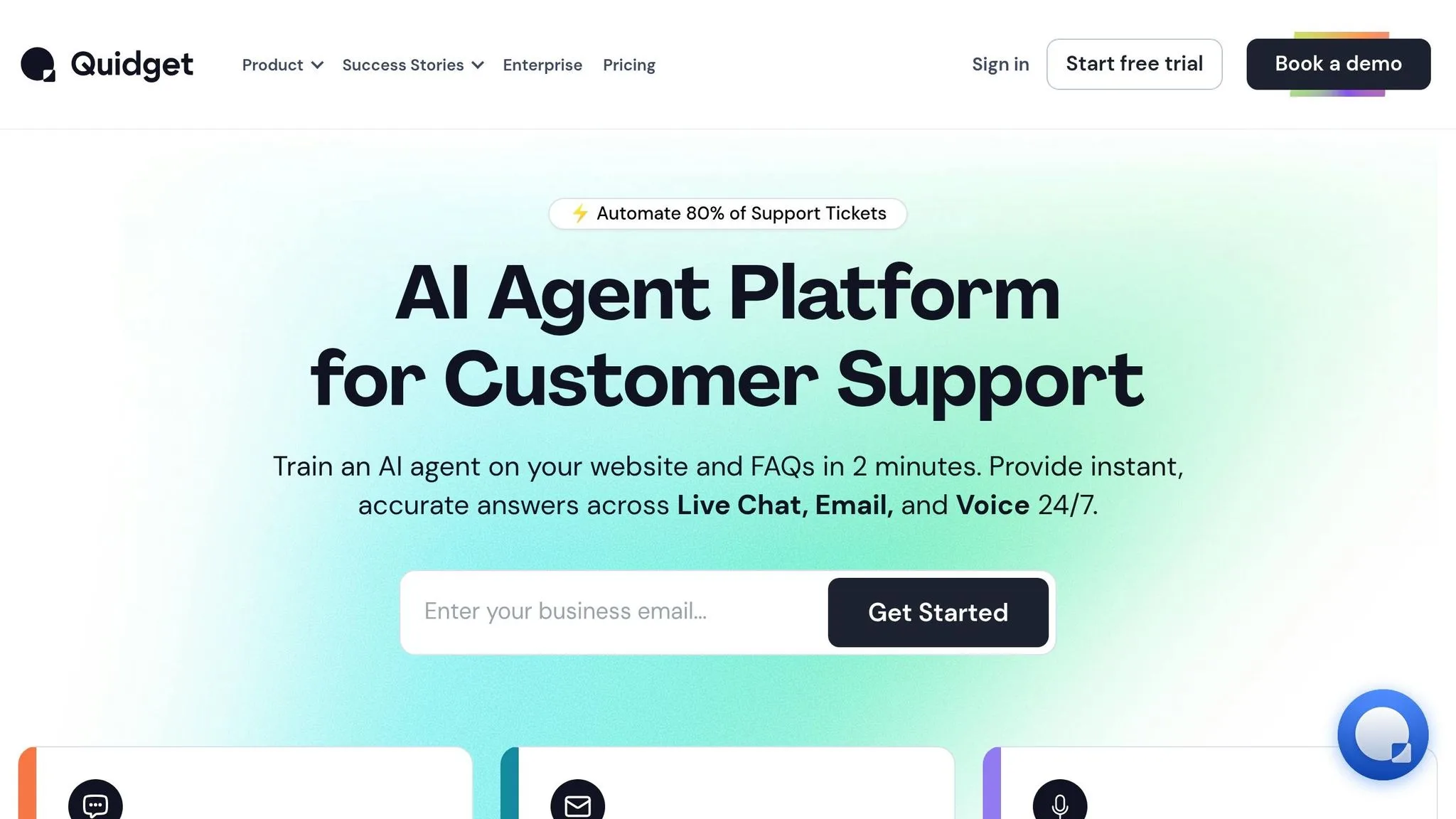
When comparing these platforms, it’s clear that Quidget’s all-in-one design sets it apart as a next-generation AI agent solution. Let’s dive into the key differences that define these two options.
Quidget positions itself as an AI-first platform, bundling its AI Assistant, Web Chat, and Custom Flow Builder into every plan at no additional cost. In contrast, Tidio separates its features – Lyro AI, Live Chat, and Flows – into different pricing tiers. This modular approach means you’ll need to pay extra to access features that Quidget includes as standard.
Another important distinction is pricing. Quidget offers built-in API access and a no-code setup for $99/month. Meanwhile, Tidio’s advanced flows require more time to configure, and API access is locked behind a $749/month paywall.
Automation capabilities also differ significantly. Quidget automates up to 80% of Tier-1 support requests, while Tidio’s Lyro AI focuses on supplementing its live-chat functionality. Additionally, Quidget provides full customization of its chat widget – colors, backgrounds, and icons – right from the start. Tidio, however, requires a paid upgrade to remove branding and unlock advanced customization options.
Feature Comparison Table
| Feature | Quidget | Tidio |
|---|---|---|
| Primary Focus | AI-driven automation with autonomous agents | Live chat platform with AI enhancements |
| Setup Time | ~2 minutes (no coding required) | Quick start; advanced flows take longer |
| Tier-1 Automation | Up to 80% of routine queries | Varies; depends on Lyro AI configuration |
| API Access Price | Starts at $99/month | Starts at $749/month |
| Language Support | 45+ languages with auto-detection | Multi-language support available |
| Feature Inclusion | AI, chat, and flows in standard plans | Separate plans for AI, chat, and automation |
| Starting Price | $16–$19/month | $24/month |
| Target Business Size | Startups to enterprise | Small to mid-size e-commerce |
| Branding Customization | Included from day one | Requires $59/month Growth plan |
Quidget’s bundled approach simplifies costs and ensures predictable pricing, making it a strong choice for businesses looking for robust automation and API integrations. On the other hand, Tidio’s modular pricing structure can lead to higher costs as you scale or add features. For those prioritizing advanced customization and comprehensive automation without hidden fees, Quidget offers a more straightforward and cost-effective solution.
sbb-itb-58cc2bf
Feature Analysis: How Quidget and Tidio Compare
Quidget’s focus on 24/7 AI customer support and advanced automation sets it apart. Let’s break down the key features of both platforms to see how they stack up.
Support & Ticketing Capabilities
Quidget emphasizes automation in its ticketing process. Its AI agents handle ticket creation, classification, and resolution seamlessly. For example, when a customer contacts support, Quidget’s AI immediately analyzes the query, resolves it if possible, or routes it to a human agent with all the necessary context for a smooth handoff.
Tidio, on the other hand, functions primarily as a live chat platform. Escalation happens manually – when the chatbot encounters a query it can’t resolve, it alerts a human operator. This setup requires manual categorization and review, which can slow down response times.
Quidget integrates directly with tools like Zendesk, Freshdesk, and productivity platforms such as Slack, WhatsApp, and Calendly. These integrations enhance its automation capabilities and scalability. Meanwhile, Tidio focuses on ecommerce, offering strong native integrations with platforms like Shopify and WordPress. However, for broader CRM connections, Tidio relies on Zapier, which can add extra costs and potential reliability concerns.
Now, let’s dive into how each platform leverages AI to streamline customer interactions.
AI Chatbot Technology
The way these platforms approach automation highlights their differences. Quidget uses AI agents that adapt and learn from your website, FAQs, and documents. Powered by Natural Language Processing (NLP) and machine learning, Quidget’s AI understands context and intent, going beyond simple keyword matching.
When Quidget’s AI encounters a question it can’t confidently answer, it automatically transfers the conversation to a human agent, including the full conversation history. This ensures customers don’t have to repeat themselves. Quidget also offers Voice AI capabilities, enabling spoken interactions.
Tidio’s chatbots, by contrast, are built on rule-based triggers and workflows. Users design these flows manually using a drag-and-drop editor, defining specific actions and responses for various scenarios. While this approach can handle repetitive tasks effectively, it requires significant time and effort to set up.
Quidget’s advanced AI enables it to handle up to 80% of Tier-1 support requests automatically, and it supports automatic language detection for over 45 languages. This makes it a strong choice for businesses with global audiences, as it eliminates the need to create separate bots for each language.
Next, we’ll explore how both platforms deliver insights through analytics.
Analytics & Reporting Tools
Quidget’s analytics focus on operational performance and ROI. It tracks metrics like the percentage of queries resolved by AI versus human agents, offering clear insights into how automation impacts efficiency. Other data points – such as ticket volume reduction and geographic trends – help businesses plan budgets and allocate resources effectively.
Tidio, on the other hand, offers real-time visitor monitoring. This allows agents to see which pages customers are browsing and provides basic metrics like response times and satisfaction scores. However, as Kevin Tan from Chatboq points out:
“Basic reporting works at a small scale, but forecasting workload or tracking SLA trends may require deeper analytics.”
For businesses that need to predict future support demands, monitor SLA compliance, or assess the financial impact of automation, Quidget’s detailed dashboards and ROI-focused reporting provide the depth required for strategic decision-making.
Pricing: Quidget vs Tidio
Cost Structure Breakdown
Quidget starts at $79 per month after a 7-day free trial, while Tidio begins at a lower price point of $24 per month. However, the pricing structures reveal key differences in how features are bundled.
Quidget offers a straightforward three-plan structure – Pro, Pro Plus, and Enterprise – that includes AI Assistant, Web Chat, and Custom Flow Builder in every tier. This all-in-one approach ensures you get a complete automation toolkit from the outset. On the other hand, Tidio separates key features like Lyro AI, Live Chat, and Flows into separate paid modules. This means accessing multiple functionalities can lead to additional charges.
SelectHub analysts highlighted this in their review of Tidio:
“While the free plan is a great starting point, the jump in price for higher tiers might be a bit steep for smaller businesses or those just starting out.”
Tidio’s tiered pricing often results in costs climbing quickly as your customer base grows. Quidget, however, uses a usage-based pricing model, which adjusts according to your actual needs rather than imposing fixed seat limits. This makes Quidget’s pricing more adaptable as your business scales.
Return on Investment
When comparing ROI, AI automation features are where Quidget stands out. Quidget automates up to 80% of Tier-1 support requests, which directly reduces the need for more human agents as your business grows.
For example, in 2026, Softorino adopted Quidget for customer support. The AI system now handles 60% of their first-level responses, leading to a 35% drop in overall support ticket volume. This shift allowed their human team to focus on complex customer needs, improving efficiency.
Quidget’s AI-driven model helps lower labor costs without requiring additional hires, offering predictable support expenses that align with growth. Instead of hiring more agents to manage increased volume, businesses can scale Quidget’s AI capabilities while keeping their human team focused on high-value interactions.
In contrast, Tidio’s pricing model ties growth directly to rising costs. As contact volume increases, businesses often need to purchase additional agent seats or upgrade to higher tiers. Quidget avoids this issue by using AI to manage volume surges, making budgeting for support much easier as your company scales.
Which Platform Fits Your Business?
Small Businesses & Startups
If you’re running a small business or startup with a tight budget, your choice often boils down to balancing immediate needs with long-term growth potential. Tidio is a great option if you’re looking for a straightforward live chat tool. It offers a unified inbox to manage messages from email and Facebook Messenger, all with a simple, no-code setup. With a 94% user sentiment rating from 2,623 reviews, many small business owners appreciate its ease of use and reliability.
That said, Quidget might be a better fit for teams aiming to scale through automation rather than hiring more staff. Starting at just $16 to $19 per month, compared to Tidio’s $24 base price, Quidget includes advanced features like an AI Assistant, Web Chat, and a Custom Flow Builder right out of the gate – no need for additional modules. Its 2-minute, no-code setup means you can get an AI-powered system up and running almost instantly. Quidget’s automation can handle up to 80% of Tier-1 support queries like “Where is my order?” or basic troubleshooting.
For startups targeting global markets, Quidget’s support for 45+ languages is a game-changer. It automatically detects and responds in your customer’s native language. Plus, if your team eventually needs custom integrations, Quidget offers API access starting at $99, whereas Tidio requires a steep $749 for similar functionality.
If your business is growing quickly, Quidget’s automation capabilities can keep pace without needing to add more staff.
Mid-Size & Enterprise Companies
Bigger companies often face the challenge of managing increasing support demands without ballooning costs. Here, Quidget’s AI-first approach shines by delivering measurable efficiency gains. Many mid-sized businesses report that Quidget handles most Tier-1 queries, significantly reducing ticket volumes.
In contrast, Tidio’s pricing structure scales with the number of agent seats and contact volume, which can lead to higher costs as your business grows. Quidget avoids this issue by using AI to manage spikes in query volume, enabling businesses to handle thousands of additional requests without needing to expand their support teams.
For enterprise-level companies, Quidget offers additional perks like ISO, PCI, and GDPR compliance, backed by 14 years of experience from SupportYourApp, which has served over 250 global businesses. The platform integrates seamlessly with tools like Zendesk and Freshdesk, making it easy to hand off complex issues to human agents when needed. For companies dealing with intricate workflows – such as billing disputes, refund requests, or SLA tracking – Quidget’s AI efficiently handles initial triage and gathers relevant data before routing cases to the appropriate team member.
Final Verdict: Quidget or Tidio?
Both platforms cater to different customer support needs. Tidio is a great fit for those seeking a straightforward live chat tool with a unified inbox and basic widget customization. It’s particularly suitable for small online stores looking for essential chat functionality and boasts a 94% user satisfaction rating from 2,623 reviews.
On the other hand, Quidget takes automation to the next level with AI agents that can handle up to 80% of Tier-1 support queries. This makes it ideal for businesses managing high volumes of customer interactions without adding extra staff. It’s designed to tackle complex support needs while scaling effortlessly to handle thousands of queries.
Pricing also sets these platforms apart. Quidget includes AI Assistant, Web Chat, and Custom Flow Builder in its standard plans, whereas Tidio offers advanced features as separate, higher-cost modules. Additionally, API access pricing varies significantly between the two, which could influence your choice if custom integrations are a priority.
Ultimately, the decision comes down to your business needs. Choose Tidio if you’re running a small store and need a simple live chat solution. Opt for Quidget if you’re looking for AI-powered agents to reduce ticket volume, manage intricate queries across 45+ languages, and scale your support operations. With a 2-minute, no-code setup and a 7-day free trial (no credit card required), Quidget makes it easy to see if AI-driven customer support meets your business goals.
FAQs
Is Quidget more expensive than Tidio at scale?
No, Quidget is not more expensive than Tidio at scale. Quidget operates on a usage-based pricing model, which adjusts predictably as your business grows. Unlike Tidio’s tiered plans, which can lead to sharp cost increases as your user base expands, Quidget keeps costs tied to performance and automation outcomes. This makes it a more budget-friendly and scalable option for businesses aiming to grow efficiently.
Which is better for AI automation: Quidget or Tidio AI Agents?
Quidget outshines Tidio in AI automation by leveraging autonomous AI agents that continuously learn and adapt from interactions. These agents bring advanced natural language processing (NLP), contextual understanding, and multilingual capabilities to the table. In contrast, Tidio uses rule-based chatbots with more limited AI capabilities. Quidget’s agents take automation further by automatically creating, classifying, and resolving tickets. This level of automation not only boosts scalability but also cuts down on manual tasks and elevates the overall customer experience. For businesses aiming for cutting-edge AI-driven solutions, Quidget clearly stands out.
Can I set up Quidget without a dedicated developer?
Quidget is built for simplicity, allowing you to set it up in under 2 minutes – no coding or developer needed.
How long does it take to migrate from Tidio to Quidget?
Migrating from Tidio to Quidget is fast and straightforward, often completed in under a day. Quidget offers assisted import tools to make the transition seamless and efficient.
Is Quidget better than Tidio for outbound sales?
Yes, Quidget outperforms Tidio for outbound sales. Quidget’s AI agents take the initiative by engaging leads across various channels, helping businesses qualify prospects and drive conversions with minimal manual input. While Tidio emphasizes live chat and manual escalation, Quidget’s autonomous AI agents adapt and learn from interactions, enabling smarter outreach. This makes Quidget a stronger option for enhancing outbound sales and driving revenue growth.
Why are companies switching from Tidio to Quidget?
Companies are turning to Quidget because of its cutting-edge automation, scalability, and autonomous AI features, which go beyond the limitations of Tidio’s rule-based chatbots. Quidget’s AI agents take care of tasks such as ticket creation and resolution, cutting down on manual work and boosting efficiency. With its outcome-based pricing model, costs remain predictable, unlike Tidio’s tiered plans, which can become increasingly expensive. Businesses using Quidget have seen impressive results, including a 70% drop in ticket backlogs and response times that are four times faster – delivering clear ROI and improved analytics.


