


Choosing between Quidget and Fin.ai depends on your budget and operational needs. Here’s a quick breakdown:
- Quidget offers fixed monthly pricing starting at $79 for 10,000 responses, making costs predictable. It integrates with multiple helpdesks like Zendesk and Freshdesk, supports 45+ languages, and provides a 2-minute no-code setup. Ideal for teams seeking flexibility and cost stability.
- Fin.ai charges $0.99 per resolved conversation, which can scale with usage. It’s native to Intercom and excels in structured workflows like refunds or account updates. Best for teams already using Intercom or those prioritizing performance-based pricing.
Quick Comparison
| Category | Quidget | Fin.ai |
|---|---|---|
| Pricing | Fixed plans ($79–$599/month) | $0.99 per resolved conversation |
| Setup Time | 2-minute no-code setup | Quick, self-service setup |
| Best For | SaaS, eCommerce, multi-channel | Intercom users, workflow automation |
| Integrations | Zendesk, Freshdesk, API | Intercom, Zendesk, Salesforce |
| Language Support | 45+ languages | 45+ languages |
If you need predictable costs and multi-channel flexibility, Quidget is the better choice. For Intercom-heavy workflows and pay-for-performance pricing, go with Fin.ai.
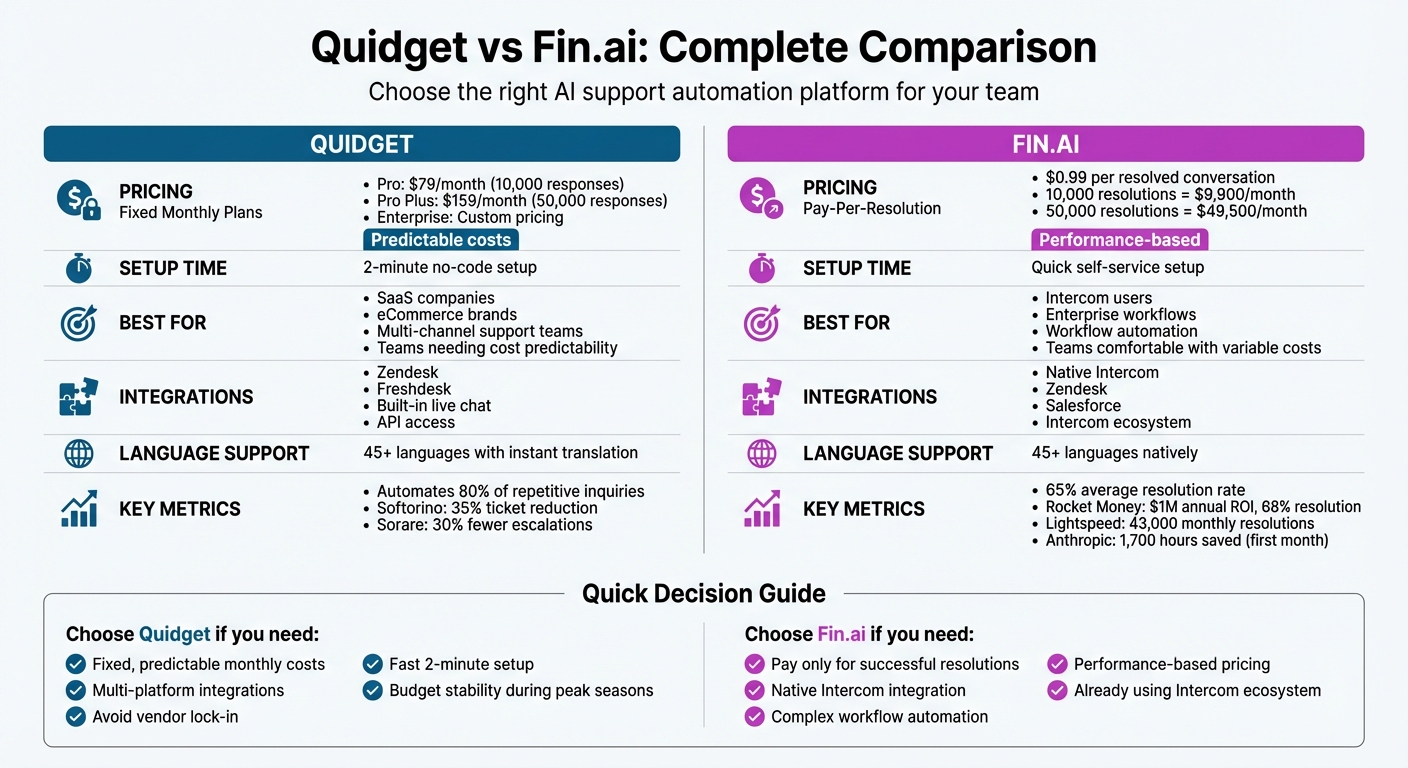
Quidget vs Fin.ai: Pricing, Features, and Integration Comparison
Main Differences Between Quidget and Fin.ai
The debate between Quidget and Fin.ai comes down to two key factors: how you pay for AI support automation and the platforms where you need it to work. Quidget offers predictable fixed monthly pricing that scales with response volume, while Fin.ai charges $0.99 per successfully resolved conversation. This pricing contrast has a direct impact on budgeting and ROI calculations.
Another major distinction lies in their integration options. Quidget works with Zendesk, Freshdesk, and even provides its own built-in live chat feature, which includes instant translation in over 45 languages. On the other hand, Fin.ai operates natively within Intercom but can also integrate with Zendesk and Salesforce. For teams juggling multiple tools or aiming to avoid vendor lock-in, Quidget provides more integration flexibility.
Comparison Table: Quidget vs Fin.ai
Here’s a breakdown of the key differences between the two platforms:
| Category | Quidget | Fin.ai |
|---|---|---|
| Best For | SaaS, eCommerce, and growth teams looking for predictable pricing | Intercom users or enterprises focused on workflow automation |
| Setup Time | 2-minute no-code setup | Quick, self-service setup |
| Pricing Model | Fixed monthly plans ($79–$599+) | $0.99 per resolved conversation (performance-based) |
| Reporting | AI summaries and performance dashboards | CX Score, Topics Explorer, and performance dashboards |
| Deployment Flexibility | Multi-channel (Web, Zendesk, Freshdesk, API) | Native Intercom + external stacks (Zendesk, Salesforce) |
| Language Support | 45+ languages with instant translation | 45+ languages natively |
What the Numbers Tell Us
The numbers highlight the strategic differences between these platforms. Quidget prioritizes cost predictability and flexible deployment, while Fin.ai focuses on performance-based pricing and structured workflows. For instance, Softorino achieved a 35% reduction in support ticket volume using Quidget, while Rocket Money reported an estimated $1M in annual ROI with a 68% resolution rate through Fin.ai. Both platforms deliver measurable results, but Quidget’s fixed pricing ensures you can avoid unexpected costs – a big advantage for teams managing tight budgets or seasonal demand spikes.
For companies requiring helpdesk integration across multiple platforms, Quidget stands out by eliminating vendor lock-in. Its API access and multi-channel deployment allow teams to create custom workflows without overhauling their existing support systems. These factors make Quidget a go-to choice for teams prioritizing cost control and integration flexibility.
Next, we’ll dive into how these differences translate into distinct support automation features.
sbb-itb-58cc2bf
Quidget vs Fin.ai Features
Let’s break down how Quidget and Fin.ai tackle support workflows, automation, and reporting. Quidget is built to handle repetitive questions while seamlessly passing complex issues to human agents, complete with context. On the other hand, Fin.ai takes a more autonomous approach, managing multi-step actions like processing refunds or updating account settings through its "Procedures" feature. These differences highlight how each platform delivers distinct operational advantages.
Support & Ticketing
Quidget automates up to 80% of repetitive "how-to" inquiries and ensures unresolved issues are handed off to live agents with full chat history through integrations with tools like Zendesk, Freshdesk, or its own live chat system. Its no-code setup works across various channels – WhatsApp, Slack, and Telegram – offering businesses cost predictability and scalable support without vendor lock-in.
Fin.ai takes a more autonomous route, resolving tickets directly within Intercom or through integrations with Zendesk and Salesforce. Its structured "Procedures" combine natural language with deterministic logic to manage complex workflows. For example, Lightspeed reported a 65–72% resolution rate while processing over 43,000 AI-handled resolutions monthly using Fin.ai. Positioned as a complete AI Agent System, Fin.ai thrives when users fully commit to its ecosystem.
While both platforms excel in ticket management, they also stand out in automating more intricate tasks.
AI Automation & Resolution
Quidget allows you to train AI agents on up to 10,000 sources per chatbot, including documents, links, and web pages. Its no-code setup includes pre-built templates for support, sales, and lead generation. You can customize the AI’s tone and behavior, and when the system encounters uncertainty, it routes the query to a human agent. This makes Quidget a flexible choice for teams looking for predictable SaaS pricing and adaptability.
Fin.ai uses a proprietary AI engine that integrates Retrieval-Augmented Generation (RAG) and multi-stage validation for handling complex workflows. It features an advanced simulation framework for batch testing and multi-turn scenario validation before deployment. Anthropic saved over 1,700 hours in its first month using Fin.ai, achieving a resolution rate of over 58%. Across its customer base, the platform averages a 65% resolution rate, with top performers reaching 80–93%. However, Fin.ai is most effective when your processes align with its predefined structure.
Both platforms also offer analytics to track performance, but their focus areas differ.
Reporting & Analytics
Quidget prioritizes ROI and ticket deflection. It includes an ROI calculator to estimate net savings based on ticket volume and cost per ticket. Additionally, it provides AI Summaries for every chat, allowing teams to review conversations without sifting through full transcripts. This focus on operational efficiency and cost control makes it easier to demonstrate value to decision-makers.
Fin.ai zeroes in on resolution performance and customer experience metrics. Its CX Score and Performance Dashboard track outcomes, while the Topics Explorer identifies trends in customer queries. It also includes audit logs and answer inspection tools for quality control and governance. While Fin.ai’s reporting is detailed, it shines when evaluating resolution-based outcomes rather than broader operational metrics.
Pricing: Fixed Plans vs Pay-Per-Resolution
When deciding between Quidget and Fin.ai, pricing plays a key role in determining which platform aligns better with your needs. Quidget sticks to a tiered, fixed monthly pricing structure, offering predictable costs no matter how many conversations its AI manages. On the other hand, Fin.ai uses a pay-per-resolution model, charging $0.99 for each successfully resolved conversation. While straightforward, this approach can lead to rising costs as your conversation volume grows, which can complicate budgeting and planning. Below, we break down the details of each pricing model to help you decide.
Quidget’s Fixed Monthly Pricing
Quidget provides a range of pricing tiers designed to fit businesses of different sizes, positioning it among the top AI-powered tools for customer service teams.
- The Pro plan starts at $79/month (billed annually), covering 10,000 AI responses, 5 chatbots, and 3 seats per bot.
- The Pro Plus plan costs $159/month (billed annually), offering 50,000 responses, 10 chatbots, and 5 seats per bot.
- For larger enterprises, custom pricing is available, which includes tailored limits and dedicated account management.
This fixed pricing model makes it easier to predict monthly expenses, even during periods of increased support demand. Plus, a 7-day free trial is included with all plans, giving you a chance to explore the platform without financial risk.
Fin.ai’s Resolution-Based Costs
Fin.ai takes a different approach, charging $0.99 for every successful resolution. For a team handling 10,000 resolutions in a month, this translates to $9,900 in fees. If the volume reaches 50,000 resolutions, the cost jumps to $49,500. For example, Lightspeed, a company using Fin.ai, processed over 43,000 monthly resolutions with a success rate between 65% and 72%. This resulted in an estimated monthly cost of approximately $42,570.
However, the per-resolution fee is just one part of the total cost. Additional charges may apply for features like helpdesk integration, extra seat licenses, or add-ons such as Copilot. While this model offers scalability, the overall expenses can rise significantly, making it less predictable than a fixed pricing plan. For businesses that need consistent budgeting, Quidget’s approach may provide more stability as support volumes grow.
Is Quidget Better Than Fin.ai for Customer Support?
Deciding between Quidget and Fin.ai comes down to your team’s specific needs and how you prioritize budget predictability and operational features. Quidget is ideal for businesses that want fixed pricing, multi-channel deployment, and control over their automation logic. On the other hand, Fin.ai suits teams already integrated with Intercom or those comfortable with outcome-based pricing. Let’s break down how these platforms perform in different scenarios.
SaaS and Growth Teams
SaaS companies often experience fluctuating support demands as they scale. In these situations, Quidget’s fixed pricing helps keep expenses predictable, avoiding surprise costs during product launches or seasonal peaks. This is a big advantage over Fin.ai’s outcome-based pricing model.
Another standout feature? Quidget’s quick, no-code setup. In just 120 seconds, teams can connect existing documentation and FAQs to deploy AI agents right away. This is especially valuable for growth teams with limited engineering resources. The platform takes care of up to 80% of repetitive inquiries, such as account setup or "how-to" questions, which are common in SaaS environments.
When issues require human intervention, Quidget seamlessly routes conversations to live agents via Zendesk, Freshdesk, or its own live chat tool. It ensures agents have full context, so customers avoid frustrating dead ends. Additionally, Quidget offers API access and integrations with tools like Calendly and OpenAI, making it a solid choice for SaaS companies that need custom workflows. For teams prioritizing cost predictability and versatile deployment, Quidget clearly offers an edge.
eCommerce Brands
eCommerce companies often face high inquiry volumes during sales events or product launches. In these scenarios, Quidget’s fixed monthly pricing prevents the cost spikes that can occur with Fin.ai’s resolution-based pricing. This makes Quidget a better fit for brands managing global customers or seasonal surges in demand.
The platform is designed to handle common eCommerce questions, such as "where is my order?" and shipping issues, automating up to 80% of these repetitive queries. With support for over 45 languages, Quidget is especially useful for brands with international audiences. Plus, it integrates easily with tools like Zendesk and CoSupport.ai, allowing teams to enhance their existing support workflows with AI automation.
For eCommerce brands, cost stability is a major concern during events like Black Friday or holiday sales. Quidget’s predictable pricing eliminates financial uncertainty, making it easier for finance teams to plan accurately. This reliability is a key advantage for businesses that rely on stable SaaS pricing models.
Support Leaders & Operations Teams
Support leaders often need detailed control over automation logic, escalation processes, and analytics. Quidget delivers on this with a no-code setup and granular features, such as the ability to train chatbots with up to 10,000 sources on its Pro Plus plan.
Tools like AI Summaries allow leaders to quickly review conversations, while custom instructions let them fine-tune the AI’s tone and behavior. When the AI encounters complex issues, Quidget’s "human handoff" feature ensures customers are seamlessly transferred to live agents with full context. These capabilities are critical for teams managing high-stakes interactions.
For additional support, Quidget offers a concierge service to help teams build bots and workflows tailored to their business goals. While Fin.ai boasts an average resolution rate of 65%, its outcome-based pricing can lead to unpredictable costs as ticket volumes grow. For support leaders who need stability and operational flexibility, Quidget provides a more reliable foundation for AI-driven customer service.
Which Platform Should You Choose?
Deciding between Quidget and Fin.ai comes down to how your team approaches budgeting, the tools you already rely on, and the level of control you need over automation logic. Both platforms offer robust AI support automation, but their pricing models and deployment strategies differ. Here’s a quick breakdown to help you decide.
When Fin.ai Makes Sense
Fin.ai is a strong option for teams already using Intercom. Since it’s a native Intercom agent, setup is quick and straightforward. It can handle over 1 million conversations weekly with an impressive 99.97% uptime, making it a dependable choice for high-volume operations.
Its outcome-based pricing model works well for teams that prefer paying based on successful results and are okay with costs fluctuating alongside support volume. This is particularly beneficial for teams managing intricate, multi-step processes like refunds or account changes, where precise, rule-based logic is essential. However, if your team values consistent budgeting, Quidget might be a better fit.
Why Quidget Is the Smarter Choice
Quidget stands out for its predictable pricing and adaptable deployment options. With fixed monthly pricing – $79/month for the Pro plan or $210/month for Pro Plus – teams can avoid unexpected costs during peak periods like product launches or holiday sales. This makes Quidget a solid choice for SaaS companies, eCommerce businesses, and support teams that prioritize stable budgeting.
The platform’s predictable SaaS pricing and customizable workflows give it an advantage over outcome-based models. It integrates with multiple helpdesks, supports over 45 languages, and includes API access for building custom workflows. Setup is quick, requiring just 120 seconds, and it can automate up to 80% of repetitive inquiries. For example, Softorino reduced support ticket volume by 35%, and Sorare cut escalations by 30% using Quidget.
In addition to cost consistency, Quidget offers extensive control over support workflows and automation logic. It includes pre-built templates for sales and lead generation, along with a concierge service to assist teams in creating custom bots. For teams seeking scalable AI customer service without the unpredictability of outcome-based pricing, Quidget is the more flexible and dependable choice. These distinctions in pricing and operational control make it easier to identify the right fit for your needs.
FAQs
Is Quidget more expensive than Fin.ai at scale?
Quidget offers more predictable costs at scale when compared to Fin.ai. With Quidget’s transparent pricing structure, teams can plan their budgets without worrying about unexpected spikes as usage increases. On the other hand, Fin.ai uses an outcome-based pricing model, charging $0.99 per resolved conversation with a 50-resolution minimum, plus potential extra fees. This approach can make costs harder to anticipate. For teams focused on scalability and maintaining consistent expenses, Quidget tends to be the more budget-friendly option.
Which is better for AI automation: Quidget or Fin.ai?
Quidget is a great fit for teams that value scalability, flexibility, and predictable pricing. Its transparent pricing structure makes budgeting straightforward, which is especially helpful for growing teams. On the other hand, Fin.ai takes a resolution-based pricing approach. While this model might attract those looking for specific resolution guarantees, it can become more expensive as your needs grow due to added fees. For teams seeking broader automation capabilities, Quidget emerges as the stronger option.
Can I set up Quidget without a dedicated developer?
Yes, you can set up Quidget without needing a developer. It offers a simple, no-code setup process that takes just about 2 minutes. This easy onboarding approach allows teams to quickly implement and start using Quidget’s AI support automation, even without technical skills.
How long does it take to migrate from Fin.ai to Quidget?
Migrating from Fin.ai to Quidget is a breeze – it usually takes just about 2 minutes. Both platforms emphasize quick setup and no-code deployment, making the process incredibly efficient. Quidget’s onboarding process is designed to be simple and fast, allowing teams to integrate and deploy AI support agents with ease. This minimizes downtime and ensures a seamless transition, so operations can continue without skipping a beat.
Is Quidget better than Fin.ai for outbound sales?
Quidget stands out as a top option for outbound sales, thanks to its versatile platform that supports a wide range of automation needs, including sales-specific tasks. Unlike Fin.ai, which is designed primarily for resolving support-related issues, Quidget empowers teams to implement AI agents specifically tailored for outbound sales efforts. Plus, it doesn’t rely on a helpdesk setup or come with unpredictable pricing. With Quidget’s straightforward pricing model and flexibility, it’s a solid choice for teams seeking reliable and adaptable automation solutions.
Why are companies switching from Fin.ai to Quidget?
Companies are choosing Quidget for its clear pricing, scalable automation capabilities, and flexible deployment options. While Fin.ai relies on outcome-based pricing – which can get expensive and complicated as businesses grow – Quidget stands out with a straightforward and transparent pricing model. Additionally, it supports a wider range of automation workflows, making it ideal for teams focused on improving efficiency, simplifying budgeting, and planning for sustainable growth.


