

Voice AI for Customer Support: Hype or Ready for Prime Time? (2026 Honest Assessment)

If you run a contact center or CX team, your inbox has become a graveyard of bold promises. Vendors insist human agents are walking dead weight. Skeptics counter that modern voice AI is just IVR with a marketing budget. The truth sits somewhere in the messy middle, and it’s more interesting than either camp admits.
Gartner predicted AI would power 75% of customer service interactions by 2025, up from 25% in 2020. That trajectory is real. But adoption doesn’t hand you a competitive edge – execution does. Deploy voice AI thoughtfully and you stop bleeding money on repetitive calls. Rush it, and you train your customers to associate your brand with a robotic voice that doesn’t listen. This piece is an honest look at what conversational AI can actually handle on your phone lines right now, and where it still falls flat.
How Voice AI Actually Works in Customer Support
The voice agents of 2026 are not the phone trees you suffered through in 2012. They run on three core technologies operating in milliseconds, and understanding them helps you spot vendor BS.
From Speech Recognition to Intent Resolution
Automatic Speech Recognition (ASR) is the ears. It converts speech to text. Thanks to deep learning, accuracy has jumped dramatically, even with background noise, accents, and the occasional mumbled “yeah.”
Natural Language Understanding (NLU) is the brain. It reads the transcribed text and figures out intent. When a customer says, “My package never showed up,” the NLU tags it as track_order. This is where most systems either shine or embarrass themselves.
Text-to-Speech (TTS) is the voice. The best modern engines have finally ditched the 2008 GPS-robot sound. They pause, breathe, and pace like a person. It’s eerie, and it’s effective.
The Role of Large Language Models
The real shift in voice AI maturity during 2026 is the LLM layer. Old voicebots needed a programmer to script every possible path. Today, large language models let agents handle context, follow conversational tangents, and summarize account history on the fly. Customers can speak naturally instead of learning the bot’s vocabulary.
If you’re wondering how this differs from text-based chat, the mechanics of real-time voice add serious complexity. Here’s a breakdown of the differences between chatbots and voice agents.
The Current State of Voice AI: Hype vs. Reality
Major outlets have been running obituaries for the traditional call center since January. The numbers are real; the implications are overstated.
What the Headlines Get Right (and Wrong)
Grand View Research projects the global voice AI market for customer support will grow at a 22.3% CAGR through 2030. That’s explosive, and it’s driven by genuine NLP advances. But a growing market is not the same as universal competence. Voice AI is not a 1:1 replacement for human judgment.
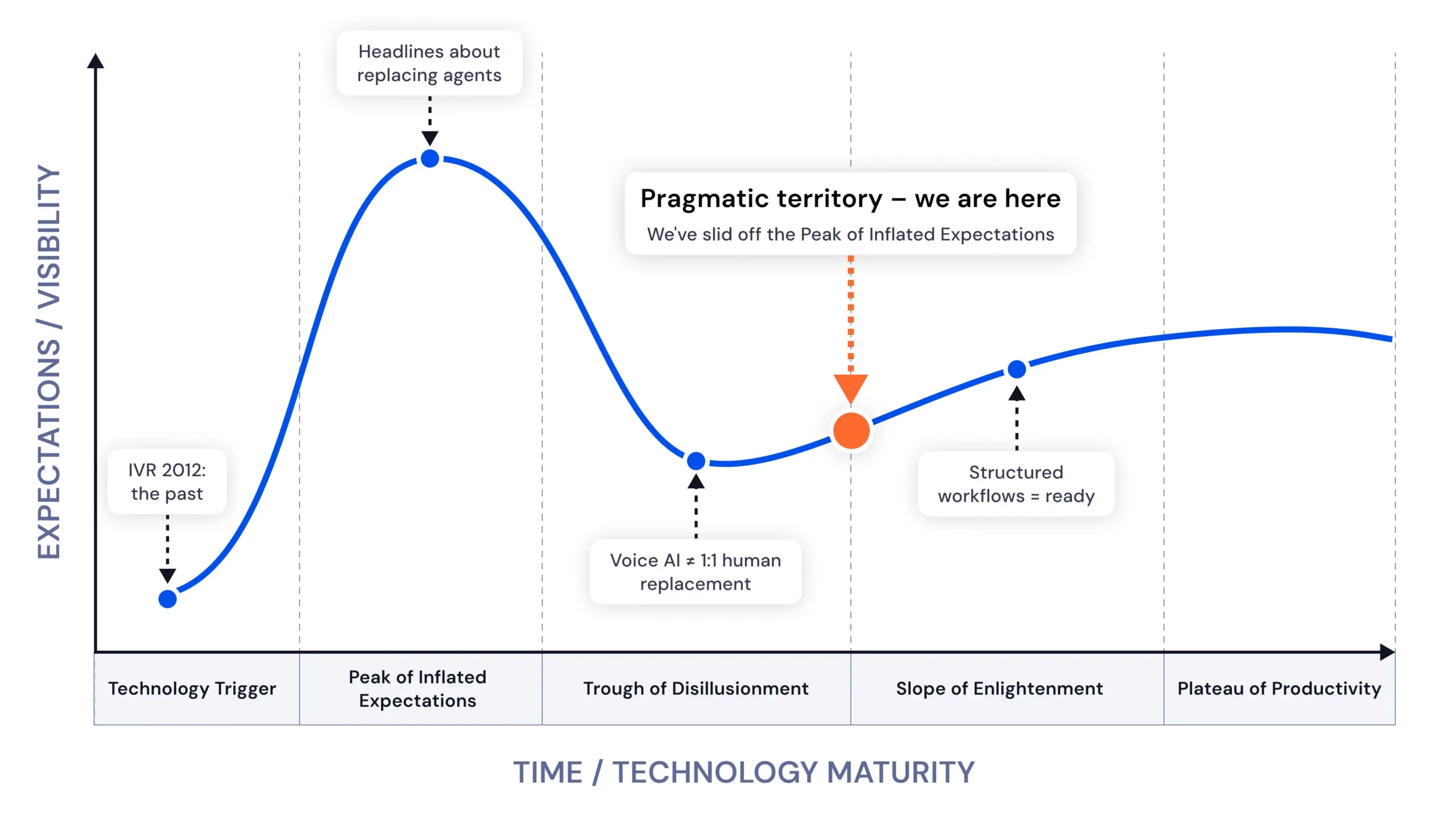
Where We Are on the Maturity Curve
We’ve slid off the Peak of Inflated Expectations and landed in pragmatic territory. Voice AI handles structured, predictable workflows beautifully. It stumbles when conversations turn emotional, open-ended, or politically sensitive.
Think of it as a spectrum. On the safe end: appointment scheduling, order tracking, password resets. On the risky end: complex B2B troubleshooting, creative negotiation, or a grieving customer closing a deceased relative’s account. Know the difference before you flip the switch.
What the Data Actually Says
PwC’s consumer sentiment research cuts through the noise. Only one in four customers prefers a voice bot over a live agent for complex issues. But for simple tasks – tracking an order, confirming an appointment – 65% are completely comfortable with AI. That gap is your strategy.
McKinsey measured the operational impact: voice AI cuts average handle time by up to 40% for routine inquiries. Not in a pilot deck. In production. When scoped correctly, the technology prints money.
Where Voice AI Excels Today: 4 Proven Use Cases
Don’t automate everything. Automate the right things. Here are four bounded, high-volume voice AI use cases call centers run daily that are genuinely ready for production.
1. Appointment Booking and Scheduling
This is the boring hero of automation. A customer calls to move a dental cleaning or reschedule a delivery window. The agent checks your Calendly, Acuity, or CRM in real time, offers open slots, books it, and sends a confirmation. No human touches the keyboard.
The downstream effect matters: automated voice reminders and instant booking confirmations drop no-show rates by 20–35%, according to Accenture’s cross-sector data. That’s revenue protection disguised as customer service.
2. Order Status and Shipment Tracking
The “Where is my order?” (WISMO) call is the most expensive repetitive question in e-commerce. It burns agent hours and customer patience. A voice agent integrated with Shopify, Magento, or your ERP pulls live carrier data instantly. The customer gives an order number; the bot reads back tracking details.
Juniper Research found that businesses using conversational AI for order status see a 30% decrease in live agent call volume within the first quarter. That is headcount you do not have to hire next month. For a deeper implementation walkthrough, read about e-commerce order status automation.
3. FAQ and Tier-1 Support Deflection
Return policies, store hours, basic warranty terms – this information lives in your help center but somehow still eats 30% of your phone volume. A voice agent can deflect these instantly, at containment rates that make CFOs smile.
Accuracy is strong in primary English-speaking markets. US, UK, Canadian, and Australian dialects are well-optimized. European and major Asian languages have reached decent maturity. But thick regional accents and low-resource dialects still cause drop-offs. Build a smooth human handoff for those moments. Don’t pretend the bot is omniscient.
4. After-Hours Call Routing and Emergency Escalation
Voicemail is a customer-experience graveyard. Overnight outsourcing is expensive. A voice agent gives you genuine 24/7 coverage for basic triage. It can answer simple questions, capture intent, and route true emergencies to an on-call manager with context attached. Your human team sleeps; your coverage doesn’t.
Where Voice AI Still Falls Short (And Will for a While)
Any vendor promising perfection in these areas is selling snake oil. Run.
Complex, Multi-Intent Conversations
A customer calls and says: “I want to return these shoes, but I lost the receipt, and I was overcharged on my last statement, and I moved to a new address.” A standard voice agent will lock up. Humans parse overlapping problems instinctively. AI parses intents, and overlapping intents break the model.
Emotional Nuance and Empathy Gaps
Sentiment analysis can detect a raised voice. It cannot sit with grief. An AI cannot genuinely empathize with a customer closing a parent’s bank account or a passenger whose flight was canceled after a funeral. Those moments require a human being who can say, “I’m sorry,” and mean it.
Integration Hurdles with Legacy Phone Systems
Cloud-native telephony – Twilio, Talkdesk, Genesys – plugs into modern voice AI cleanly. If your center runs on twenty-year-old on-premise hardware, prepare for middleware hell. Heavy engineering. Significant cost. Don’t let a vendor gloss over the integration audit.
Language and Dialect Limitations
Standard dialects are highly optimized. Niche regional sub-dialects and non-English markets with limited training data still face lower containment rates. Be honest about your customer base.
Voice AI vs. Human Agents: A Clear-Eyed Comparison
| Capability | Voice AI Agents | Human Agents |
| Scalability | Thousands of concurrent calls | Limited by headcount and shift schedules |
| Cost Per Interaction | Pennies per minute | Wages, benefits, overhead, attrition |
| Ideal Scenarios | Routine FAQs, transactional updates, routing | Complex troubleshooting, high-value sales, empathetic care |
| Handling Frustrated Callers | Never loses patience; also never de-escalates with intuition | Variable; prone to burnout, but capable of genuine rapport |
| Problem Solving Scope | Bounded by APIs and knowledge bases | Unbounded; can creatively resolve novel issues |
A Roadmap for Investing in Voice AI
Ignoring voice AI isn’t a neutral choice anymore. Your competitors are already reducing call center operational costs with automated systems. But rushing deployment is how you end up on the front page of Reddit for the wrong reasons. Here is a practical voice AI roadmap for call centers.
Stage 1: Audit Your Call Drivers and Containment Rate
Pull your last month of call logs. What are the top five reasons people dial in? If 40% or more are simple transactional requests, you have a clear automation candidate.
Containment rate is the percentage of calls the AI resolves entirely without human transfer. Measure your current state before you promise the board a number.
Stage 2: Pilot with One Low-Risk, High-Volume Use Case
Do not flip your entire queue on day one. Pick a single workflow. After-hours order tracking. Weekend appointment rescheduling. One thing. Prove it works under real load before you expand.
Stage 3: Measure, Train, and Expand
Treat the system like a trainee, not a server. Review the calls where it failed. Update training data. Refine NLU intents. Expand responsibilities only after accuracy stabilizes. This is not set-and-forget technology.
Build vs. Buy vs. Hybrid: Make the Right Call
| Approach | Upfront Cost | Time-to-Value | Control | Maintenance | Best For |
| Build from Scratch | Very high | 6–12 months | Total | Dedicated AI team required | Tech giants with proprietary security mandates |
| Buy (SaaS) | Low | Days to weeks | Very limited | None | Small teams with zero engineering support |
| Hybrid (e.g., Quidget) | Moderate | 2–4 weeks | High, tailored to workflows | Managed by provider | Mid-market and enterprise brands needing efficiency without a research lab |
How Quidget Approaches Voice AI Differently (And Honestly)
Full disclosure: Quidget builds voice AI. We have a horse in this race. That also means we see what breaks in production, and we design around it.
Built for Retail and E-commerce, Not Just Enterprise
Most legacy voice platforms were architected for banks and telecom giants. Quidget was built for Shopify merchants, mid-market retailers, and CX teams that need to deploy in weeks, not quarters.
Transparent Fallback and Human Handoff
When our agent hits a wall, it doesn’t pretend. It transfers cleanly to a human, passing full conversation context so your agent never asks, “Can you repeat that?” for the third time. That’s the difference between automation and alienation.
Trained on Real Calls, Not Synthetic Data
We benchmark at >90% intent recognition accuracy on first attempt for retail and e-commerce FAQs, with sub-1-second latency on cloud telephony. Those numbers come from real production traffic, not lab conditions. We train on actual call recordings because synthetic datasets miss the beautiful mess of how customers really talk.
If you want to see how that translates to your stack, explore Quidget’s AI platform.
Frequently Asked Questions
What types of calls can voice AI handle today?
Bounded, predictable workflows: scheduling, order tracking, FAQ deflection, after-hours triage. It is not ready for complex emotional escalations or multi-layered troubleshooting.
Is voice AI cheaper than human agents?
Per-interaction cost drops to pennies. But total cost of ownership includes integration, training, and fallback handling. For high-volume routine calls, the math is compelling. For low-volume complex calls, it isn’t.
How accurate is voice AI with different accents?
US, UK, Canadian, and Australian English are highly accurate. Major European and Asian languages are solid. Niche regional dialects and thick accents still cause errors. Always design a human fallback.
Can voice AI integrate with my existing CRM or helpdesk?
Cloud-native stacks integrate cleanly. Legacy on-premise hardware requires custom middleware and engineering budget. Audit your telephony before you buy.
Will customers get frustrated talking to an AI?
Not if the AI is fast, accurate, and honest about its limits. Customers hate being trapped in loops. They don’t hate efficiency.
How long does it take to deploy a voice AI solution?
Out-of-the-box SaaS: days to weeks. Hybrid configurable platforms: 2–4 weeks. Custom builds: 6–12 months. Match your timeline to your internal engineering capacity.
Is Voice AI Ready for Your Support Stack?
Voice AI is not ready to replace your human team. It is ready to handle the repetitive, high-volume work that burns that team out. Start with a clear audit. Pilot one use case. Measure honestly. Keep humans in the loop for everything that matters.
As one of our VPs of Product put it: “The most successful voice AI deployments today are not trying to replace agents, but to handle the repetitive, high-volume inquiries that burn out teams. The technology is ready for those bounded use cases – the hype comes from promising human-level conversation across every scenario.”
That’s the line. Stay on the right side of it.
For a broader look at automation strategy beyond voice, read our comprehensive guide to customer support automation.


