

AI Support Agents vs. Human Agents: The Numbers No One Wants to Talk About

There’s a thread on r/ecommerce that’s stuck with us. Someone wrote “AI will never replace humans in support,” it pulled a few hundred upvotes, and the replies were a pile-on of agreement. Genuinely persuasive, too — until you notice that across forty-some comments, not one person cited a number. Meanwhile the founders over on r/Entrepreneur posting “we cut the support team in half and CSAT went up” don’t cite numbers either. Two camps, total conviction, zero evidence on the table.
So let’s put some evidence on the table. Deflection rate, handle time, CSAT, cost per ticket — the four numbers this fight actually turns on, and the four nobody in those threads ever quotes.
Fair warning on where we land: this isn’t really an AI-versus-human question, and full disclosure — we build a tool that sits in the middle, so weigh that however you like. But the metrics got us to that position, not the other way around, and they’re worth walking through even if you’re sure we’re just talking our book.
Start with the prediction everybody half-quotes
Gartner’s the one that reset this conversation. In March 2025 they put out the forecast that by 2029, agentic AI will autonomously resolve 80% of common customer service issues with no human in the loop, shaving roughly 30% off operational costs in the process (Gartner).
The evangelists quote that and drop the word “common.” The skeptics don’t quote it at all. But “common” is doing all the work in that sentence, and we’ll come back to why.
The detail that actually sticks out is the one Gartner buried lower in the same release: they also expect north of 40% of agentic AI projects to be killed off by the end of 2027 — torched by costs that ran away and value nobody could pin down. Same analyst, same breath: 80% resolution is coming, and almost half the teams reaching for it will crash. That’s not a contradiction. It’s a warning about execution, and most people skip right past it.
Deflection is where the skeptics go quiet
Deflection — the share of tickets closed without a human ever touching them — is the stat the “AI can’t really do this” crowd would rather not look at.
Modern LLM agents clear 60%+ on the right ticket types. The eesel AI writeup (here) puts SaaS in the 40–60% band and e-commerce shops with mature setups at 55–75%; the best-in-class teams push past 80%. Password resets and account lookups? They deflect at 70%+ basically every time.
Now the part that matters more than any of those ceilings. The average tech company deflects about 23% (Alhena). Plenty of teams never get out of the 20s. So the real spread isn’t “AI works vs. it doesn’t” — it’s 23% for the median company against 80% for the ones who scoped it well. Same models. Same vendors, half the time. The variable is judgment about what to point the AI at, and that’s a management problem dressed up as a technology problem.
The cost gap is almost rude
Here’s what the r/Entrepreneur crowd is really flexing, even when they don’t spell it out.
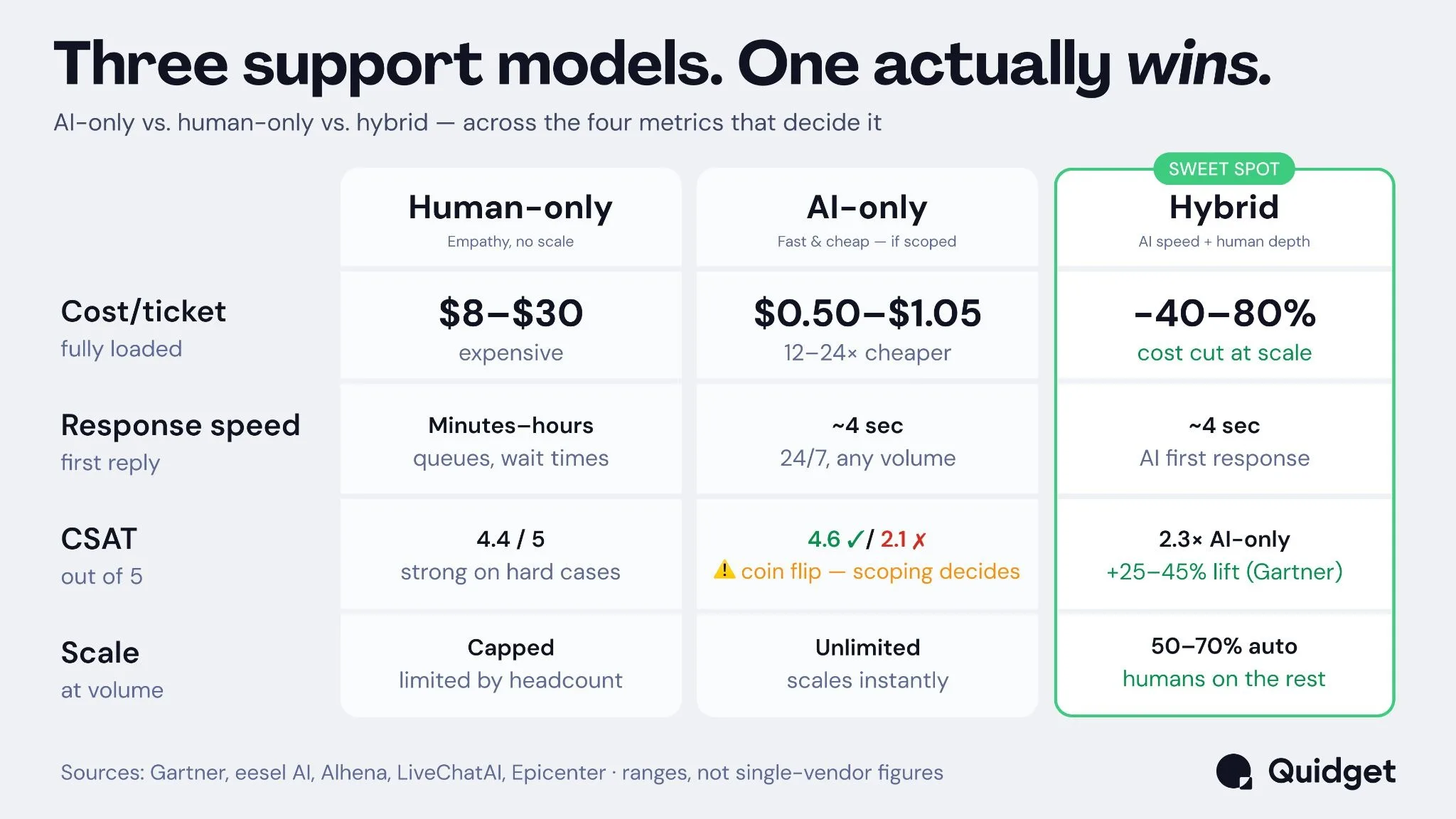
Fully loaded, a human ticket costs somewhere between $8 and $12, and at a lot of companies the all-in figure is closer to $20–$30 once you count benefits, training, tooling, the lot. An AI-handled ticket lands at $0.50 to $1.05 (LiveChatAI; the cost-comparison numbers throughout this piece lean on eesel AI’s AI-vs-human breakdown). Call it a 12-to-24x gap per interaction.
Make it concrete. Ten thousand tickets a month, blended $15 each — $150K. Send half to an AI layer at $0.75 and you’re at about $79K. Roughly 47% gone before you’ve changed a single rota or trimmed a second off response time. That’s not a wild outlier, either; companies rolling out self-service typically report a quarter to nearly half their tickets stop reaching a human, with payback inside a year.
The “we’ll always do it the human way” line never accounts for the obvious: when a competitor runs at half your cost-to-serve, that gap doesn’t evaporate. It turns into their pricing, their roadmap, their next hire. Principle is expensive when the company across the street isn’t paying for it.
Speed, satisfaction, and a number I only half-trust
Speed’s not a debate. AI answers in about four seconds, at 3 a.m., on a holiday, as patient with the ten-thousandth customer as the first. Nothing staffed by people competes with that, and nobody’s really claiming otherwise.
Satisfaction is where it gets interesting — and where we’ll plant a flag of doubt. The eesel data has AI-resolved tickets scoring 4.6 out of 5, just ahead of the 4.4 humans average. Honestly, we don’t fully buy that one at face value. AI gets pointed at the easy tickets, humans inherit the messes, and a CSAT comparison that doesn’t control for difficulty is comparing a softball to a brawl. The directional point holds — well-scoped AI doesn’t drag satisfaction down, and often nudges it up — but “4.6 beats 4.4” is suggestive, not settled. Someone should run that with matched ticket types; we haven’t seen it done.
What we do trust is the downside. Scope the AI badly and CSAT collapses into the 2.1–2.8 range. That’s not a soft dip; that’s customers who actively resent the experience, stuck in a loop, hammering “agent, agent, AGENT.” And it squares with the fact that 73% of people still want a human available as an option (Epicenter). Take that door away and you don’t bank the savings — you manufacture exactly the horror stories keeping those r/ecommerce threads alive.
So which model actually wins?
Honestly, “human-only” barely deserves a paragraph. It’s wonderful for the genuinely hard, emotional, high-judgment conversations, and it’s a non-starter on cost and speed at any real volume. Everyone already knows this. Moving on.
The fight that matters is AI-only versus hybrid, and AI-only is where we’d spend your caution. It can be brilliant — top-band CSAT, rock-bottom cost — but it’s a coin flip decided entirely by scoping, and when it loses, it loses ugly: the 2.1 CSAT, the queue of furious people, a straight shot into Gartner’s 40% project graveyard. The upside and the catastrophe are separated by one design decision.
Hybrid is the boring answer that happens to be right. AI takes the first response and fully closes the routine 50–70%; the moment a ticket turns complex or emotional, a human picks it up — ideally with the whole conversation already in hand. The payoff shows in the numbers: roughly 2.3x the CSAT of AI-only setups, first-contact resolution up 5–10%, costs down 40–80% at scale. Gartner attaches a 25–45% satisfaction lift to this exact division of labor.
We’ll concede the thing the tidy version of this argument leaves out: hybrid is harder. You’re now running two systems and a seam between them, and that seam is where most of the failure actually lives. Anyone selling you hybrid as the easy middle path is selling you something. It’s the right model and the fiddly one, both at once.
The honest bit about Quidget
This is the part where we’re contractually obligated to mention we build this, so here’s the unvarnished version.
The hard problem in hybrid was never “can the AI answer.” It’s the seam — knowing where common ends and complex begins, and handing off without making the customer start over. Get the line wrong one way and a human’s answering password resets at $15 a pop. Get it wrong the other way and your bot is arguing with someone about a refund it was never going to win.
That seam is the only thing Quidget is really trying to be good at. It takes the high-volume, well-scoped tickets where the deflection and CSAT numbers above actually hold, and it escalates — with context attached — the second a ticket needs a person. That’s the pitch. If you’d rather wire that boundary together yourself, the metrics in this post still point the same direction; you don’t need us to act on them.
Where that leaves you
The numbers nobody wants to quote aren’t really about AI or humans. They’re about a gap that’s already opening between the teams deflecting 80% and the ones stuck at 23% — a gap that compounds into cost, then price, then everything downstream. Gartner’s 2029 clock is running. The 40% who fumble it will, we’d bet, mostly be the all-or-nothing crowd — the ones who treated a scoping question like a religious one.
You don’t have to win the Reddit argument. You just have to land in the messy, two-system middle before the competition finishes moving in. The spreadsheet already settled this; the only open question is who reads it in time.
Curious where your own tickets fall on the common-versus-complex line? Map your deflection opportunity with Quidget — or steal the framework and do it yourself. Either way, run the math before someone else runs it on you.


