

What a “resolution” actually costs: AI customer support pricing in 2026, compared

Somewhere in the last twelve months, every AI support vendor discovered the same word.
Zendesk now bills $1.50 to $2.00 per AI resolution. Intercom’s Fin charges $0.99 per resolution. Ada runs $1 to $3.50 per resolution depending on your contract. Three years ago they all sold seats. Now the whole category has agreed that you should pay for solved conversations instead of chairs – which, credit where due, is the right idea. We’ve been pricing this way since day one, so watching the giants arrive has been a little like hosting a party and having the neighbors show up at midnight claiming they organized it.
But here’s what actually changed for you, the person paying the bill: “per resolution” stopped being a pricing model and became a marketing phrase. When every vendor says the same three words, the words stop telling you anything. The price is no longer the number on the pricing page. It’s the number on the pricing page, times a definition you haven’t read, plus fees that live two clicks deeper.
This article is the two clicks deeper.
A resolution is whatever the vendor says it is
There is no industry standard for what counts as a “resolution.” None. Each vendor writes its own definition, and the definition is where the money moves.
Some count a resolution when the AI sends an answer and the customer doesn’t reply – which sounds fine until you realize customers also stop replying when they give up. Some count a conversation as resolved if the AI participated, even when a human finished the job. Some let the AI mark its own homework: the bot decides the issue is closed, and that decision is a billing event.
So run this test on any tool you’re evaluating. Your AI answers a question at 2pm. The customer comes back at 4pm, still stuck, and your teammate sorts it out by hand. Did you pay for that conversation?
With a surprising number of vendors, the answer is yes. You paid the AI fee and your teammate’s time. The failure cost you twice.
Our answer, for the record: no. At Quidget, a resolution is a conversation the AI handles start to finish. The moment a human touches it, it’s $0. That single sentence should exist in every vendor’s pricing FAQ, and the fact that it usually doesn’t tells you something.
The four places the real price hides
Once you know the headline number is negotiable with reality, the rest of the bill follows a pattern. Four patterns, actually.
The seat add-on. Zendesk’s new AI pricing is $1.50-$2.00 per resolution plus $50 per agent per month. Read that again: the per-seat tax that per-resolution pricing was supposed to kill came back as a line item on top of it. If you have five agents, that’s $3,000 a year before a single ticket is resolved.
The minimum commit. Several vendors only quote per-resolution rates against an annual commitment to a volume you’re guessing at. Guess high, you pay for resolutions that never happen. Guess low, you meet cost number three.
The silent overage. Since January 2026, Zendesk automatically bills for resolutions above your plan — no approval step, the meter just runs. Intercom customers have publicly reported Fin bills jumping more than 100% month over month, not because the business doubled, but because volume did. Usage pricing without a cap you control is less a bill than a weather event.
The credit system. Some tools sell monthly credit bundles instead of priced resolutions – $150 a month buys you a pool of “credits,” and different actions burn different amounts. Nobody outside the vendor’s finance team can tell you what a resolution costs in that system, which is presumably the point.
None of these are scams. Every one is in the documentation. But documentation is where numbers go when they’d hurt the pricing page.
The math at 1,000 conversations a month
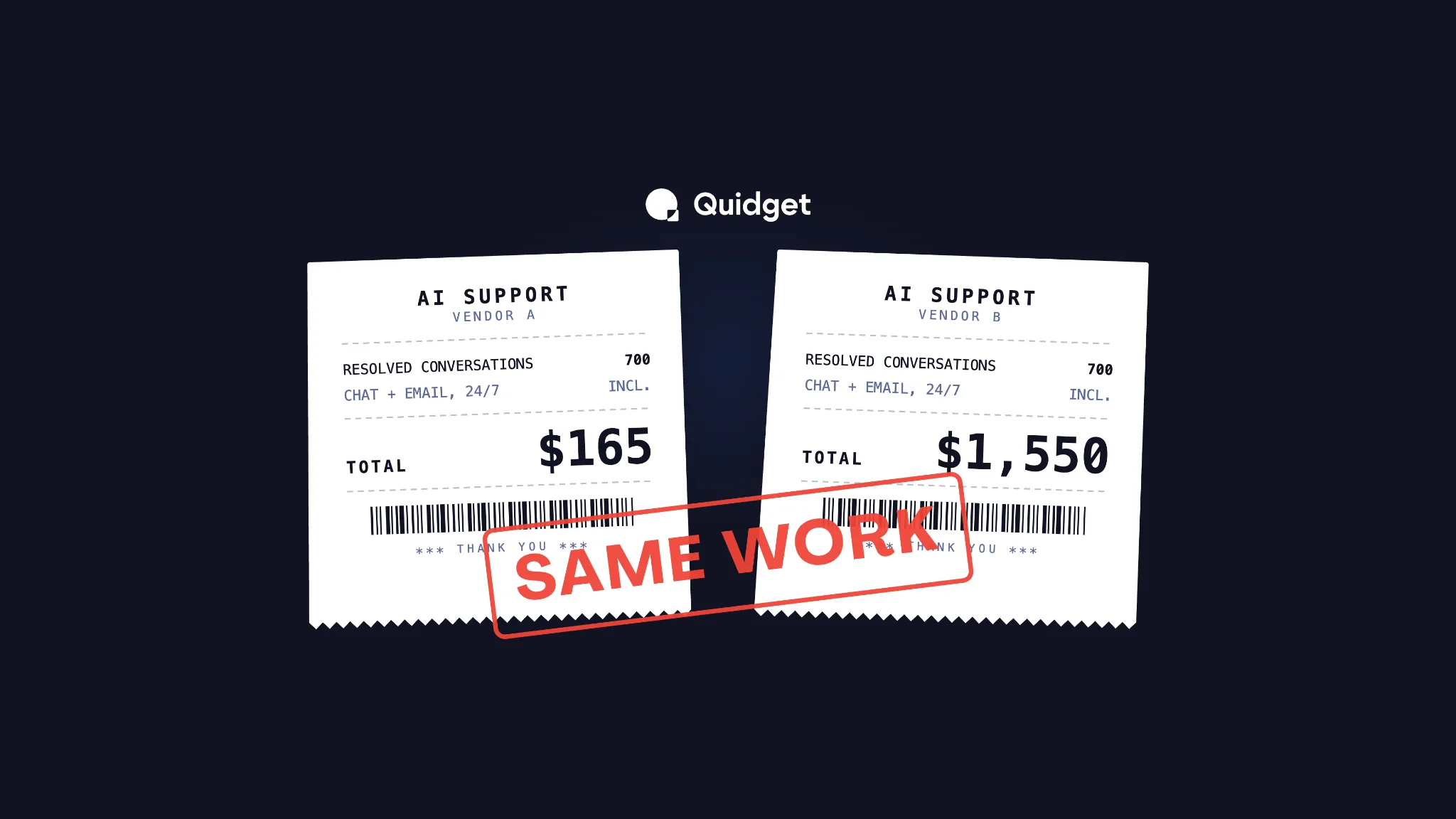
Let’s make it concrete. Say you’re a typical SMB: 1,000 support conversations a month, an AI that resolves 70% of them (700 resolutions), and three people on support.
| Rate | Resolutions (700) | Seat fees (3 agents) | Monthly total | |
|---|---|---|---|---|
| Quidget | $0.20/resolution | $140 | $0 (2 seats free, $25/seat after) | $165 |
| Fin (Intercom) | $0.99/resolution | $693 | Intercom seats billed separately | $693+ |
| Zendesk AI | $1.50-$2.00/resolution | $1,050-$1,400 | $150 ($50/agent) | $1,200-$1,550 |
| Ada | $1.00-$3.50/resolution | $700-$2,450 | – | $700-$2,450 |
Rates are from public pricing pages and announcements as of July 2026; check current pages before you buy, because this category repriced itself twice in the last year.
Same work. Same 700 solved conversations. The spread between the cheapest and the most expensive row is roughly 10x – per year, that’s the difference between $2,000 and $18,000 for identical output.
And yes, we’re the cheap one. We’ll say the word out loud, since most vendors treat it like a slur: Quidget is the cheap AI customer support option, at $0.20 per resolution, all-in. Cheap gets a bad reputation because it usually means “worse.” In usage pricing it means something specific and boring: a lower number multiplied by the same volume. Our verified customers resolve real volume at this rate – Softorino handles 60% of first-level responses through Quidget, and their bill still looks like a rounding error next to the table above. When the unit is identical – one solved conversation – a 5-10x markup buys you nothing but the markup.
Seven questions that expose the whole bill
Take these into any demo. Any vendor who answers all seven in plain sentences is probably safe to buy from, whoever they are.
- How exactly do you define a resolution? Get it in writing. “AI participated” and “AI handled it start to finish” are different products.
- If the AI fails and a human takes over, do I pay? The only good answer is no.
- Are there per-agent or per-seat fees on top? “Per resolution, plus seats” is per-seat pricing with a costume on.
- Is there a monthly minimum or annual commitment? You’re buying elasticity. A minimum removes it.
- What happens when I go over my plan – do you bill me or ask me? Automatic overage billing means your worst support month and your worst invoice arrive together.
- Can I see, per conversation, what I was billed and why? If the vendor can’t show the receipt, the meter belongs to them.
- What’s my all-in monthly cost at my actual volume, in writing? Not the rate. The total. Watch how long this takes.
The pattern behind all seven: in usage pricing, transparency is the product. A usage model you can’t audit is a subscription with extra anxiety.
What this looks like when it’s simple
We built Quidget’s pricing to survive this checklist, so running it through takes one paragraph.
A resolution is a conversation the AI handles start to finish – if your team steps in, that conversation costs $0. The rate is $0.20 per resolution, all-in. Two team seats are included; extra seats are $25. There’s no minimum, no annual commit, and no silent overage — your bill is $0.20 times a number you can count yourself. Behind the widget there’s a full (deliberately simple) helpdesk: shared inbox, handoff with context, conversation history. If you already run a helpdesk you love, keep it and add Quidget on top for $249 a month flat, same $0.20 rate.
That’s the whole pricing model. It fit in a paragraph, which was the goal.
The honest close: the industry moving to per-resolution pricing is good for you. It’s the right unit. But the vendors who adopted the unit also brought their old habits – seat fees, minimums, meters you can’t read. So before you sign anything this year, do two things. Multiply your last month’s ticket volume by each vendor’s real all-in rate. Then ask your current tool the seven questions above.
If any answer takes more than one sentence, you’ve found where the money is.
Quidget resolves up to 80% of support conversations automatically, at $0.20 per resolution. Create your bot and run the math on your own traffic – your first resolved conversations will cost you less than this article took to read.


