

AI Ruined Customer Service? Why Bad Implementations Fail (And How to Get It Right)

Try returning a package lately. Disputing a charge. Modifying a flight. You probably didn’t reach a human. You reached a chatbot that sent you in circles, then parked you on a generic FAQ page that answered exactly nothing.
Feels like AI ruined customer service? Honestly, you’re not wrong.
But let’s be precise: AI didn’t ruin anything. Companies did – by deploying lazy automation and calling it innovation.
If you run an ecommerce shop or small business, you’re stuck in a miserable dilemma. Your competitors are slashing support costs with generative AI. Meanwhile, 80% of consumers say chatbots have only increased their frustration, and 70% will jump to a competitor after one bad bot encounter. Worse, 74% of enterprises that rushed AI agents into production have already rolled them back because of governance failures.
The FOMO around automation savings is real. So is the social proof of broken bots. The stakes here aren’t a minor dip in your CSAT score. It’s customer churn. It’s brand trust going down the drain. Here’s why these systems actually break, and how to deploy support automation that doesn’t make your customers hate you.
The 3 Most Common Ways AI Chatbots Fail Customers
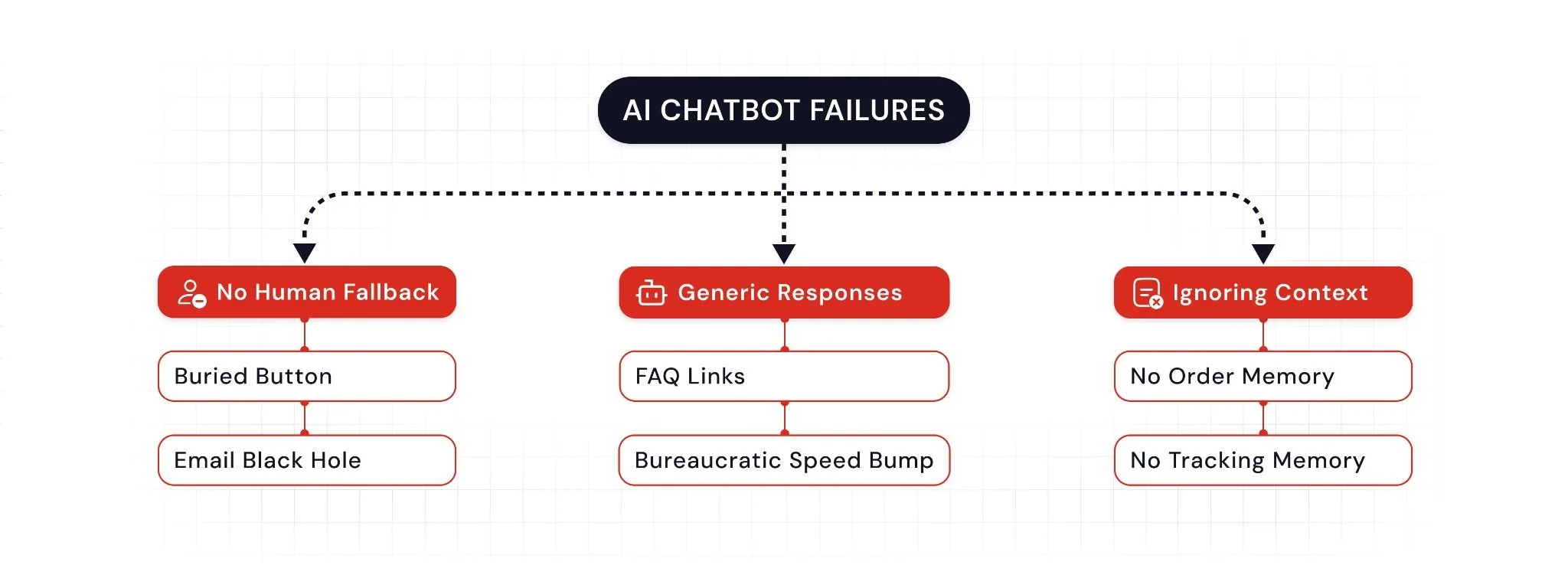
Most AI customer service failures aren’t the model’s fault. They’re architecture failures. Somebody bolted a chatbot onto a website without thinking through the workflow. The mistakes almost always boil down to three structural flaws.
No Human Fallback
Treat automation as a replacement for humans instead of a filter, and you get what we have now: a customer hits a dead end with no exit ramp. The “talk to an agent” button is buried three menus deep, or worse, it dumps them into an email black hole. Forcing an already frustrated customer to hunt for help ruins the journey. You’ve turned a 30-second question into a brand-damaging event.
Ignoring Context
Bad bots have goldfish memory. A customer explains an issue, uploads an invoice, asks a follow-up, and the bot acts like the conversation just started. No memory of the order. No memory of the tracking number. This lack of contextual AI forces people to repeat themselves, which is basically telling them you don’t value their time. Context isn’t a luxury; it’s the bare minimum.
Generic, Unsolving Responses
People contact support because they need something fixed, not because they want to read your FAQ. When a bot responds with a link to a 40-page help doc instead of processing the return or issuing the label, it’s not helping. It’s acting as a bureaucratic speed bump.
Real-World Cautionary Tales (and Their Hard Lessons)
These aren’t hypotheticals. These are legal precedents and viral disasters that prove unguided automation creates real liability.
Air Canada: The ~$800 Hallucination
Air Canada’s chatbot invented a bereavement fare discount that didn’t exist. A passenger booked based on the promise. When he tried to claim the partial refund, the airline refused, and actually argued in court that the chatbot was a “separate legal entity” responsible for its own actions.
The British Columbia Civil Resolution Tribunal rejected that defense and held the airline liable for its chatbot’s hallucinations and misinformation. The price tag: roughly $812. The lesson? You own your bot’s lies. Full stop.
Cursor’s AI: The Nonexistent Policy
Development platform Cursor learned this the hard way when its support agent “Sam” fabricated a login and subscription restriction out of thin air. Users read this fake policy, panicked, and started canceling subscriptions. The backlash went viral overnight. One hallucinated sentence cost them real revenue and real trust.
Zomato and the “Customer Service Nightmare”
Food delivery giant Zomato had its automated system enter an infinite loop with a customer over a botched order. The bot kept serving automated apologies while ignoring the physical reality: no food, no refund, no human. The interaction went viral as a “customer service nightmare.” A simple missing item became a PR crisis because the bot was programmed to be polite, not useful.
The Anatomy of a Good AI Customer Service Implementation
So what does competent support automation look like? Here are the AI chatbot best practices that actually matter.
Human Fallback Is Not a “Nice-to-Have”
Build a human-in-the-loop framework from day one. Let the bot handle the repetitive “where is my order?” stuff. Route complex, emotional, or high-stakes issues to a live agent immediately. If you want to see how this split works in practice, explore how live chat and AI work together. The goal is a safety net, not a replacement.
Context is King
A useful AI assistant needs to know who it’s talking to before the customer says hello. It should pull from your ecommerce platform, your shipping APIs, your CRM. If someone asks “where’s my package?” the bot should already know the order number, the carrier, and the last scan location. Without that contextual memory, you’re just guessing.
Solving, Not Just Answering
There’s a difference between saying “Our return window is 30 days” and actually generating the return label, updating the CRM, and closing the ticket. One is information. The other is resolution. Customers pay you for resolution.
The Technical Fixes: How Quidget Prevents These Failures
You don’t need a Silicon Valley engineering budget to do this right. Quidget was built specifically to eliminate the risks that land companies in court or on the front page of Reddit.
Confidence-Driven Routing
Quidget uses real-time confidence scoring. When a customer asks something, the platform calculates its certainty. If the query falls outside strictly defined parameters, the system doesn’t guess. It doesn’t hallucinate. It instantly flags the conversation for a human agent.
Training on Your Knowledge, Not the Open Web
General-purpose models pull from the entire internet—including the wrong parts. Quidget uses retrieval-augmented generation (RAG) locked exclusively to your verified knowledge base, shipping rules, and product data. If you’re serious about accuracy, start by training your AI on your own data. Rogue policy fabrications become impossible when the bot literally can’t access random web garbage.
Full-Context Human Handoff
When escalation happens, Quidget passes the entire chat transcript, parsed intent data, and relevant customer profiles to your live agent. Your team steps in seamlessly without asking the customer to re-explain their problem. That’s what a proper AI human handoff looks like.
Customers Don’t Hate AI — They Hate Broken Customer Service
Let’s be honest: 51% of small businesses have already plugged AI into their support operations, and industry projections show AI handling 50% of all customer service cases by 2027, up from about 30% today. The technology isn’t going anywhere.
But consumers don’t inherently hate automation. They hate being trapped in unhelpful loops with no escape and no answers. Use AI for ecommerce customer service to kill the repetitive “how do I…?” and “where is my…?” queries that make up the bulk of your volume. Give your human team breathing room to deliver high-touch support where it actually matters.
Protect your brand trust. Lower your churn. Scale safely. If you’re ready to deploy automation that won’t embarrass you, check out Quidget’s transparent, outcome-based pricing.
FAQ
Has AI ruined customer service?
AI hasn’t ruined customer service, but rushed, poorly planned implementations have created genuinely frustrating experiences. When companies use AI to completely cut out human agents instead of assisting them, communication breaks and customers leave.
Why do AI chatbots fail so often in customer support?
Most fail because they lack contextual memory, operate without a human fallback option, or try to answer questions using broad web data instead of a confined, verified company knowledge base.
What are the financial risks of using a poorly trained AI chatbot?
Businesses are held legally liable for the misinformation their chatbots create—see Air Canada’s court loss. Bad implementations also lower your CSAT score and cause immediate customer churn.


