

The “Eat Your Own Dog Food” Playbook: Running Support Entirely on Our Own AI Agent

There’s a specific kind of post that does numbers in r/SaaS. Not the “we hit $10k MRR” flex, not the launch announcement nobody asked for. It’s the quiet one: “We’re running all of our customer support through our own AI agent now. Here’s what broke.”
People upvote that. Hard. Because it’s the rarest thing in a builder community — a team actually using the thing they sell, in production, on real customers, and telling you where it leaks.
So here’s ours. No case-study gloss, no “10x your support” headline. Just what happened when we stopped answering tickets by hand and pointed the whole inbox at Quidget — the agent we’d been telling everyone else to buy.
Why we had to eat our own dog food
For a long time, support at Quidget was a human job. Someone on the team answered “how do I reset my password” at 11pm and called it customer obsession. Honestly, a lot of it was avoidance — it’s easy to not fully trust an AI agent with your own customers, even while you’re building one for everyone else.
That’s the tension every team in this space lives with. You’ll happily demo your product to a prospect. Will you point it at your own account, where a bad answer costs you a churned user and a screenshot in someone’s group chat? Most companies won’t. And customers can smell it. “Do you use this yourselves?” is the single hardest question in a sales call, and the only answer that lands is yes — and here are the receipts.
So we committed, publicly, which is half the trick. Once you say “we’re going AI-first on support” out loud, the consistency principle does the work willpower won’t. There’s no quiet backing out. People are watching.
The setup (faster and dumber than we expected)
We’ll save you the suspense: standing it up took a single afternoon, not the two-week migration we’d braced for. We pointed Quidget at our help docs, three months of resolved tickets, and the changelog. That’s it. No grand knowledge-architecture project.
The resolved tickets mattered most. They’re a transcript of how a real human had already answered every common question, in our actual voice. Docs are how you wish you talked. Tickets are how you actually answer.
First mistake — write this down, because everyone makes it: we over-scoped the launch. The instinct is to make the agent handle everything on day one. Wrong move. The version that worked was almost embarrassingly narrow: let the agent own the repetitive, high-volume, low-stakes questions and route the rest to a human. Password resets, billing-cycle questions, “where’s the export button,” “does this integrate with X.” The boring 80%.
The numbers (the part you actually came for)
Here’s the honest scoreboard after going live:
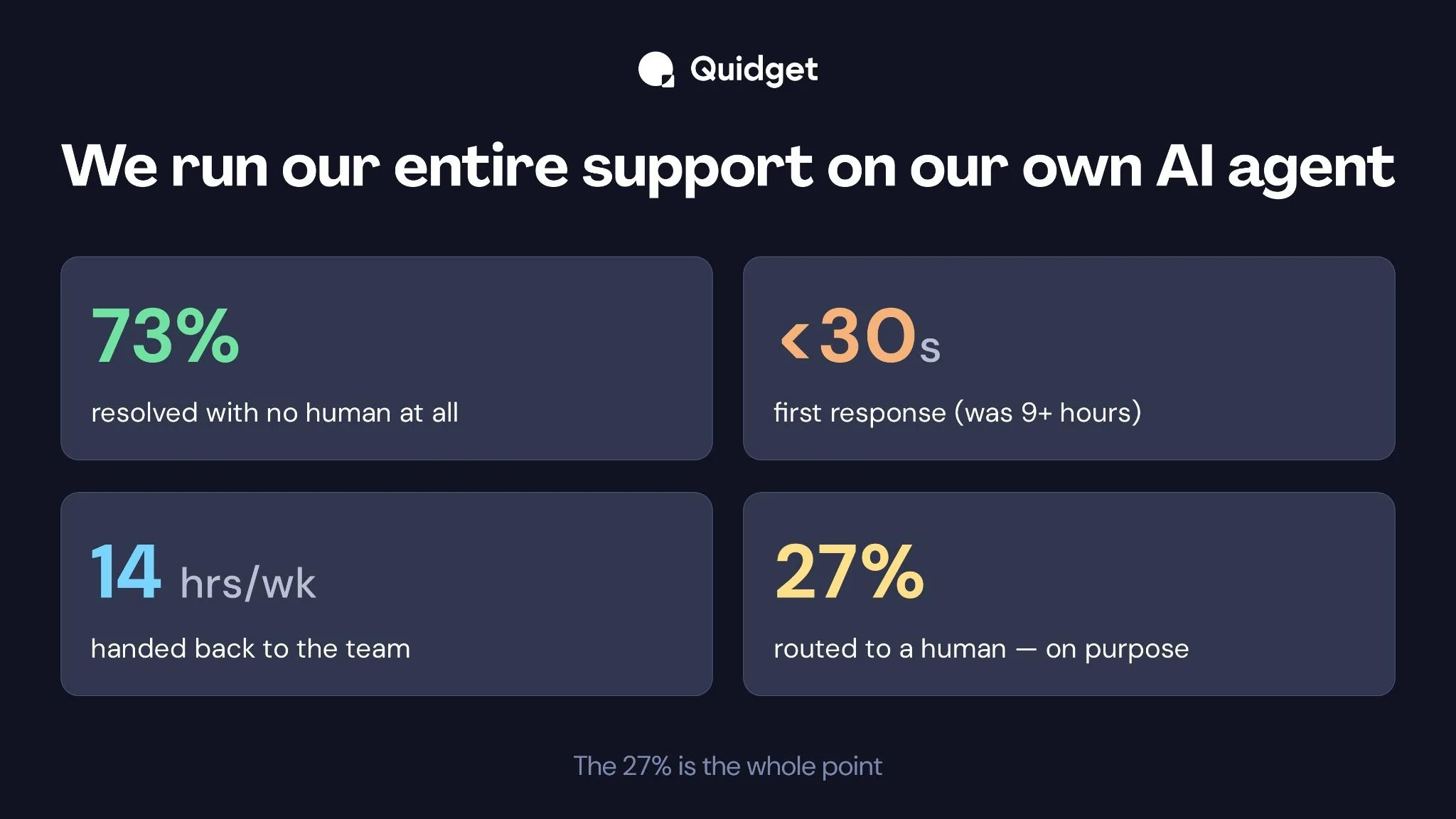
- Volume: the agent now sees about 430 conversations a week.
- Resolution: 73% close out with zero human involvement — no nudge, no hand-off, nothing.
- First response: dropped from a little over 9 hours (read: “whenever someone got to it”) to under 30 seconds.
- Time back: roughly 14 hours a week the team no longer spends in the inbox.
That last number is the one that changed how we work. Fourteen hours is a full feature shipped. It’s the difference between answering support and building the product that generates the support. The 73% looks great on a slide; the reclaimed hours are what you feel on a Tuesday.
And before this reads like an ad: the agent isn’t magic. It’s a very fast, very patient teammate who has read every doc we’ve ever written and never gets annoyed at the same question for the 400th time. That’s the whole value. Turns out that’s worth a lot.
The mistake we’re not proud of
You came for the real story, so here’s the one that stung. Early on, a customer asked whether our Pro plan included single sign-on. The agent said yes. It doesn’t — SSO is Enterprise-only. So the customer upgraded to Pro specifically for SSO, went looking for it, and found nothing. Wrong, stated with total confidence, and it cost them money. The worst possible combination. We found it in the logs the next morning, with a justifiably irritated reply already sitting in the thread.
Here’s the lesson, and it’s the part most “AI support” posts skip: the failure wasn’t the wrong answer. Humans give wrong answers too. The failure was that the agent didn’t know it was at the edge of its knowledge. A good support rep says “let me check with the team.” A naive agent just… guesses, fluently.
So the fix wasn’t a smarter model. It was teaching the agent to recognize its own uncertainty and hand off instead of improvise. The moment it was tuned to escalate when confidence was low — to say “let me get a human on this” rather than invent — the trust problem mostly went away. An agent that knows what it doesn’t know beats a smarter one that doesn’t.
What it still doesn’t do (and we’re fine saying so)
If a vendor tells you their AI handles 100% of support, close the tab. Here’s what Quidget deliberately doesn’t touch:
Anything emotional or high-stakes — an angry customer threatening to churn, a billing dispute, a “your product lost my data” panic — goes straight to a human. Always. Those moments are where loyalty is won or lost forever, and they’re exactly where a chipper AI tone makes things worse. That remaining 27% of conversations routes to a person, by design, not by failure.
It also doesn’t make judgment calls. “Should we refund this person outside policy because they’ve been with us two years?” is a human decision. The agent surfaces the context — who they are, what they’ve paid, what they asked — and a human makes the call in ten seconds instead of ten minutes. That’s the model that actually works: not AI replacing support, but AI doing the reading so the human only does the deciding.
The playbook, if you want to copy it
Strip away our specifics and here’s the repeatable version:
- Commit in public. Tell your community you’re going AI-first. The accountability is the feature.
- Feed it your resolved tickets, not just your docs. Docs are how you wish you talked. Tickets are how you actually answer.
- Launch narrow. Hand it the boring, repetitive 80%. Keep the messy 20% human until you trust the logs.
- Tune for humility, not IQ. The biggest win is teaching it to escalate when unsure. Confident-and-wrong is the only unforgivable failure.
- Watch the logs daily for two weeks. You’re not babysitting a robot; you’re learning what customers actually ask — which is gold for your roadmap anyway.
- Publish your numbers. Real ones, including the ugly ones. That’s what gets upvoted, and that’s what builds the trust that closes deals.
The part nobody tells you
The dogfooding wasn’t really about support. It turned out to be the most honest product research we’ve ever done. Every gap in the agent’s answers was a gap in our docs. Every escalation was a signal about where the product confused people. We learned more about our own software in two weeks of reading AI support logs than in six months of user interviews.
And the credibility compounds. The next time a prospect asks “do you use this yourselves?”, there’s no sales answer needed — just a screenshot of the dashboard. That single move — running your own support on your own agent and being transparent about exactly where it wins and where it taps out — is worth more than any landing page.
So that’s the playbook. If you’re building in this space and you haven’t turned your own product on yourselves, that’s not caution. That’s a tell. Your customers already suspect it, and the teams who go first — publicly, with the mistakes included — are the ones whose threads get pinned.
Point it at your own inbox this week. Worst case, you find out what your customers have been confused about all along. Best case, you get your Tuesdays back.
This is the experiment we ran on Quidget, our own AI support agent. We’d rather you read the logs than the brochure — so put it on your own support and tell us where it leaks.


