

Best Zendesk alternatives in 2026 (now that Zendesk bills per resolution too)

If you’re reading this, one of three things probably happened.
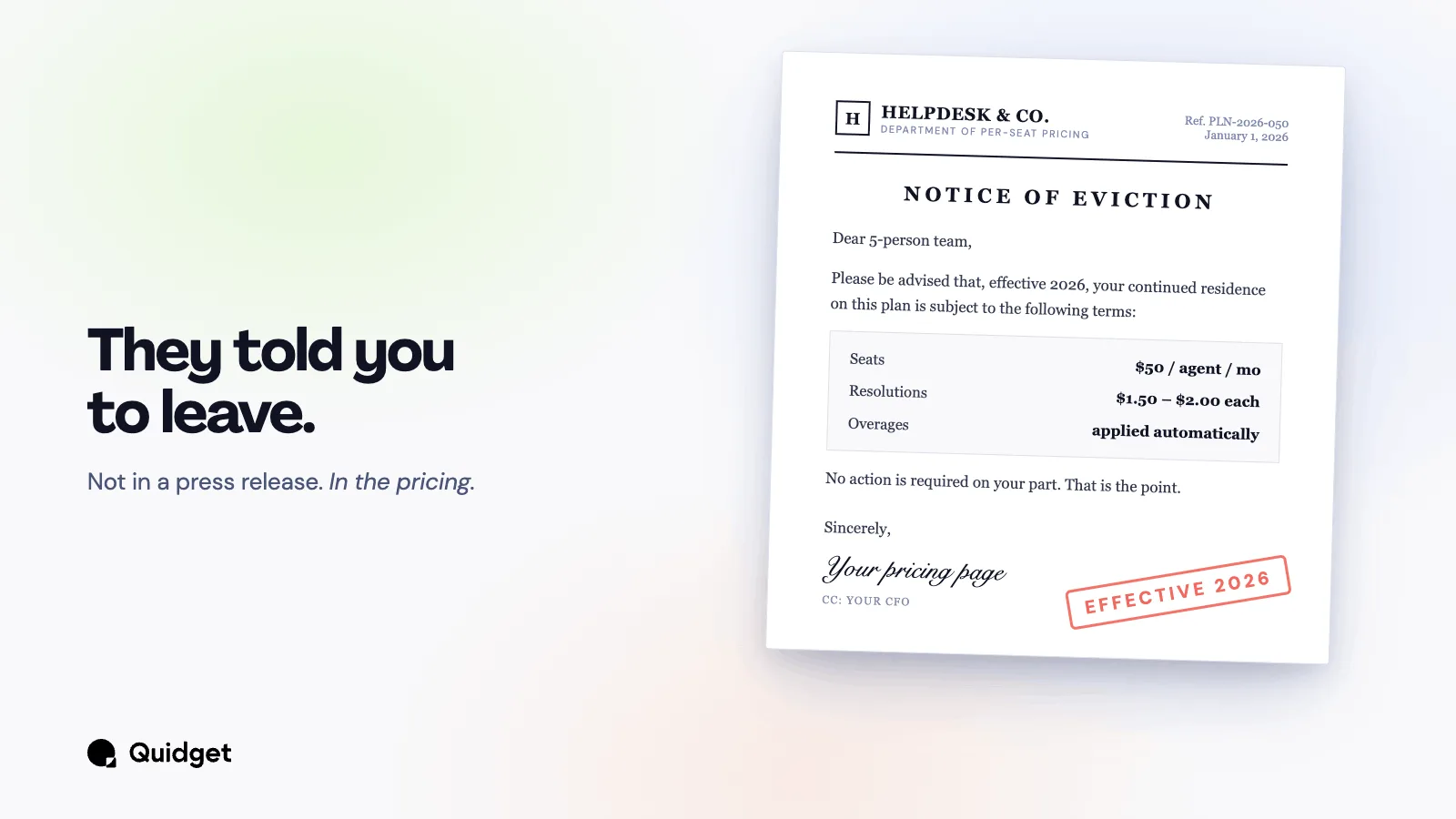
Your Zendesk bill arrived with AI resolution charges you didn’t fully expect. Or you priced out their new AI pricing – $1.50 to $2.00 per resolution, plus $50 per agent per month – and did the multiplication. Or you’re simply tired of paying enterprise-workflow prices for what your five-person team actually uses, which is an inbox, some macros, and a bot that answers the same ten questions.
Whatever brought you here, you have company. Zendesk changed its economics in 2026, and a lot of small teams are re-shopping because of it. Three changes matter:
- Per-resolution AI pricing arrived at Relate 2026 – $1.50-$2.00 per AI-resolved conversation, layered on top of $50/agent/month. Usage pricing plus a seat tax.
- Automatic overage billing has been on since January 2026. Go past your plan and the meter runs – Zendesk bills first, you find out on the invoice.
- Forethought got absorbed, and its AI now sits behind a threshold of roughly 20,000+ tickets a month. If you’re mid-market or smaller, the good stuff points away from you.
None of this makes Zendesk a bad product. It makes Zendesk a product increasingly priced and built for a customer that isn’t you. So here’s an honest tour of the alternatives – including who each one is really for, and who should just stay put.
What to look for in a replacement (three filters)
Before the list, the criteria. Three filters remove most of the noise.
AI and helpdesk in one, not a bot bolted on. The Zendesk model – helpdesk here, AI add-on there, each with its own fee – is exactly the structure that produced the bill you’re staring at. The alternatives worth switching to treat the AI agent and the inbox behind it as one product.
A defined resolution price. If a tool bills per resolution, make it show you the definition in writing, the all-in monthly at your volume, and its overage policy. (We wrote a full teardown of this, with a seven-question checklist – worth reading before any demo, ours included.)
No forced migration. Moving helpdesks is a quarter-long project. Some tools on this list can sit on top of your existing setup, which means you can test the economics before you commit to the move.
The list
1. Quidget – for teams that want the AI to do the work and the bill to stay legible
Yes, our list, our product first – you knew the deal when you clicked. Here’s the honest case.
Quidget is an AI support agent with a full, deliberately simple helpdesk behind it: shared inbox for AI and human conversations, handoff with complete context, ticket history, team seats. The pricing is the part people re-read: $0.20 per resolution, all-in. A resolution means the AI handled the conversation start to finish – if your team touches it, that conversation costs $0. Two seats included, $25/seat after, no minimums, no overage billing. At 1,000 conversations a month with 70% auto-resolved, that’s about $140-$165 – roughly a tenth of the same volume on Zendesk’s new AI pricing. Full comparison: Quidget vs Zendesk.
The no-migration angle: not ready to leave Zendesk? Keep it. Quidget runs alongside your existing helpdesk for $249/month flat, same $0.20 rate – so you can watch the resolution rate on your own tickets before you move anything. Verified numbers behind it: Softorino runs 60% of first-level responses through Quidget (live in under two days), JJESIM cut inbox volume 40%. Built by the SupportYourApp team – 15 years running support for 250+ brands.
Not for you if: you need deep workflow automation, SLA tooling, or enterprise compliance checklists. Our helpdesk is simple on purpose; if you love macros the way some people love spreadsheets, look at Freshdesk below.
2. Fin (Intercom) – for teams that want the biggest AI-agent brand and will pay for it
Fin is the best-known AI agent in the category, and it’s genuinely capable – Intercom claims 76% average resolution rates (their number, not ours). Pricing is $0.99 per resolution, plus Intercom’s per-seat costs underneath, so the math lands well above self-serve territory but below Zendesk’s new rates.
The 2026 wrinkle: Salesforce announced a ~$3.6B agreement to acquire Fin. If you’re evaluating now, you’re buying into an integration year – roadmap, pricing, and support motion all subject to a new owner’s priorities. Some teams will see Salesforce scale as reassurance. Others – especially ones that have lived through a platform acquisition – will read it as a reason to wait or look elsewhere. Full comparison: Quidget vs Fin.
Best for: brand-conscious teams with budget who want the most-marketed AI agent and don’t mind the Intercom stack around it.
3. Chatbase – for teams that want voice AI at a self-serve price
Chatbase moved fast in 2026: voice AI went out to all users at roughly $150/month, WhatsApp support landed, HIPAA compliance shipped, and in June it added its own help desk. If phone support matters to you and your budget says self-serve, it’s the strongest voice story at this price point.
The caution flag is the billing model: Chatbase sells credit bundles, and different actions burn credits at different rates – so translating “$150/month” into “cost per resolved conversation” takes real effort. Run your volume through their credit math before you commit. Full comparison: Chatbase vs Quidget.
Best for: SMBs that specifically want voice + chat in one tool and are comfortable managing a credit balance.
4. Tidio – for Shopify stores that want chat-first support
Tidio grew up as live chat for e-commerce and it’s still the natural pick if your support life revolves around a Shopify store – its Lyro AI agent ships with commerce-specific skills, and the install base is huge. Entry pricing is friendly ($29-$59/month), but the ladder climbs quickly: the Plus tier runs around $749/month and the new Premium tier reaches $2,999/month. Map which tier your features actually live in before you decide it’s the cheap option. Full comparison: Tidio vs Quidget.
Best for: e-commerce teams on Shopify who want chat-first support with AI attached, and whose needs fit the lower tiers.
5. Crisp – for European teams that want flat, predictable pricing
Crisp takes the opposite bet from everyone else on this list: flat monthly pricing (roughly €45-€295 depending on tier), explicitly positioned against per-resolution billing, with EU hosting and data residency as first-class features. If your volume is stable and high, flat pricing can genuinely win the math. Two things to check: AI features are gated to the €95+ tiers, and a flat price cuts both ways – in slow months you’re paying the same bill for less work, and there’s no per-conversation receipt to audit. Full comparison: Quidget vs Crisp.
Best for: European SMBs with steady volume that value data residency and bill predictability over unit-level transparency.
6. Freshdesk – for teams that want Zendesk’s shape at a smaller size
The closest like-for-like swap on this list. Freshdesk is a traditional ticketing helpdesk with the familiar furniture – SLAs, automations, a marketplace – plus Freddy AI, which now ships vertical agents with 50+ prebuilt workflows for Shopify, Stripe, and friends. If your team genuinely uses workflow depth and you just want it cheaper and simpler than Zendesk, start here.
The AI economics are the murky part: Freddy is priced per session, and a “session” is a fuzzier unit than a resolution – the definition question from our pricing teardown applies double.
Best for: teams that need real ticketing workflows (not just an inbox) and treat AI as an add-on rather than the main event. Full comparison: Freshdesk vs Quidget.
7. Gorgias – for DTC stores that live inside their orders
Gorgias is the e-commerce specialist: the inbox is built around Shopify orders, so agents (human or AI) can act on refunds, edits, and tracking without leaving the ticket. For a DTC store where 60% of tickets are WISMO, that’s a real workflow advantage. Pricing scales with ticket volume, so model a peak-season month – Black Friday math is different from March math. Full comparison: Quidget vs Gorgias.
Best for: Shopify/DTC brands whose support is mostly order surgery.
The comparison table
| Tool | Best for | AI pricing model | Helpdesk included | Watch for |
|---|---|---|---|---|
| Quidget | SMBs that want AI-first support, legible bills | $0.20/resolution, defined, $0 handoffs | Yes (simple by design) | No deep workflow/SLA tooling |
| Fin (Intercom) | Brand-conscious, bigger budgets | $0.99/resolution + Intercom seats | Via Intercom | Salesforce acquisition year (close ~Jan 2027) |
| Chatbase | Voice + chat at self-serve price | Credit bundles (~$150/mo) | Yes (new, Jun 2026) | Credit burn hard to convert to unit cost |
| Tidio | Shopify chat-first support | Included by tier | Chat-centric | Tier ladder: $59 → $749 → $2,999 |
| Crisp | EU teams, stable volume | Flat tiers (€45-€295) | Yes | AI gated at €95+; no per-unit receipt |
| Freshdesk | Workflow-heavy teams leaving Zendesk | Per-session (Freddy) | Yes (full ticketing) | “Session” even fuzzier than “resolution” |
| Gorgias | DTC/Shopify order-heavy support | Volume-based plans | Yes (order-centric) | Peak-season volume pricing |
Pricing as of July 2026, from public pages and announcements. Verify against live pricing before you buy – and get the all-in number for your volume in writing.
Who should actually stay on Zendesk
Credibility check: some of you should close this tab and stay.
Stay if you’re running a large support org that genuinely uses the deep stuff – multi-brand workflows, granular SLA policies, workforce management, a marketplace integration your ops depend on. Stay if you’re pushing 20,000+ tickets a month, where the absorbed Forethought capabilities start earning their keep and per-resolution fees can be negotiated down on an enterprise contract. And stay if you have the admin capacity to configure spend caps properly, which defuses most of the overage problem.
The teams that should leave are the ones Zendesk’s 2026 pricing quietly told to leave: five-seat teams paying for workflow depth they never touch, plus $50/agent for AI, plus $1.50+ per resolution, plus overages they discover on the invoice. If that’s you, the market has never had better exits.
Start with the math. Take last month’s ticket count, multiply by each tool’s real all-in rate, and see what the same month of work costs across this table. If you want the shortcut: Quidget’s number is $0.20 times your resolved conversations, and you can point it at your own docs this afternoon without migrating anything – the cheapest way to find out is to watch it resolve your actual tickets.
Related reading: What a “resolution” actually costs: AI support pricing in 2026, compared – the seven questions to ask any vendor on this list before you sign.


