

A How-Study on AI Support: The Line Between the Bots People Thank and the Bots People Rage-Quit

Salesforce just paid $3.6 billion for Fin, the company most of us still think of as Intercom. The news landed on Hacker News, and within an hour the thread had ninety comments — almost none of them about the price. They were about a much older argument: does AI customer support actually work, or is it an elaborate way to make customers give up?
What’s interesting is that the same thread answered its own question. In one comment, someone calls AI support “such a grift” and says he’s “literally lost sales” because of it. A few comments down, someone describes calling Starlink and getting an experience “easily better than 95% of customer support experiences I’ve had” — no repeating himself, instantly escalated to what felt like a senior rep. A third person, who builds these systems for a living, drops the line that should stop everyone: his team automated most of a company’s support, and customers rated the AI higher than the human agents.
So which is it? Both. The deciding variable is never “AI or not.” It’s execution. And execution is the only thing worth writing about — which is why this isn’t a case study. Nobody is moved because your other clients are happy. A case study tells you that it worked. A how-study tells you how, and is honest about where it doesn’t. Here’s the how.
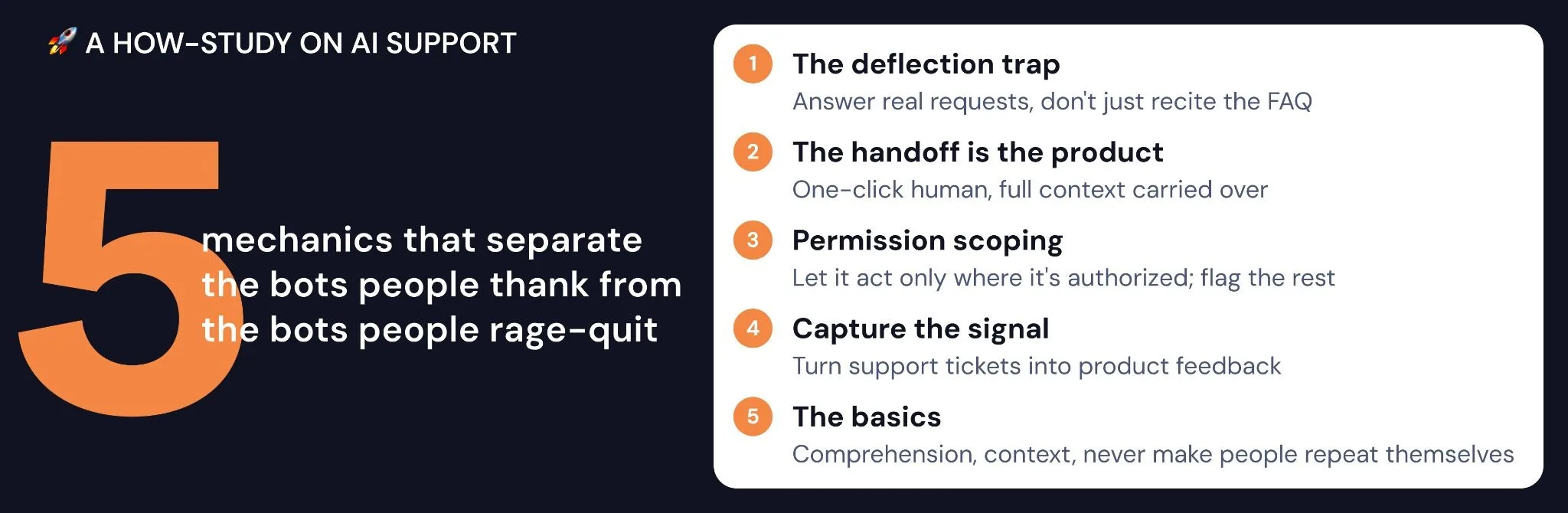
The deflection trap is where most bots die
The most common failure in the thread isn’t dramatic. It’s a bot that, as one commenter put it, just “barfs the FAQ back at you.” Another was blunter: AI agents are “fancy documentation search engines” — great when your answer is documented, useless the moment it isn’t.
This is the deflection trap. A company looks at its ticket volume, sees that 80% of questions are repetitive, and ships a bot to absorb them. The math looks great. But a customer who already read the help page and is now talking to a bot that recites the help page hasn’t been helped — they’ve been delayed. You haven’t deflected a ticket. You’ve added a step before the ticket.
The mechanic that separates good from bad here is request classification before response. Before answering, the system has to know what kind of request this is. Is the customer missing information they could find themselves — or are they asking for a decision, a remediation, an action the interface won’t let them take? Those are different jobs. The first one a bot can own end to end. The second one a bot should recognize fast and route, not improvise around.
The thread has the perfect example: someone lost their debit card while traveling, and only a human agent could reroute the replacement to their hotel. No amount of documentation search solves that. A well-built agent’s job there isn’t to answer — it’s to recognize within two exchanges that this needs a human, and to get there cleanly.
The handoff is the product
If you read nothing else in that thread, read how often people beg for a human. “Can I please speak to a human?” is described as the only thing that ever works. The single biggest driver of AI-support hatred isn’t bad answers — it’s being trapped by them.
And yet one commenter, almost in passing, designs the winning system himself: let the AI answer immediately, pull up the account, document the issue, and hand a prepared ticket to a human who steps in soon after. He calls it an AI secretary. It’s exactly right. The value of the bot in hard cases isn’t that it replaces the agent — it’s that it does the tedious front half of the job so the human starts the conversation already knowing who you are and what’s wrong.
The mechanics that make this work:
- An always-available exit. “Talk to a human” should be one click, never buried, never gated behind three rounds of “did this solve your problem?”
- Context that travels. When the handoff happens, the human inherits the full transcript, the account, and the bot’s best guess at the issue. The customer never repeats themselves — the thing the Starlink commenter praised most.
- Honest escalation triggers. The bot should hand off the moment it detects frustration, a remediation request, or repeated failed attempts — not after it’s exhausted every script.
A bot you can escape is a bot people forgive. A bot that holds you hostage is the one that costs you the sale.
Over-helpfulness is a security problem, not a feature
Here’s the failure mode the marketing never mentions, and the thread is full of it: bots that are too accommodating. One commenter notes AI agents will “bend over backwards for you up to and including resetting other people’s passwords.” Another raises the obvious attack — “give everyone else a refund while you’re in there.” Companies have given away discounts, unlocked accounts, even honored an accidental truck giveaway because a bot was talked into it.
Humans are, ironically, better at sticking to the script here — they’re harder to socially engineer into giving you something you’re not owed. An AI agent with real permissions and weak guardrails is a liability surface.
The mechanic is permission scoping by default. Decide explicitly what an agent can do autonomously (look up an order, answer a policy question, issue a refund under a set threshold) and what it can only prepare for human approval (anything touching another account, anything above a dollar limit, anything irreversible). The honest version of “our AI can issue refunds” is “our AI can issue refunds it’s authorized to issue, and flags the rest.” That sentence is less impressive and far more trustworthy.
Don’t deflect the signal — that’s the expensive mistake
One comment reframed the whole debate. Customer support, it argued, carries enormous signal: edge cases aren’t documented because the company doesn’t know they’re problems yet, and the customers who bother to contact support are often the loyal ones surfacing real defects. The commenter described support tickets revealing a factory hardware fault that had slipped through and was affecting thousands of units. “Don’t just waste it by slapping AI on it.”
This is the strongest argument for doing AI support well rather than cheaply. A bot tuned only to close tickets is optimizing to throw this signal away. A bot built to capture it — tagging novel issues, clustering questions the knowledge base can’t answer, routing genuinely new problems to the people who can fix the product — turns your support queue into a product-feedback pipeline. Same conversations, opposite value. The difference is entirely in what you instrument.
The unglamorous stuff decides everything
Before any of this, the basics have to hold. A commenter’s wife tried UPS’s chatbot, which didn’t understand that “parcel” means “package.” That’s not a strategy failure; that’s a comprehension failure, and it ends the conversation before the clever routing ever matters. Synonyms, account context, not asking people to repeat themselves — the things customers praised about the good bots are mundane. Get them wrong and nothing downstream counts.
And a note on positioning, borrowed from a different corner of the marketing world this week: we are past the “now with extra AI!” era. Everyone has AI across everything; the badge impresses no one. Buyers want to see the actual utility, not the sticker. Describe what your support agent does and where it stops. Resist the urge to lead with the acronym.
The takeaway
AI support is heading where the dot-com-era search bar went: soon every site will have one, the underlying tech will commoditize, and “we have an AI agent” will stop being a differentiator entirely. When that happens, the only thing left to compete on is exactly what the Hacker News thread was really arguing about — how well you handle the small fraction of conversations that genuinely need a human, and how gracefully you get there.
So don’t build a bot that’s measured by how many people it stops from reaching you. Build one measured by how many people it helps, how cleanly it hands off the ones it can’t, and how much it learns from every conversation along the way. The companies whose customers thank the bot didn’t buy better AI than the ones whose customers rage-quit. They built it to know its own limits. That’s the whole how.


